Brief Listening-Skills Introduction (Tips)
To handle exam listenings like this, preview the signposts (e.g., “first,” “however,” “in practice”), listen for the framework (theory → mechanisms → case examples → limits → takeaways), and track contrast markers (“not only…but also,” “whereas”). Note any conditions that must be met—these often appear in inference questions. After listening, summarize the main claim in one sentence and list 3–4 mechanisms with one example each.
Micro-Introduction to the Topic (Anticipation)
You’ll hear a lecturer argue that people who work together on joint projects, especially in co-ops, can move from suspicion to cooperation when classic contact theory conditions are designed into the encounter. Expect practical examples and cautions about when contact backfires.
Keywords & Phrases (Used in the Script)
Contact theory — the idea that structured positive contact between groups can reduce prejudice; it frames the whole lecture.
Intergroup contact — planned interaction across group lines; used for projects and co-ops.
Equal status — participants engage as peers; used as a success condition.
Common goals — outcomes both sides want; used to align effort.
Cooperation — working together rather than competing; key to de-escalation.
Institutional support — backing from authorities or norms; used to stabilize the program.
Superordinate identity — a shared, higher-level “we”; used to reframe “us vs. them.”
Stereotype — oversimplified belief about a group; we talk about weakening it.
Outgroup — the “other” side; used when discussing perceptions.
Empathy — understanding others’ feelings; positioned as an outcome of good design.
Perspective-taking — imagining the other’s point of view; used as a practice within projects.
Decategorization — seeing people as individuals; used to lower defensiveness early on.
Recategorization — later grouping everyone under a shared identity; supports long-term change.
Trust dividend — extra cooperation you earn after trust forms; used to explain momentum.
Social capital — networks and norms that enable collective action; used as a payoff.
Co-op — a cooperative enterprise; given as a practical venue.
Joint project — a specific, shared task; used as the basic unit of contact.
Pilot program — a small trial; used to test design before scaling.
Reciprocity — mutual exchange; used in daily micro-interactions.
Proximity — physical or repeated closeness; used to make contact routine.
Listening Audio
Listening Transcript: Please do not read the transcript before you listen and answer the questions.
Contact theory begins with a modest claim: under the right conditions, bringing people from different groups together can reduce prejudice. It is not magic, and it is not automatic. Unstructured contact may simply harden boundaries. But when intergroup contact is designed with equal status, common goals, cooperation, and institutional support, it can transform how neighbors think, feel, and act toward one another. Today I want to show how those abstract conditions become concrete through co-ops, joint projects, and everyday practices that turn rivals into collaborators.
Start with equal status. In many conflicts, people meet across a table that is already tilted—one side feels judged, the other feels defensive. Equal status levels the surface before the conversation begins. In a neighborhood tool-sharing co-op, for example, membership fees are scaled so that both sides contribute something meaningful, everyone signs the same safety agreement, and every member must both borrow and lend within the first month. The message is simple: no donors and recipients here—only peers. That parity matters because status leaks into every interaction. If one group arrives as the “helped” and the other as the “helpers,” stereotypes will ride in with them. Equal status says: your expertise counts; your time counts; your dignity is non-negotiable.
Now the second condition: common goals. A joint project gives people a reason to sit beside one another other than debating their differences. Consider a mixed neighborhood deciding to upgrade a public playground. Parents across the divide want the same outcome: a safe, lively place for children. The goal is shared, measurable, and visible—new swings, fresh paint, shade, seating. Because the outcome is common, effort aligns. You do not have to adore one another to sand the same bench. You only have to agree that the bench should not splinter small hands.
Common goals, however, won’t carry the day without the third condition: cooperation. Cooperation means the task is structured so that progress requires interdependence. In the playground project, teams intentionally mix neighbors to measure, cut, assemble, and paint. Responsibilities overlap just enough that people must ask and answer small questions: “Hold this while I drill?” “Can you check the level?” Those micro-interactions are where attitude changes begin. Each successful ask produces a tiny deposit in the relationship account. After a dozen such deposits, you begin to earn a trust dividend, the surplus willingness to give the other person the benefit of the doubt during a mistake or a misunderstanding. That extra patience is fuel for the next conversation.
The fourth condition is institutional support. If the city council, the school principal, or the religious council refuses to back the project, participants will worry that cooperation is fragile and reversible. Institutional support can look like permits granted on time, a small budget for materials, or a public statement that affirms the joint project’s value. Just as important are norms: a clear code about how disagreements will be handled and who will mediate them. Without support, the project depends on heroic personalities; with it, cooperation can outlast any single volunteer.
Those are the classic pillars of contact theory. But how do they play out over time? In practice, successful intergroup contact moves through three overlapping phases: decategorization, recategorization, and consolidation.
In the first phase, decategorization, projects lower the volume on group labels so people can meet as individuals. The playground team begins with icebreakers tied to the task rather than identity: measure your forearm and cut a board to match; swap a favorite tool story; teach one safety tip you wish you had learned earlier. This may sound trivial, yet it creates a buffer where stereotypes struggle to stick. You are less likely to flatten someone into an outgroup caricature while swapping advice on which sandpaper grit saves you time. Decategorization does not erase history; it simply gives individuals a chance to be seen before the banner of “us versus them” is hoisted.
Next comes recategorization. Having learned names and micro-skills, the team adopts a superordinate identity that includes everyone. It could be as simple as wearing the same project T-shirt or naming the group “Friends of Cedar Park.” Symbols alone are insufficient, but they help a new “we” take root. The superordinate identity is not a trick to hide differences; it is a scaffold to hold them while people work. When the group starts saying “our playground” without flinching, recategorization is happening. The label is not cosmetic; it changes expectations. “Our” implies shared responsibility and a willingness to show up again.
Consolidation is where momentum lives. Early wins produce social capital—networks, trust, and shared norms that make the next collaboration easier. If the bench painting finished on time with laughter and pizza, the next agenda item—building a shade structure—will feel less risky. People who cooperated once will cooperate twice because the cost of coordination is lower. In this phase, it becomes possible to extend contact beyond the original task. The co-op that began with tools may add a seed exchange; the playground team may host a monthly cleanup; neighbors might launch a tutoring swap. Each addition makes the contact more routine, and routine is the quiet architect of culture.
What about empathy and perspective-taking? They do not arrive on command. Empathy grows when people see each other operate under strain. Watching a neighbor steady a ladder with bruised knuckles while still smiling at a child’s joke has a different weight than hearing a speech about unity. Perspective-taking often starts with concrete tradeoffs: one group prefers the slide painted in bright colors; the other worries about glare in summer heat. To resolve it, they try standing on the equipment at midday, squinting into the sun together, and testing sample panels. In that process, each side experiences a slice of the other’s world. The exercise is mundane and transformative at once.
Contact can fail, and we should be frank about that. If equal status is violated—say, one group controls the budget and the other group is expected to supply “gratitude”—resentment will calcify. If common goals are vague, each side will suspect a hidden agenda. If cooperation is superficial—parallel tasks completed separately—the groups will slide past one another and then return to their corners with old stories intact. If institutional support is performative—press conferences without permits—cynicism will bloom. And if proximity is sporadic, the gains may evaporate between rare meetings. Proximity matters because habits thrive on repetition. When people pass each other daily on the path to school or the bus stop, the tiny muscles of civility get toning exercise.
How do we design for success? Begin with a pilot program. Start small—a two-week tool-sharpening clinic in the co-op, a one-day mural on the school wall, a weekend “repair café” where people fix toasters and bikes for anyone who walks in. The pilot program lets organizers test the mix: Are tasks truly interdependent? Are roles distributed so new participants can contribute meaningfully on day one? Are there quick wins in the first hour that prove progress is possible? Feedback loops matter: a mid-project check-in to adjust pace or pairings, a simple form where participants can request a different role without embarrassment, and a debrief where lessons are named and celebrated.
Reciprocity requires choreography. Build it into the day. If one group hosts at their community center in week one, the other hosts in week two. If the electrician teaches safe wiring basics this Saturday, the carpenter teaches safe saw use next Saturday. Trade not just labor but knowledge. Knowledge reciprocity is especially powerful because it changes status within the project—today you are the learner; tomorrow you are the teacher. That rotation builds respect more reliably than speeches ever will.
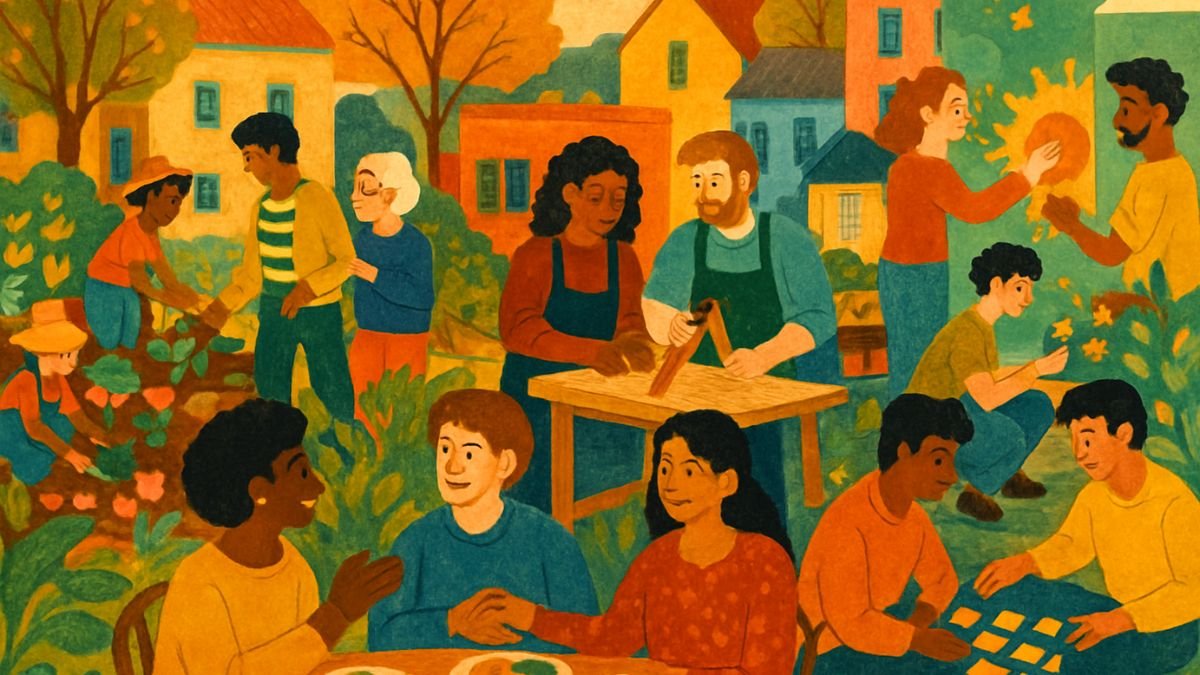
Let me offer a composite example. In a small city with a tense border between neighborhoods, residents launch a food-garden co-op on a vacant lot that straddles their line. The charter sets equal status: one member, one vote; dues on a sliding scale; task credits that count the same whether earned by a teenager or a retiree. The common goal is clear: grow produce for members and the local food pantry. Cooperation is engineered: irrigation cannot run unless both sides open valves on their end; harvest days require teams from both neighborhoods to sign off on weights; the compost system needs alternating layers delivered on a schedule that no single group can meet alone. Institutional support arrives from the city’s parks department: water access, soil testing, and a small grant for tools.
In month one, the co-op emphasizes decategorization: first names on seedling trays, mixed teams building raised beds, and low-stakes decisions like where to place the herb spiral. By month three, recategorization emerges: the group begins to call themselves “The Line Gardeners,” and the T-shirts appear. A superordinate identity forms around the produce stand’s Saturday ritual; kids from both sides invent a chant to advertise basil. Empathy takes root when a heatwave scorches seedlings and a grandmother from one side teaches a teenager from the other how to shade tender plants with burlap. Perspective-taking deepens during the first argument about distribution: members debate how much should go to the pantry. They resolve it by standing together at the pantry line, seeing the faces, and adjusting the policy. Social capital accumulates visibly; more people show up to workdays than tools are available, a problem that seems like a miracle compared to the old days of empty sign-up sheets.
After six months, the trust dividend shows up in places that look unrelated to gardening. Two volunteers who met over compost now co-lead a street-lighting petition, and their mixed signatures sail through a council vote. The “Line Gardeners” begin hosting repair cafés, and a pattern takes hold: you arrive as “us” and “them,” but you leave as “neighbors with a shared problem to fix.” Proximity helps: the vacant lot is on a bus route, so stopping by becomes a habit. Reciprocity becomes reflex; someone who borrows a drill returns it with freshly charged batteries and a small bag of tomatoes.
None of this erases large-scale injustice. Contact theory is not an alibi for avoiding structural change. But it does something high-level policies struggle to do: it alters daily expectations of one another. When intergroup contact is repeated, fair, purposeful, and supported, it builds a shared memory that can resist the next shock. People remember the afternoon they planted mint together, how children laughed while a sprinkler made an accidental rainbow, and how the schedule crunch before the harvest somehow pulled more hands to the table. Those memories are not sentimental; they are practical. They make it easier to pick up the phone rather than pick a fight.
So, can foes become neighbors? Yes, when projects honor equal status, articulate common goals, require cooperation, and enjoy institutional support. Add decategorization to open the door, recategorization to strengthen the frame, and consolidation to make walking through it a habit. The payoff is social capital that multiplies across tasks and a trust dividend that shows up exactly when the weather turns rough. And perhaps the most important ingredient is patience—proximity repeated over time—because culture rarely changes with a single handshake, but it can change with five hundred small ones.









0 Comments