Has anyone ever saved you from something you never found out was coming?
Think about that for a second, because by definition you can’t answer it. That’s the whole strangeness of the word we’re following tonight, and it’s a word I think deserves far more love than it gets.
Forestall. We use it to mean prevent by acting in advance. You forestall an argument. You forestall a crisis. It sounds administrative, faintly bureaucratic — the kind of word that lives in memos.
But go back to the Old English and it’s not administrative at all. It’s foresteall, and it breaks into fore — before, in front — and steall, a standing place, a position, the same root that gives us stall. So to forestall is, literally, to take up a position in front of something. To place yourself on the road it’s traveling before it arrives.
It began as an ambush word. It described stepping out into a path and interception.
And in medieval England it was actually a crime. Forestalling the market meant going out along the road to meet farmers before they reached the town, buying up their goods before they could get to the market square, and then reselling at whatever price you liked. It was theft by geography — theft accomplished purely by being early and standing in the right place.
So this word starts out as an act of interception, and only later softens into what we mean now. But it never quite loses that original physicality, and I don’t think we should let it. Because there’s something bracing about hearing forestall correctly.
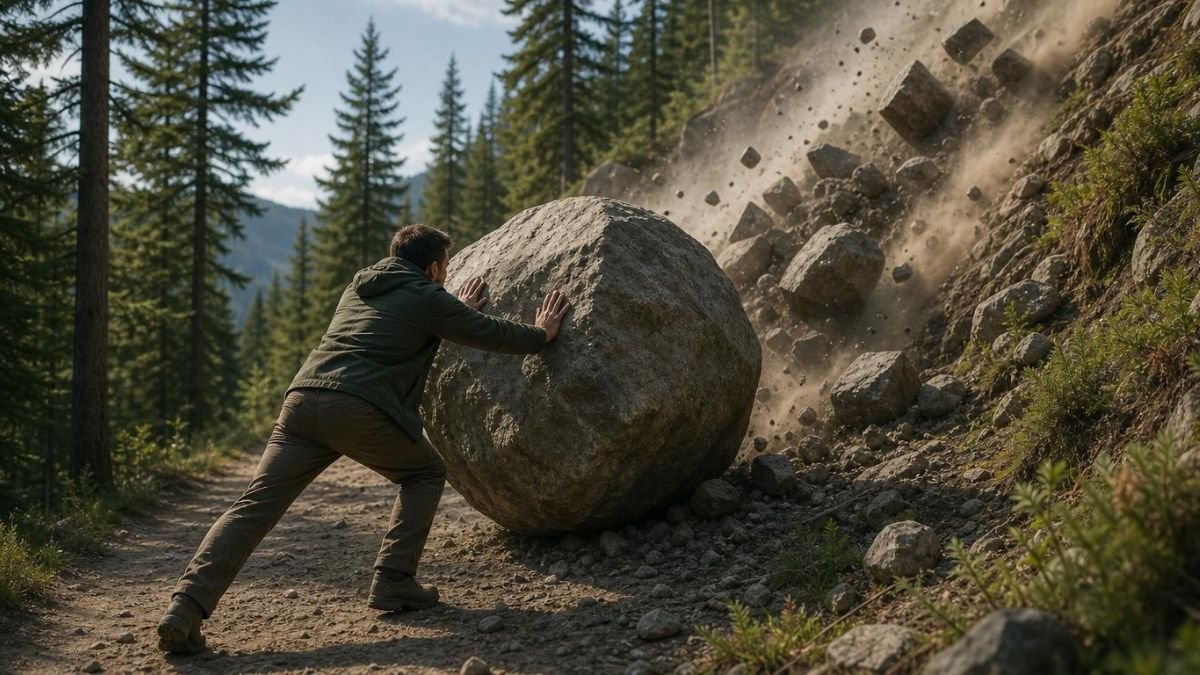
To forestall a disaster is not to sit at a desk anticipating it. It is to walk out onto the road it is traveling and stand there, in advance, with your feet planted, before it comes around the bend.
That reframes a great deal of ordinary life for me. The conversation you have with your brother in October so that December doesn’t detonate. The savings account nobody notices. The maintenance on the roof in a dry month. The apology offered early, before the resentment has had time to set. The doctor’s appointment you didn’t want to make. All of that is somebody walking out to a curve in the road and standing there in the cold, on the strength of nothing but a guess about what’s coming.
And here’s the part that moves me most, and the reason I wanted to do this word at all.
Forestalling, when it works, produces nothing.
That’s the deal. If you do it perfectly, the outcome is an absence. The bridge that didn’t collapse. The argument that never occurred. The illness that stayed a risk factor and never became a diagnosis. The company that didn’t fail. And an absence is not a story. You can’t point at it, you can’t photograph it, and nobody will ever be able to prove it would have happened.
So the most valuable acts in a human life are, structurally, invisible. Prevention leaves no evidence. Nobody has ever thrown a party for a disaster that didn’t occur.
Think about what that means for how we distribute credit. We give it, overwhelmingly, to rescue. To the dramatic save, the heroic response, the person who was brilliant in the emergency. And that’s fair, that’s real. But the emergency itself was often somebody else’s forestalling that went unfunded, or unlistened-to, or was quietly cut two years earlier because nothing was going wrong. That’s the cruel loop that the word exposes: successful prevention makes the prevention look unnecessary, and so it gets removed, and then the thing happens, and then we celebrate whoever handles it.
Which means the people who have done the most for you may be the ones with the least to show. The parent whose vigilance meant nothing bad ever happened. The friend who quietly said something to the right person. The engineer nobody has heard of. Their entire life’s work is a list of things that aren’t there.
Now, I want to make one careful distinction, because there’s a counterfeit of this word and most of us practice it nightly.
Worry is not forestalling.
Worry looks like it. Worry believes it’s doing the same job — it’s up at three in the morning, staring down the road, running the scenarios. But worry has no stall in it. No position, no standing place, nothing planted. It’s the fore without the steall. It watches the road obsessively and never once walks out onto it.
And the test between them is embarrassingly simple. Forestalling produces an action — a call made, a form filed, a sentence finally said out loud, a small amount of money moved. Worry produces another round of worry. If you’ve spent three hours on something and there’s no action at the end of it, you weren’t forestalling. You were rehearsing.
The good news in that is enormous, though. Because it means the cure for a certain kind of dread is not to think harder. It’s to go and stand in the road. One phone call. One appointment. One awkward conversation. The dread doesn’t dissolve because you solved it in your head; it dissolves because you finally took up a position.
So here’s what I’ll leave you with, and it comes in two directions.
Looking forward: there is something coming down the road toward you right now that you have already seen. You know what it is. You’ve known for a while, and you’ve been calling your circling around it thinking about it. So what would it actually look like to walk out and stand in front of it this week?
And looking back: somewhere in your life, someone stood on a road for you, in the cold, before something that consequently never arrived. You will never know what it was. So who would you thank, if the greatest thing anyone ever did for you was something you never found out about?




0 Comments