
Why do we prove that something is real by pointing at meat?
Because that's what this phrase does, and it does at least three enormous jobs at once with two of the plainest words in the language.
Flesh and blood. We say it about family — he's my own flesh and blood. We say it about human limitation — I'm only flesh and blood, I can't do everything. And we say it about reality — she was standing there in flesh and blood, meaning actually present, not imagined, not a rumor, not a photograph.
Three different meanings. Family, frailty, and reality. And it's worth asking what they have in common, because I don't think it's a coincidence that one phrase covers all three.
Start with the pairing itself. Flesh and blood — the solid and the liquid. The part that holds shape and the part that moves through it. It's a very old way of naming a whole body, and you find it across ancient literatures, usually to mean a human being, particularly in contrast to something spiritual or divine. The formula is essentially: not a god, not an idea, not a spirit — a creature made of substance.
Now the family meaning, which is the most common.
My own flesh and blood. It's said with force, usually in extremity — in defense, or in grief, or in the middle of a betrayal, when someone can't believe what a relative has done. And notice what it's claiming: not shared history, not affection, not choice. Material continuity. The claim is that we are literally made of the same stuff — that the substance in you came from the substance in me, or from a common source, and that this fact creates an obligation that no argument can dissolve.
Which is a genuinely strange basis for love, when you look at it directly. We don't apply this standard anywhere else. We don't feel bound to strangers who happen to share our blood type. But we treat this particular material continuity as the deepest bond available, and every culture on earth has agreed with us about it.
And I think the reason is that it's the one connection that can't be revoked. Every other bond is maintained by conduct — friends can stop being friends, spouses can part, colleagues disperse. But you cannot resign from being someone's flesh and blood. That's why the phrase surfaces most often at the exact moment someone is behaving as though they could. It's the sentence people reach for when a relationship is being denied, because it points at the one thing that stands whether anybody wants it to or not.
And I should say plainly: this is also the phrase's cruelty. It has been used to trap people in families that harmed them, as an argument against every reasonable boundary. But he's your own flesh and blood. Material continuity is a fact; it is not a moral obligation to endure anything. The phrase describes a bond, not a sentence — and plenty of people have had to build their real family elsewhere, out of people who share none of their substance and all of their loyalty, and there is nothing lesser about that.
Now the second meaning: frailty. I'm only flesh and blood.
Here the phrase means breakable. And notice how honest it is. When we want to name our limits, we don't point at our psychology or our willpower. We point at the material. We say: I am made of soft tissue and fluid, and soft tissue tears, and fluid leaks, and there is a limit to what this substance can take.
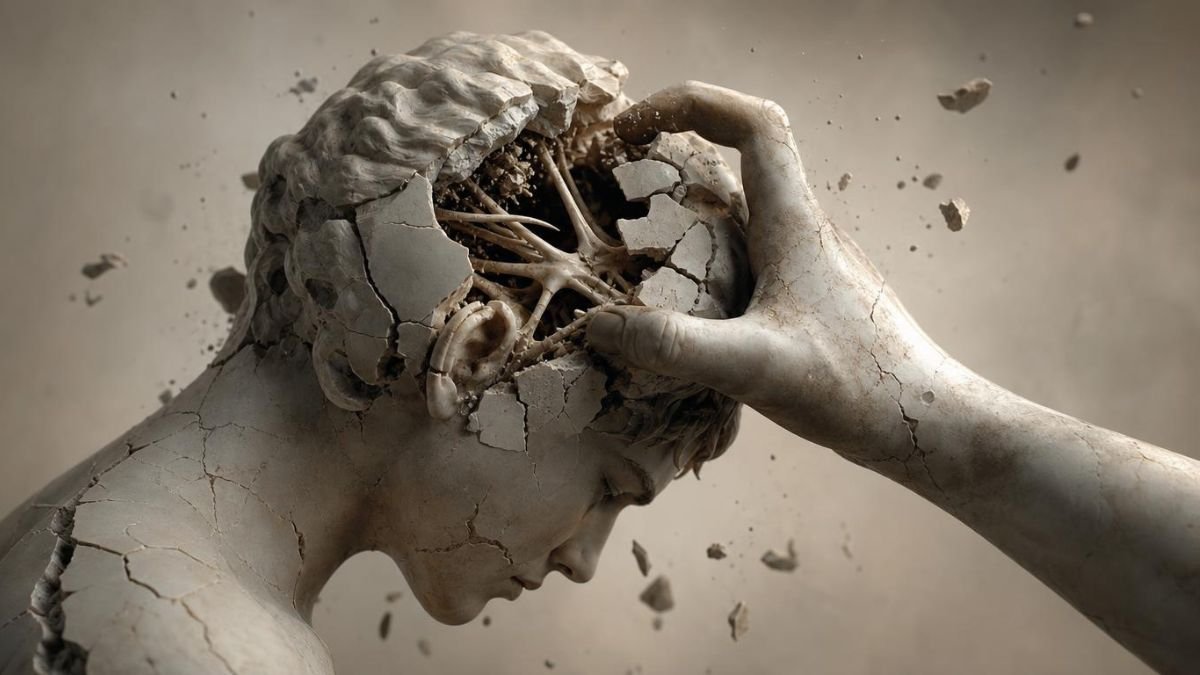
There's something dignified in that admission. It refuses the fantasy — very popular right now — that a person is essentially a mind operating a vehicle, and that the vehicle should simply comply. Flesh and blood says no: you are the vehicle. Your exhaustion isn't a failure of discipline; it's a material fact about a material thing. Blood volume is finite. Tissue takes time to repair. You can override that for a while, and the substance keeps its own accounts.
And the third meaning: reality. In flesh and blood — meaning actually here.
This one is the most poignant now, because we've built a world in which almost all our contact is with representations. Voices without bodies. Faces on glass. Text arriving from people who are, at that moment, nowhere near us. And when someone finally appears in the room, we reach for this phrase, because we need a way to distinguish the representation from the creature — and we go straight to substance. Not the real her. Her, in flesh and blood.
Which reveals something we know without articulating: that presence is physical. There is information in a body that no transmission carries. Temperature. The tiny timing of a response. The way a person occupies space. The fact that they are breathing in the same air, which is not a poetic flourish — you are literally exchanging molecules with anyone you stand near, and with nobody you speak to on a screen.
So all three meanings converge on the same claim: that what's made of substance is what's binding, what's limited, and what's true. Family is real because it's material. Weakness is real because it's material. Presence is real because it's material.
And I think that's a useful corrective for a period that treats the body as a slightly embarrassing peripheral. This phrase, which is older than all of it, keeps insisting: you are a substance, you came from a substance, and the people who matter to you are substances who can be stood next to.
So here's what I'll leave you with. Think of someone you love who you've mostly been experiencing as a voice, a screen, a name that appears on a device. And ask yourself the plainest question this phrase can ask: when did you last see them in flesh and blood — actually in a room, breathing the same air — and what exactly is stopping you from doing it again soon?






0 Comments