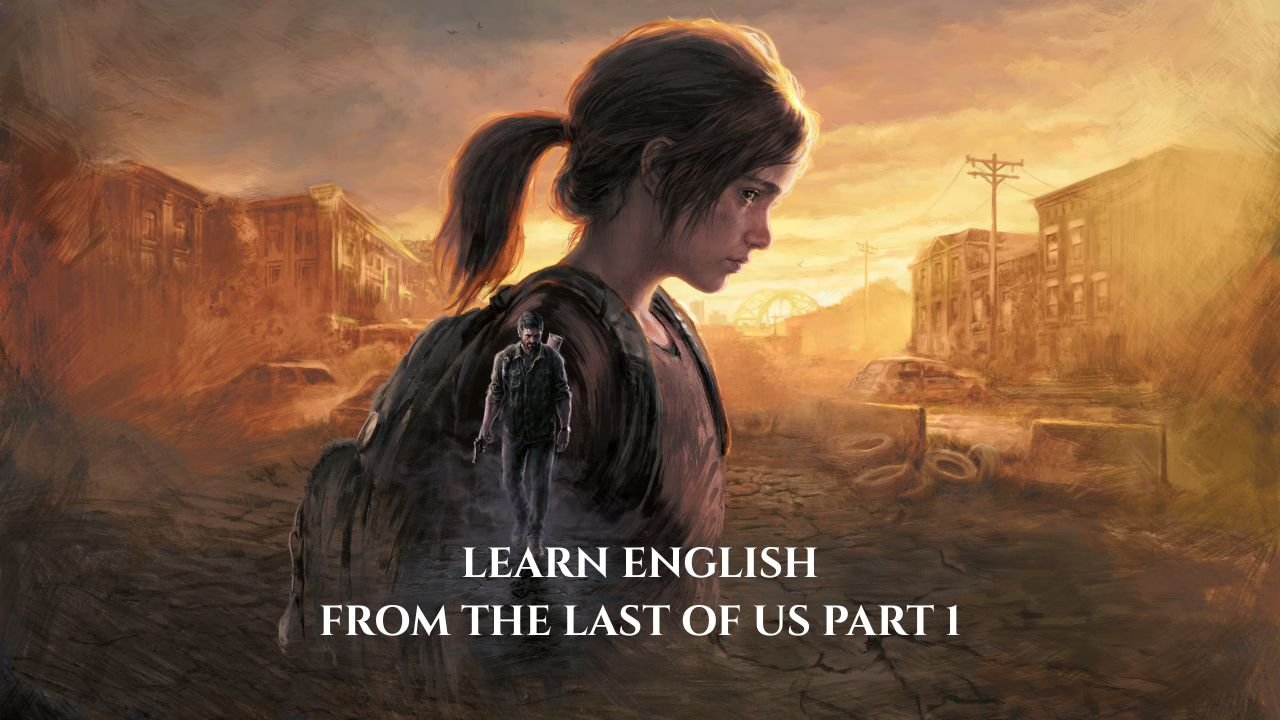
Describe the last place that made you feel something.
Not a list of its features. Not "it was old" or "it was big." The feeling of it. The weight of the light. The texture of the silence. The way the space made your chest do something unexpected. Can you do that in English?
That's what we're building today. This is Episode 8 of The Last of Us: Lessons from the End of the World. We're talking about writing — specifically, the kind of writing that makes a reader stop and look at the wall for a second because you've done something to them.
The Last of Us is remarkable, among many other things, for its environmental storytelling. When Joel and Ellie move through an abandoned shopping mall, every detail tells a story — the faded sale signs, the overturned strollers, the small shoe with no child to fill it. The game's art direction, lighting, and sound design work together to create spaces that feel lived-in and then violently unlived-in. The absence of people is the presence of them.
Good writing does the same thing. It fills space with specific, telling details — the ones that stand in for a whole truth.
Let's start with the fundamental principle: specificity over generality.
Bad writing says "The building was destroyed." Good writing says "The staircase had collapsed in on itself like a broken accordion, and through the gap, you could see three floors of someone's life — a kitchen, a child's room, the corner of what might have been a study — open to the grey sky."
The first sentence is accurate. The second is alive. The difference is specificity — the willingness to pick details, name them, and trust that they will carry meaning.
This is one of the most consistent markers of strong descriptive writing: writers who trust details. They don't reach for large abstract words when small concrete ones will do more. They don't say "tragic" when they can show you the small shoe.
In writing circles, this principle is often called "show, don't tell." It's slightly oversimplified as a rule — telling has its place, and some of the greatest writing tells beautifully — but as a starting orientation for developing writers, it's invaluable. Instead of telling us Joel is grief-stricken, the game shows us the photograph he keeps, the way he looks at it when he thinks no one is watching. Instead of telling us Ellie is sharp and observant, the game shows us the questions she asks, the things she notices, the moments she catches others off guard.
Here's an exercise inspired by this principle: Take an emotion — choose one of the following: grief, hope, disgust, or longing. Now, without using the word itself, describe a space or a moment that embodies that emotion. What would the room of grief look like? What specific objects would be in it? What would the light be doing? What would be absent? Write a paragraph of at least six sentences. Then, give it to someone and ask them to identify the emotion. If they identify it correctly, you've shown successfully.
Now let's talk about narrative structure, because story isn't just about accumulating beautiful sentences — it's about how those sentences are arranged.
The Last of Us has a brilliantly simple narrative structure under its complex emotional surface: it's a journey story. Joel and Ellie must travel from Boston to Salt Lake City — a goal, a direction, a trajectory. This structure — called a quest narrative — is one of the oldest in storytelling. It gives the audience a sense of forward momentum even when the story pauses for emotional depth. We always know, in a quest narrative, where we are in relation to the destination.
In writing terms, structure is about organizing information so that the reader experiences it in the most powerful sequence. This isn't always chronological — skilled writers manipulate time, starting in the middle, flashing back, jumping forward — but every decision about sequence should serve the story's emotional logic.
There are a few key structural tools worth knowing.
In medias res — from the Latin, meaning "into the middle of things" — is the technique of starting a story in the middle of the action rather than at the beginning. The Last of Us does this in a subtle way: we begin with Joel's ordinary life before jumping into the outbreak. We're in the middle of his world when the chaos hits. This creates immediacy — we're already invested before things go wrong.
Foreshadowing is the technique of planting hints of future events earlier in a narrative. The Last of Us is excellent at this — small details in the environment, small behaviors in characters, that only make full sense on a second reading or playthrough. In writing, foreshadowing rewards attentive readers and creates a sense of a carefully constructed, intentional world.
The narrative arc — sometimes called the story arc or dramatic arc — is the overarching shape of a story: exposition (setup), rising action (building tension), climax (peak crisis), falling action (aftermath), and resolution (conclusion). Understanding this structure helps you both to read stories analytically and to construct your own more intentionally.
Let's talk about point of view, because it's one of the most consequential choices a writer makes.
Point of view (POV) is the perspective from which a story is told. In fiction:
First person: I walked into the room. The story is told from inside the narrator's consciousness. We know only what the narrator knows and feels.
Second person: You walked into the room. Unusual in fiction, but powerful — it implicates the reader directly. The Last of Us, as a video game, is effectively second person in many moments: you are Joel, you are making these choices.
Third person limited: Joel walked into the room. He noticed the smell. The story is told from outside a character, but with access to their thoughts and feelings. Most close third-person literary fiction uses this.
Third person omniscient: Joel walked into the room. Outside, Ellie was thinking about the question she'd wanted to ask for weeks. A narrator who can see into any character's mind at any time.
Each POV has strengths and limitations. First person creates intimacy and immediacy; it limits information to what one character knows. Third person omniscient gives the writer enormous freedom; it can feel distancing if not handled well.
For English learners writing in English, I recommend starting with first person for personal essays and narrative writing — it's the most natural, most honest POV for someone writing about their own experience. Save third person for fiction and academic writing.
One more technique worth naming: the use of sensory detail. The best descriptive writing engages all five senses, not just sight. When the Last of Us renders a space, it's the sounds — the drip of water, the distant moan of something infected — as much as the visuals that create the atmosphere. In writing, remember smell (the most powerful sense for triggering memory), touch, taste, and sound, as well as sight. A scene described through three senses is far richer than one described only visually.
Writing challenge for today: Write a 150-200 word description of a real place that matters to you. It can be from your childhood, a place you love, a place you've lost access to. Use at least three senses. Use the "show don't tell" principle — let the details carry the emotion without naming it. Use one piece of foreshadowing — a small detail that hints at something that will come later in the reader's understanding of the place. And structure it with an intentional arc: begin in the middle, build to a moment of revelation, then close.
Post it somewhere. Share it with someone. The best writing, like the best language, is made to be received.
Discussion Questions
- What is the place in your life that carries the most emotional weight? What specific details would you use to convey it to someone who's never been there?
- The Last of Us uses the absence of people to suggest their presence. Can you think of another example — in art, literature, or life — where absence says more than presence?
- How does point of view change what a reader understands and feels? Try retelling a personal story from a different POV — how does the experience shift?
- What's the most powerful sentence you've ever read in English? What made it powerful?
To Go Further
Read a descriptive passage from a great novel — any author you respect. Underline every concrete, specific detail. Circle every piece of sensory information. Then try to rewrite a paragraph of it using only abstract, general language. Compare the two versions. The difference is the lesson.
Quiz: The Craft of Cinematic Writing
Instructions: Read each scenario or text excerpt carefully. Choose the best answer based on the writing techniques, narrative structures, and vocabulary discussed in Episode 8.
1. A writer wants to describe a character's profound loneliness without ever using the word "lonely" or "sad." Which of the following sentences best applies the principle of "environmental storytelling" to convey this emotion?
A) He sat in his apartment feeling completely isolated from the world outside.
B) The silence in the house was heavy, and he missed the days when people used to visit him.
C) He set the table with one plate, one fork, and carefully folded the second chair leaning against the wall, leaving it untouched for the fifth year in a row.
D) It was a deeply tragic situation, as he had no friends or family left to speak of.
2. You open a new novel and the very first sentence reads: "The windshield shattered inwards as the car spun off the bridge, and before the water even hit her face, Elena was already reaching for the seatbelt buckle." Which narrative technique is the author using to structure this opening?
A) Foreshadowing
B) In medias res
C) Falling action
D) Third-person omniscient point of view
3. In the episode, the narrator notes that playing a video game like The Last of Us actively implicates the player by making them make the choices. Which literary point of view is the closest equivalent to this interactive experience?
A) First person ("I survived.")
B) Second person ("You survived.")
C) Third person limited ("He survived.")
D) Third person omniscient ("They all survived, though none knew it yet.")
4. A student submits a creative writing assignment. The teacher highlights a specific paragraph and writes, "Excellent job using sensory detail!" Which of the following is most likely the paragraph the teacher highlighted?
A) The infected creature looked terrifying. It was tall, covered in fungal growths, and moved in a very unnatural, frightening way that made my blood run cold.
B) The bunker was dark and empty. I couldn't see anything at all, and it made me feel like I was the only person left on the entire planet.
C) The air in the subway station tasted like copper and wet ash, and somewhere in the pitch black, a wet, rhythmic clicking echoed off the tiles, vibrating against the soles of my boots.
D) When we finally reached the quarantine zone, it was heavily guarded. There were massive walls, searchlights, and soldiers everywhere you looked.
5. A filmmaker shows a lingering close-up of a cracked, leaking pipe in a dam during the first five minutes of a movie. An hour later, the dam bursts, causing a catastrophic flood. What structural tool did the filmmaker use in the opening scene?
A) A narrative arc
B) In medias res
C) Exposition
D) Foreshadowing
6. Which of the following best defines the concept of "specificity over generality" as taught in the episode?
A) Replacing the abstract word "destruction" with a concrete image like "a collapsed staircase revealing a child's bedroom open to the sky."
B) Making sure you mention every single object in a room so the reader has a complete inventory.
C) Using highly advanced, multi-syllable vocabulary words instead of simple words.
D) Ensuring the story is told in chronological order from beginning to end without any flashbacks.
7. Read the following excerpt: "Maria stared at the map, calculating the fuel they had left. Across the campfire, David cleaned his rifle, completely unaware that Maria had already decided to leave him behind at dawn." Which point of view (POV) is this passage written in?
A) First person
B) Second person
C) Third person limited
D) Third person omniscient
8. If you were analyzing the narrative arc of The Last of Us, the tense, peak moment of crisis where Joel must finally decide what to do at the hospital in Salt Lake City corresponds to which part of the dramatic structure?
A) Exposition
B) Rising action
C) Climax
D) Resolution
9. The episode discusses how The Last of Us uses "the absence of people to suggest the presence of them." Which real-world scene best captures this specific type of environmental storytelling?
A) A busy, crowded market where merchants are shouting over each other to sell their goods.
B) A pristine, untouched mountain peak covered in fresh, white snow.
C) A rusted playground carousel frozen in place, surrounded by tall weeds and a single, faded plastic toy bucket.
D) A modern museum exhibit displaying ancient Roman coins under bright glass cases.
10. When writing a personal essay about a difficult life experience, which point of view does the episode strongly recommend using to achieve the most natural and honest tone?
A) First person
B) Second person
C) Third person limited
D) Third person omniscient
1. Correct Answer: C (He set the table with one plate...)
A is incorrect: This is "telling." It uses abstract emotion words ("isolated") rather than painting a picture.
B is incorrect: While slightly better, it still explicitly tells the reader he "missed" people rather than showing the reality of the space.
C is correct: This is the essence of "show, don't tell" and environmental storytelling. By detailing the single plate and the untouched second chair leaning against the wall, the writer uses specific, concrete objects to create a profound sense of absence and loneliness without ever naming the emotion.
D is incorrect: This relies entirely on broad, general statements ("deeply tragic") instead of specific imagery.
2. Correct Answer: B (In medias res)
A is incorrect: Foreshadowing drops hints about the future; this scene is explosive, present action.
B is correct: In medias res means starting "into the middle of things." The author skips the setup (exposition) and drops the reader directly into a moment of peak crisis, creating immediate investment.
C is incorrect: Falling action occurs after the climax, not at the beginning of the book.
D is incorrect: The POV is third-person limited (focusing on Elena), but that is a perspective choice, not the narrative structure tool being used to open the book.
3. Correct Answer: B (Second person)
A is incorrect: First person is from the "I" perspective.
B is correct: Second person uses "you" and directly implicates the reader/player in the action. The episode notes that video games are effectively second-person experiences because you are making the choices and stepping into the character's shoes.
C & D are incorrect: Third person observes characters from the outside ("He/She/They").
4. Correct Answer: C (The air in the subway station tasted like copper...)
A is incorrect: This relies only on sight ("looked terrifying") and abstract descriptions ("unnatural").
B is incorrect: This describes an absence of sight and a named feeling, but lacks rich physical sensation.
C is correct: This paragraph engages three distinct senses: taste ("tasted like copper"), sound ("wet, rhythmic clicking"), and touch/physical sensation ("vibrating against the soles of my boots"). It perfectly executes the episode's advice to use non-visual sensory details.
D is incorrect: This is a purely visual list of items.
5. Correct Answer: D (Foreshadowing)
A is incorrect: A narrative arc is the overall shape of the whole story, not a specific hinting technique.
B is incorrect: This scene isn't necessarily dropping us into the middle of the action; it's a quiet detail.
C is incorrect: Exposition is the background information.
D is correct: Foreshadowing is the technique of planting small hints or details early in a narrative that point toward a future event. The leaking pipe rewards attentive viewers and sets up the eventual disaster.
6. Correct Answer: A (Replacing the abstract word "destruction" with a concrete image...)
A is correct: Specificity over generality means trusting small, concrete details to carry the weight of a larger truth, rather than relying on broad, abstract summary words.
B is incorrect: Specificity is about choosing the right, telling details, not exhaustively listing everything in a room (which becomes boring).
C is incorrect: Good writing doesn't require a thesaurus; it requires precise observation. Simple concrete words often beat complex abstract ones.
D is incorrect: Narrative structure (chronology) is separate from descriptive specificity.
7. Correct Answer: D (Third person omniscient)
A is incorrect: It does not use "I."
B is incorrect: It does not use "you."
C is incorrect: Third person limited would restrict the narrative to only what Maria knows, or only what David knows.
D is correct: The narrator knows Maria's internal thoughts (she decided to leave him) AND knows David's internal state (he is completely unaware). A narrator who can see into multiple characters' minds at once is omniscient.
8. Correct Answer: C (Climax)
A is incorrect: Exposition is the setup (Joel's life in Austin before the outbreak).
B is incorrect: Rising action is the long journey across the country, building tension.
C is correct: The climax is the peak crisis of the narrative arc, where the central conflict comes to a head and the most consequential decision must be made.
D is incorrect: Resolution is the aftermath and closing of the story (the journey back to Jackson).
9. Correct Answer: C (A rusted playground carousel...)
A is incorrect: This explicitly shows the presence of people, not their absence.
B is incorrect: This shows nature, but doesn't imply that humans were ever there.
C is correct: The faded toy and rusted playground equipment tell a story about the children who used to play there but are now gone. The absence of the children makes their past presence felt deeply.
D is incorrect: While historical, this is a curated environment, not an environmental narrative of sudden absence.
10. Correct Answer: A (First person)
A is correct: The episode states that first person ("I") is the most natural, most honest point of view for someone writing about their own personal experiences and essays.
B is incorrect: Second person ("You") is highly unusual and often feels jarring in essays.
C & D are incorrect: The episode recommends saving third person ("He/She/They") for fiction and academic writing.
Assignment: The Room Left Behind
Task:
Think of a space that belongs to someone you know well—a grandparent's kitchen, a sibling's messy bedroom, a teacher's desk, or a friend's car.
Imagine this person has suddenly left in a hurry, and you are standing in their space an hour later. Write a 150–200 word descriptive paragraph of this environment.
Your writing must:
- Use Environmental Storytelling: Show us who this person is, and what they were doing right before they left, strictly through the objects left behind. (Do not describe the person directly).
- Apply "Show, Don't Tell": Choose one underlying emotion for the room (e.g., panic, joy, exhaustion, obsession) and convey it without ever naming the emotion.
- Engage the Senses: Include at least three specific sensory details (sight, sound, smell, touch, or taste).




0 Comments