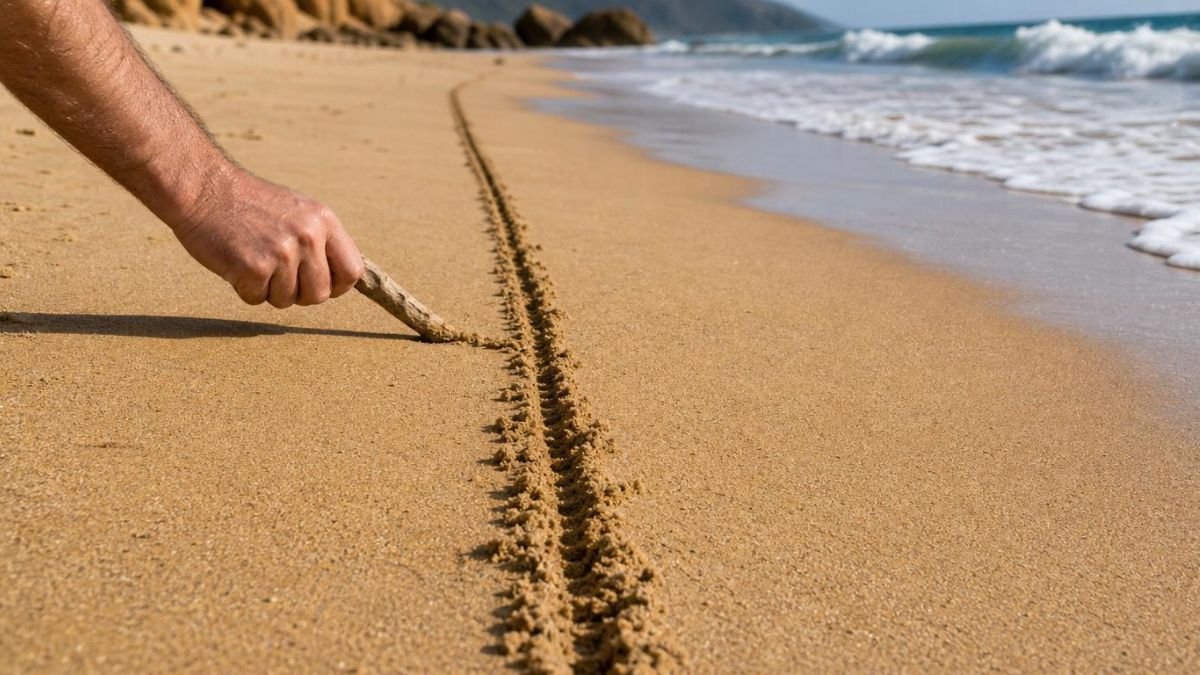
Of all the surfaces in the world, why do we draw our most serious line on the one that can't keep it?
Picture it properly, because we say this phrase so often that we've stopped seeing the image. A person crouches down. They drag a stick, or a heel, or the tip of a sword through the sand. A shallow groove appears. And then they stand up and say, in effect: not past here. That's it. That's the whole apparatus. A scratch in loose grains, on a beach, in the wind, near the sea.
The stories behind the phrase have that same quality of theater. There's an account from the Roman world, more than two thousand years old, of an envoy named Popillius Laenas meeting a king who wanted time to consider Rome's demand. Popillius drew a circle in the sand around the king's feet and told him to answer before he stepped out of it. There's the American legend of the Alamo, where Colonel Travis is said to have drawn a line across the dirt with his sword and invited the men willing to stay and die to cross it. Historians argue about whether that one ever happened. And I find it perfect that we're not sure — that the line survives as a story rather than a fact. Because a line in the sand was never really a physical object. It was always a story, told once, in front of witnesses.
Now consider what it can't do. It cannot stop anyone. A line in the sand has no height, no weight, no hardness. A child could step over it without noticing. A dog would trot straight through. The wind takes it in an hour, the tide takes it twice a day, and one careless footstep is enough. As a barrier, it's the least effective thing a human being has ever constructed.
And that is precisely the point.
Because a line in the sand isn't a wall against another person. It's a promise about yourself. The line has no power whatsoever — all the power sits in what you have decided you will do if it's crossed. That's the whole mechanism. The mark is nothing; the resolve behind the mark is everything. Which means the question to ask, before you ever draw one, isn't will they respect it. It's do I actually mean it. Because they'll find out in about a week, and so will you.
I think this is why so many of our boundaries fail, and it's rarely for the reason we tell ourselves. We say the other person didn't respect the line. Usually what happened is that we drew it and then, when the moment came, we didn't want the cost of standing behind it — the argument, the coldness, the risk of losing something. So we let the crossing pass with a small remark. And a line that is crossed without consequence isn't a line anymore. It's just a decoration on the beach.
Then there's the other failure, which is subtler and sadder: the beach covered in lines. Some people draw them constantly. Every irritation gets a groove in the sand, every mood produces a new ultimatum, and after a while nobody can tell which mark was serious, including the person who drew them. A hundred lines is the same as none. Scarcity is what gives a line its weight. If you've drawn only three in your entire life, people will step very carefully around all three.
And notice this too: a line in the sand is drawn in anger far more often than it's drawn in clarity, and those produce very different geography. Anger draws the line wherever it happens to be standing, which is almost never where the line belongs — usually too far out, in territory you can't hold, over an offense that wasn't actually the offense. Then you're stuck defending a position you chose while you were shaking. Clarity draws the line somewhere you can live, over the thing that genuinely matters, and it can be drawn quietly. In fact the strongest lines I've ever seen drawn were said softly, once, with no witnesses at all.
But here's the part I find most beautiful, and it's about the sand itself. The tide comes in every night. Which means a line in the sand is not something you draw once. It is something you redraw. Forever. That sounds exhausting, and I understand why — we want to announce a boundary and be done, to have it hold like masonry. It never does. The sea comes up the beach while you sleep and smooths everything, and in the morning you come down and the beach is blank again, and you crouch, and you draw it again.
I've come to think that's not the metaphor breaking down. That's the metaphor being honest. Boundaries in a real life are not monuments; they're maintenance. The line with your family, the line with your work, the line about what you'll accept in a friendship — none of them stay drawn. They get gently, unmaliciously washed over by ordinary life, by habit, by people forgetting, by you being tired. And the maintaining is the whole practice. The people who seem to have unshakable boundaries aren't people who built walls. They're people who are simply willing to redraw the same line, calmly, for the ten-thousandth time, without needing it to be a crisis.
And one last thing, which is almost a small miracle. Before the line, that beach was one continuous stretch of sand — undifferentiated, the same on both sides, one thing. After the line, it's two places. This side and that side. Allowed and not allowed. Before and after. Nothing physical has changed. Not one grain has been added or taken away. The entire transformation happened in meaning, made by a human being who decided that here, arbitrarily, on a shifting surface, in a world with no natural edges — here is where it stops.
That's what we do. That's what we've always done. We make edges on a formless thing so that there's somewhere to stand.
So here's what I'll leave you with. Somewhere in your life there's a line you drew once and haven't checked on in a long time — a boundary the tide has been quietly coming over, night after night, while you told yourself it was still there. Go and look at that beach. Is the mark still visible? And if it isn't, are you going to crouch down and draw it again — or finally admit that you never really meant it, and stop calling the erosion peace?






0 Comments