
Introduction
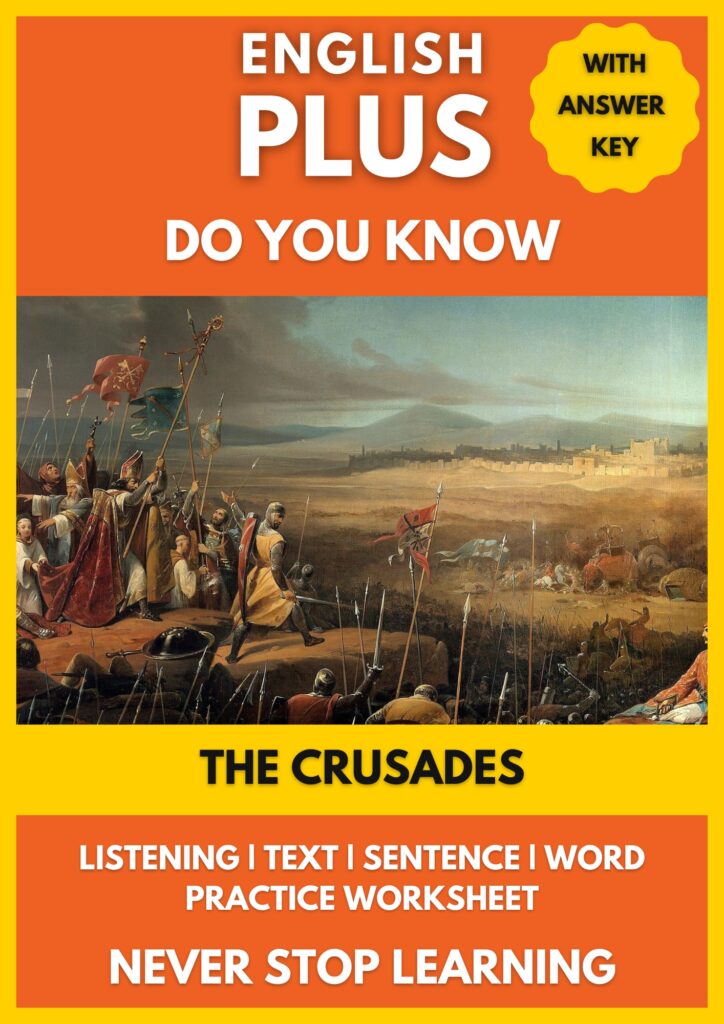
Learn about the Crusades, how they started and how they eventually failed in this very short introduction from English Plus Podcast.
Full Audio Episode
[ai_playlist id="15863"]
Interactive Transcript
CRUSADES
The city of Jerusalem is a holy place to three religions: Christianity, Islam, and Judaism. Many important events in the history of these religions took place in Jerusalem and the surrounding Holy Land. Between the year 1096 and the late 1200s, Christians fought a series of wars against Muslims. These wars were called the Crusades. The Crusades were fought for control of the Holy Land.
A HOLY DUTY?
Many Christian men, women, and children in Europe volunteered to fight in the Crusades. They left their homes and families to travel far away and fight in these religious wars. Why did they volunteer for such dangerous adventures?
Some Crusaders—people who joined the Crusades—were inspired by religious ideals. They believed it was their duty to take away control of the Holy Land from Muslims. They believed that the Holy Land—where Christianity was born—should be under Christian rule.
Other people saw the Crusades as a chance to win fame and praise, or to increase their wealth and political power. Kings and knights sought glory. Greedy soldiers hoped for riches. Merchants aimed to defeat Muslim traders and win control of trade routes in the Mediterranean Sea.
THE CRUSADES BEGIN
In 1095, Pope Urban II called on his followers to protect Christian pilgrims traveling to Jerusalem. Wandering preachers spread Urban’s message. In 1096, thousands of nobles, townsfolk, and peasants flocked to join the First Crusade.
It took years for them to complete the grueling journey. Some went on foot. Others traveled on horseback or by sea. In 1099, the Crusaders reached Jerusalem. They captured it after a bloody siege. The Crusaders massacred all Muslims and Jews sheltered inside the city walls. They set up a Christian kingdom to rule the lands around Jerusalem, and they chose a French knight as king.
THE FAILURE OF THE CRUSADES
Muslims soon fought back, and so church leaders called for a Second Crusade. It took place from 1147 to 1149. However, the rowdy, quarrelsome Crusaders were no match for well-trained Muslim troops. Most of the Crusaders were killed.
The Third Crusade began after Saladin, a famous Muslim general, reconquered Jerusalem in 1187. It was led by Europe’s top warriors, including King Richard I of England. He became known as Richard the Lion-Hearted because of his courage. But the Crusaders were forced to retreat in 1192, exhausted by fighting in the desert.
The Fourth Crusade, from 1202 to 1204, was also a failure. The Crusaders never reached Jerusalem. Instead, they looted the city of Constantinople. In 1212, hundreds of youngsters set off on a Crusade from France. The so-called Children’s Crusade ended in tragedy. Although some of the children returned home, others died of hunger or were captured and sold as slaves.
Between 1217 and 1291, there were five more Crusades. But none was successful, and the Crusader kingdom of Jerusalem lost all its land.
BITTER LEGACY
As wars, most Crusades were failures. The Crusaders did not win control of Jerusalem, or drive Muslims out of the Middle East. The Crusades caused terrible suffering in the lands the Crusaders invaded. Countless Crusaders died from injuries, accidents, and disease. By disrupting Muslim trade, the Crusades did help European merchants grow rich and finance new voyages of exploration. However, the Crusades left a legacy of bitterness and misunderstanding between Christians and Muslims that has not yet gone away.
PDF Practice Worksheet






0 Comments