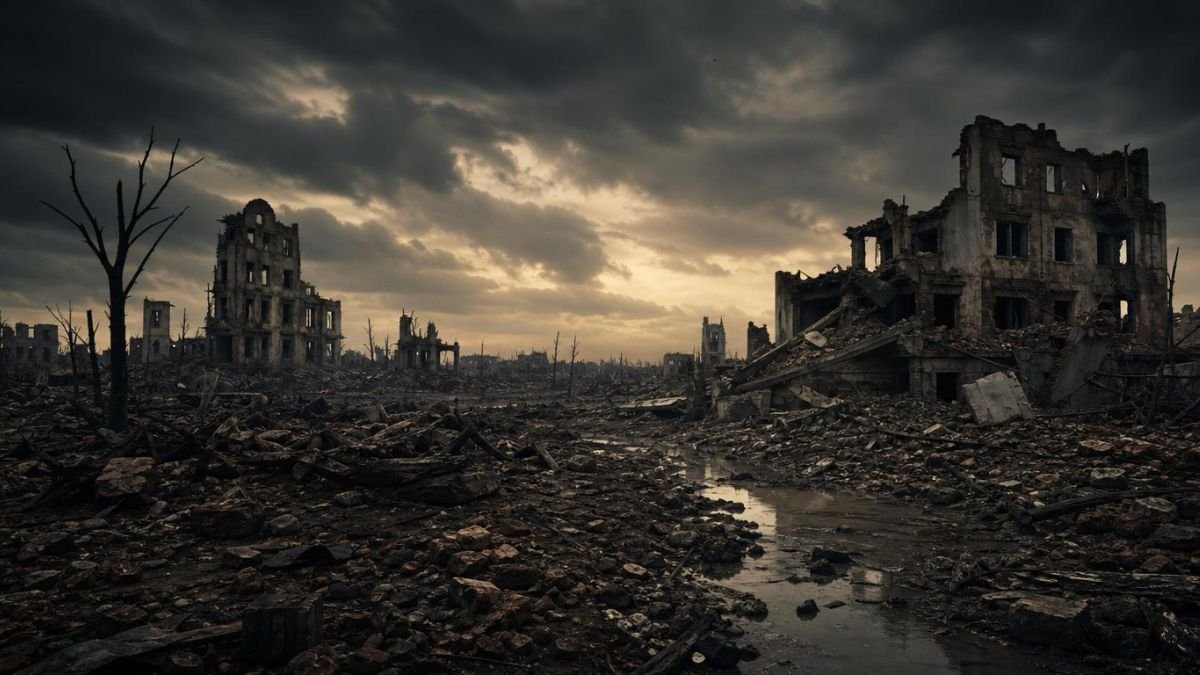
What does it actually mean to lay a place — or a person — completely to waste?
We use the word devastated so casually now. Devastated the team lost. Devastated the café was closed. And that's fine, that's how living language works. But I want to take you back to the full weight of this word, because it's one of the heaviest, most total words we have, and buried inside it is something that might change how you understand your own hardest losses. To devastate is to lay waste — to ruin utterly, to destroy so thoroughly that what's left is desolation. It's not partial. It's not a setback. Devastation is completeness. It's the total kind of ruin. And there's a secret hidden right in the middle of the word.
Listen closely. De-vast-ate. There's a word inside it: vast. And that's not an accident. Devastate comes from the Latin — de, an intensifier, and vastare, to lay waste, to make empty, to make desolate — and it's cousin to the very word vast, which originally meant not just huge, but empty, waste, desolate. A vast wasteland. To devastate something is, in the deepest root of the word, to make it vast — to empty it out, to leave it a desolate, echoing expanse where something full and alive used to be. And once you feel that, the word will never sound the same again. Because that is exactly what devastation feels like from the inside, isn't it? Not just damage. Emptiness. A vastness. A terrible, echoing space where something used to be.
Think about the last time you were truly devastated — not the casual kind, the real kind. The loss that hollowed you out. And notice how physical the feeling was, how spatial. It felt vast, didn't it? Like a great emptiness had opened inside you. Like a landscape had been laid waste. People who grieve deeply often describe it exactly this way — as a wasteland, a desert, an emptiness that stretches in every direction. And that's not just metaphor. That's the actual meaning of the word coming through, the ancient vastness at its core. To be devastated is to have some full and living part of your inner world laid waste until only a vast emptiness remains.
The word was originally about places, and that history matters. Armies devastated the land — they burned the crops, razed the villages, poisoned the wells, and left behind a vast, dead, silent waste where a thriving country had been. And I think that image tells us something true about emotional devastation, too, because the parallel is exact. When something devastates you, it doesn't just take one thing. It lays waste to a whole inner landscape. The loss of one person can devastate your entire world — because that person was woven through everything, and their absence empties not just one spot but the whole country of your life. Devastation spreads. It touches everything. That's why it's so total, and why the word carries such vastness.
But here's where I want to turn, gently, because I don't want to leave you standing in the wasteland. Because there's something else true about devastated land, and it's one of the most hopeful facts in all of nature. Land that has been laid waste does not stay waste forever. This is the astonishing thing. After the fire, after the flood, after the army has burned everything and moved on — life comes back. It always comes back. First the small things, the hardy weeds, the green shoots pushing up through the ash. And slowly, over time, the devastated land becomes fertile again — often more fertile than before, because devastation clears the ground completely, and sometimes things can grow in the cleared, emptied space that could never have grown in the crowded old world.
I'm not saying this to rush you past grief, or to slap a silver lining on genuine ruin. Devastation is real, and total, and it deserves to be honored as what it is — not minimized, not hurried. When you're in the wasteland, the last thing you need is someone insisting the flowers are coming. But it's worth knowing, somewhere in you, even in the emptiness, that vast emptied ground is not the same as permanently dead ground. The word that means laid waste has always also implied the possibility of being reclaimed. Wasteland is not the end of the story. It's the hardest middle of it.
And there's something else the vastness teaches, something almost tender. The depth of your devastation is a measure of the depth of what you had. You can only be devastated by the loss of something that filled you vastly in the first place. The emptiness is exactly the size and shape of the fullness that used to be there. So the devastation, terrible as it is, is also a kind of testimony — proof of how much there was, how deeply something mattered, how fully you had loved or lived or hoped. A shallow attachment can't devastate you. Only a vast one can. The size of the wasteland tells you the size of the world that once grew there.
So maybe to be devastated, fully and honestly, is also to have been fully alive to something — to have let something matter so much that its loss could lay you waste. That's not a small thing. That's the price of having loved a vast amount. And while I would never tell you the wasteland is a gift, I will tell you this: the ground remembers what grew there, and it will not stay empty forever, even when, standing in the middle of it, you cannot imagine anything green ever growing again.
Here's what I'll leave you with, standing in the vastness. If devastation is the emptiness left exactly where a fullness used to be — if the size of the wasteland measures the size of what once grew there — then what does your deepest devastation tell you about how vastly, how completely, you were once able to love?




0 Comments