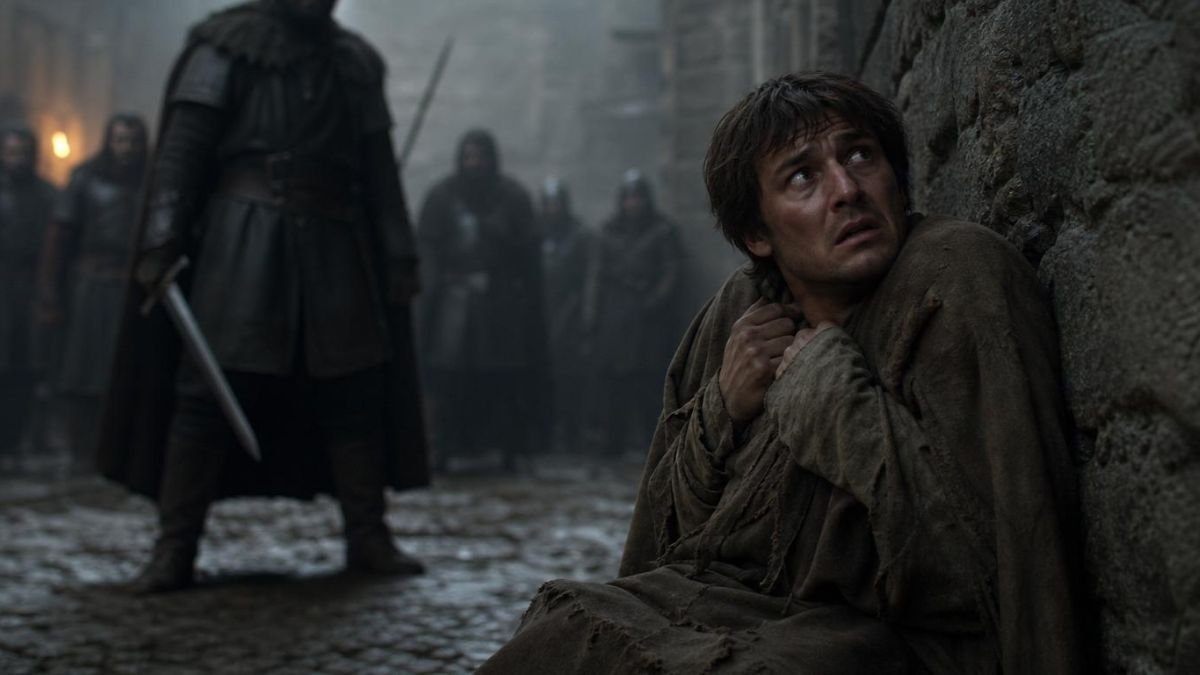
Is there a difference between being afraid and being craven?
I think there's an enormous one, and I think the language knows it, and I think most of us have been quietly punishing ourselves with the wrong word for years.
Start with the sound. Craven. It's a heavy word, thick and low, and it doesn't sound like fear — it sounds like collapse. Compare it to cowardly, which is almost prissy in the mouth. Craven has weight. It's the word you reach for when you want to actually wound someone, and there's a reason it still carries that charge after seven hundred years.
The origin is disputed but the leading trail is beautiful and grim: it appears to come through Old French from Latin crepare — to crack, to break, to burst apart. In Middle English, cravant described a defeated fighter. And crucially, it wasn't only about running away. It was about the moment of yielding. In the old judicial combats, a beaten man could cry craven — a formal word of submission, saying I am overcome, I give up, don't kill me. And to cry craven was not just to lose. It was to be dishonored. The word was the surrender.
So craven doesn't mean frightened. It means cracked. Something in you gave way under pressure, and the giving way was public, and it cost more than the fight would have.
And that distinction is the whole thing. Because fear isn't a moral category at all. Fear is a physiological event — your body detecting threat and preparing you, whether you approve or not. Nobody has ever chosen to be afraid. Being afraid is like being cold: it's information about your situation, not a report on your character. And courage, properly understood, isn't the absence of fear; nobody in history has ever been brave without being scared, because the absence of fear isn't bravery, it's just miscalculation.
Craven describes something entirely different. Craven is what happens after the fear, in the space where you decide. It's not the trembling; it's the abandoning. It's the moment you had something to protect — a person, a truth, a promise — and you traded it for your own safety, and you knew you were doing it.
That's why we almost never use the word for physical danger anymore. We use it for something worse. A craven silence. A craven apology. A craven retreat from a position you know is right. Notice that these are all social. The modern craven isn't running from a lion; he's staying quiet in a room where speaking would be uncomfortable. He's watching someone be treated badly and studying his shoes. He's disowning something he actually believes because the belief has become expensive to hold.
And here's what makes the word so exact, and so uncomfortable: cravenness always involves knowing. That's what separates it from ordinary human weakness. A craven act is one where you saw clearly what the right thing was — it wasn't ambiguous, you didn't need more information — and you did the other thing, and then you built the explanation afterward. And you were very good at building it. Everyone is. The explanations we construct for our cravenness are usually our finest intellectual work: it wasn't my place, it wouldn't have helped, I have to think of my family, someone else will say it.
That's the cracking the word describes. Not the fear — the crack that runs between what you knew and what you did.
But I want to be careful here, because this word is dangerous to hold, and I don't want to hand it to you as a weapon against yourself.
Most of what people privately accuse themselves of being craven about was not cravenness. It was fear, and fear is not a sin. Not speaking up when speaking up would have genuinely destroyed you — that's not cowardice, that's arithmetic, and anybody who calls it cowardice has never had that much at stake. There are situations where the cost is real and enormous and falls on people who didn't choose it. Silence there isn't a crack. It's a calculation, and sometimes it's the right one, and it can still hurt to make.
So the honest test isn't was I afraid — you were, everyone always is. The test is: was there a cost I could actually have paid? Cravenness lives specifically in the cases where the cost was small — mild awkwardness, a bit of disapproval, an uncomfortable evening — and you still didn't pay it. That's the narrow, precise territory of this word. It's not for the person who couldn't afford it. It's for the person who could afford it easily and declined.
And the reason the word is heavy is that these moments accumulate. One craven silence is nothing; you'll have forgotten it in a week. But the ledger doesn't forget, and there's a version of a life that gets built entirely out of small, affordable moments of not saying the thing — and the person at the end of it can't point to a single act of cowardice, and has somehow become someone they don't respect.
The good news, and I do think it's good news, is that the same mechanism runs in reverse. Courage is not built by heroic moments; almost nobody gets one. It's built the same way cravenness is — out of small, cheap decisions, made repeatedly, in rooms where nobody was watching and the stakes were mildly embarrassing at worst.
So here's what I'll leave you with. Think of a moment when the cost of doing the right thing was genuinely small — a few seconds of awkwardness, a slightly cooler room — and you didn't pay it, and you've never quite stopped remembering it. So ask yourself the real question, the one this old, heavy word is asking: not was I afraid, because you were and that's allowed — but what exactly was the price I refused to pay, and would I have even noticed it a week later?






0 Comments