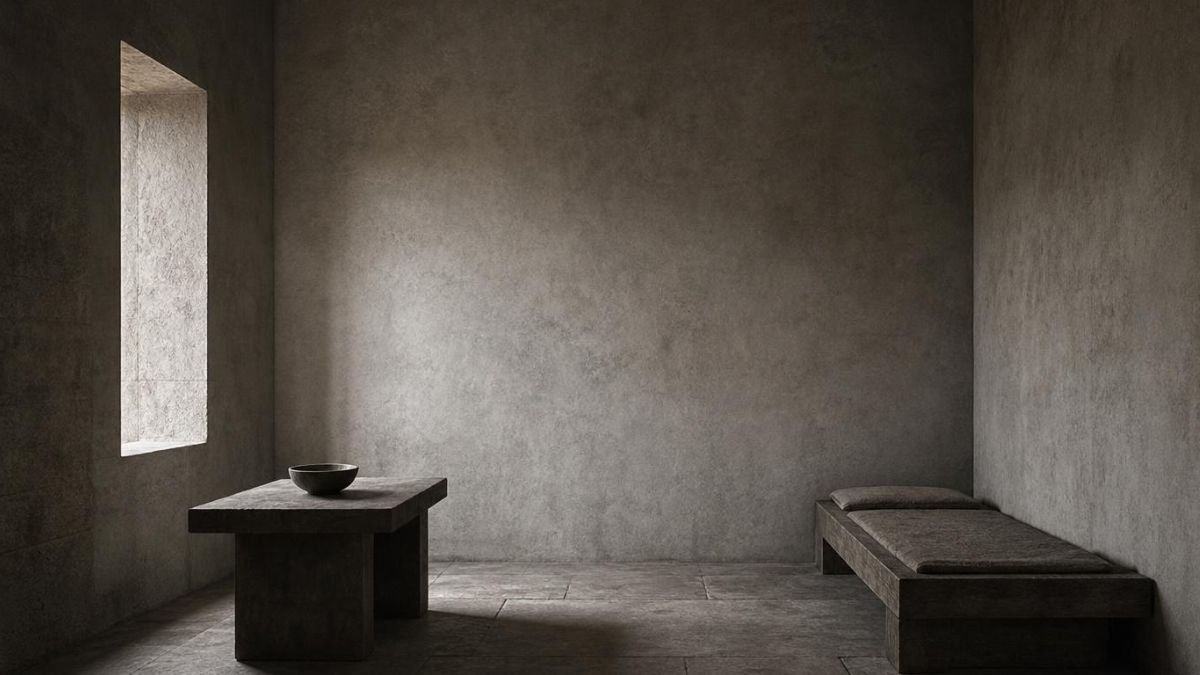
Can something be beautiful precisely because there is almost nothing there?
Because that's the odd territory of tonight's word, and it's a word most people hear as a criticism. Austere. We use it for bare rooms, plain buildings, joyless regimes, hard discipline. Austerity. It sounds cold. It sounds like something has been taken away from you.
But the origin is unexpected. It's Greek — austeros — and it started as a taste. It described wine and fruit that were dry, harsh, astringent. The taste that makes your mouth pucker and pulls the moisture from your tongue. Not bitter, not sour, not unpleasant exactly — drying. Think of a strong tea steeped too long, or an unripe persimmon, or a hard red wine that scours the mouth clean.
So before this word meant anything about buildings or budgets or monks, it meant a sensation on the tongue. And once you know that, the rest of the word's life makes sense. Everything austere shares that quality: it removes moisture. It takes away the soft, the sweet, the comfortable, and leaves the structure.
And here's the crucial thing about astringency, which most people never think about — it isn't a flavor at all. It's a texture. It's the sensation of something pulling tight. Which means the original meaning of this word wasn't about what was present. It was about what was being drawn away.
Now, I want to separate two things that get confused constantly, because I think the confusion causes real damage.
There is the austerity of deprivation, and there is the austerity of editing, and from a distance they look identical.
Deprivation is a room with nothing in it because there was nothing to put there. That's not austere; that's poor, and there's nothing beautiful about it, and every attempt to romanticize other people's poverty as a kind of spiritual simplicity should be treated with suspicion. The word gets used as a political term precisely this way — austerity as a policy, which almost always means the deprivation of people who never chose it, described in the vocabulary of virtue.
Then there's the other kind. A room with almost nothing in it because everything unnecessary was removed. That's a completely different room, even if the photograph looks the same. One is absence; the other is decision. And you can feel the difference the second you walk in, though it's hard to say why.
I think the reason is this: in a truly austere space, everything that remains is doing something. There's no filler. The single chair, the one window, the plain table — each one is carrying its full weight, and nothing is standing around decoratively. And that produces a strange intensity. When there are twenty things in a room, you look at none of them. When there is one, you actually see it. Austerity isn't the absence of beauty. It's the concentration of it into fewer objects.
That's why the great austere traditions — the monasteries, the tea rooms, the plainest chapels, certain kinds of poetry — aren't about self-punishment, whatever they look like from outside. They're about attention. Remove the excess and what remains becomes visible. It's the same logic as silence: a single note in silence is enormous, and the same note in a crowded piece of music is nothing.
And there's a further step, which is about the effect on the person rather than the room.
Astringency pulls tight. And there is something in a stripped-back environment that does exactly that to a mind. Comfort is softening — pleasantly, genuinely, and I'm not against it. But a certain amount of dryness makes you alert. Everyone knows this: the hardest, plainest periods of your life were often the ones where you were most awake. Not happiest. Most awake. When there's little to consume, you start to notice. When there's nothing to distract you, you find out what you actually think.
Which is why I'd offer this word as something other than a warning. Most of us live in conditions of quite extraordinary softness by any historical measure, and there's a specific cost to that which nobody warns you about: with enough cushioning, sensation flattens. Everything is available, so nothing is vivid. That's the sweetness that never dries — the palate goes dead.
A little astringency resets the tongue. That's literally why certain wines are served with rich food, and it's a good metaphor for a life. Some voluntary dryness — fewer things, plainer days, a stretch of doing without something you like — doesn't make you virtuous. It makes you able to taste again.
But the emphasis has to be on voluntary, and on some. Because taken too far, austerity stops being clarifying and becomes hostile to life. The tradition of stripping away can slide into contempt for anything soft, and there are people who've made themselves hard, bare, and unreachable and called it discipline. A person can be edited down until nothing is left to receive anything with. That's not austerity either. That's just drought.
So the word sits on a knife edge, and I think that's why it's stayed useful for two thousand years. It names the exact point where less becomes more, and reminds you that just past it, less becomes nothing.
So here's what I'll leave you with. Look around the actual room you're in, and then look at the less visible rooms — your week, your commitments, the things you consume. And ask: how much of what's in there is doing real work, and how much is padding you stopped noticing years ago? And if you took a great deal of it out, would you find yourself in a bare room — or would you finally be able to see the few things that were always the point?




0 Comments