
Why do we describe our worst moments as someone politely ringing to say it's time to get up?
Because that's what the phrase actually is. A wake-up call, in its original and literal sense, is a hotel service. You arrive late, exhausted, and you tell the desk: seven o'clock. And at seven o'clock a phone rings beside your head, and someone you'll never meet has performed a small kindness so that you don't miss your flight.
That's the origin. A courtesy. Something requested in advance, delivered by someone whose job is to help you make your appointment.
And then we took that gentle little transaction and applied it to the diagnosis, the collapse, the betrayal, the moment everything came apart. It was a wake-up call. Which means, somewhere in our collective sense of things, we decided that catastrophe and a polite telephone call at seven in the morning belong in the same category.
I don't think that's a mistake. I think it's one of the most quietly hopeful things our language does.
Because look at what the metaphor claims. It claims you were asleep. Not stupid. Not lazy. Not wicked. Asleep — a state everyone enters, involuntarily, every single day, and which is not a moral failing. Sleep is what happens when nothing is demanding your attention. It's the natural condition of a person whose situation has been stable for long enough.
And that's genuinely how it goes. Nobody decides to stop noticing their health, their marriage, their finances, the direction they're drifting. It simply gets quiet, and quiet is what puts you under. So the metaphor is generous where it easily could have been cruel: it says the problem wasn't your character, it was your consciousness. You weren't refusing to look. You had your eyes closed for the most ordinary reason there is.
And the second thing it claims is that you can be woken. That's the whole optimism of the phrase. Sleep is not death; it's reversible, instantly, by a sound. A person asleep is fully intact — everything is there, all of it, just temporarily offline. Which means whatever you've been sleeping through, you still have the capacity to see. Nothing has been lost except time.
Now, the third element, and it's the one that makes the phrase strange and worth thinking about.
A wake-up call has a purpose beyond waking. That's crucial. Nobody arranges one for its own sake. You ask for it because there's something at seven-thirty — a flight, a meeting, a train. The call isn't the point. The appointment is the point.
So when we call a hard event a wake-up call, we're implicitly saying: there's something you were supposed to be doing, and you were about to miss it. The phrase contains a destination. It says the alarm wasn't random noise; it was tied to something you'd committed to.
And I think that's why the phrase lands the way it does. When people describe the moment that woke them, they almost never describe learning something new. They describe remembering something they already knew — what mattered, who mattered, what they'd meant to do with the time. The information was never missing. It was just asleep with them.
But now the honest part, because this phrase can be used cruelly, and often is.
Not every catastrophe is a wake-up call. Some things are just catastrophes. When something terrible happens to a person and someone says maybe it's a wake-up call, that can be a genuinely violent sentence — it implies they were sleeping, that the disaster was instructive, that it happened for a reason and their negligence was the reason. Many terrible things carry no message at all. They're just what happened.
So the phrase should be self-applied only. It's a thing you may say about your own life, in retrospect, if you find it true. It is not a thing to hand to somebody standing in the wreckage of theirs.
And there's a second honest thing. Most wake-up calls don't work.
That's the part we skip. In a hotel, the phone rings, and a great many people say yes, thank you, put it down, and go straight back to sleep. And the same is true of the life version. Almost everyone has had one — a real one, a proper alarm, a scare or a loss or a moment of undeniable clarity — and can also tell you that within about six weeks they were exactly where they'd been before.
Because waking is easy and staying awake is the actual work, and nobody rings twice. The call is a single event. Everything after it is up to a person standing in a cold room at seven in the morning deciding whether to put their feet on the floor.
And that's really where the phrase stops being poetry and becomes a question. The alarm is not the change. The alarm is only information delivered loudly. What determines everything is the next ninety seconds, and then the next morning, and then the fifty mornings after that — long after the sound has faded and the urgency has gone and there's absolutely nothing making you get up except the memory of having decided to.
There's one more thought I want to leave in here. In the hotel, you requested the call. You booked it, the night before, in a moment of foresight, on behalf of your future self who you knew would be tired and would want to stay in bed.
I like holding the life version that way too. Something in you has been noticing for a long time — quietly, in the background, without your permission — and when the loud moment finally comes, it's not always an outside force. Often it's the part of you that had been keeping notes, finally picking up the phone.
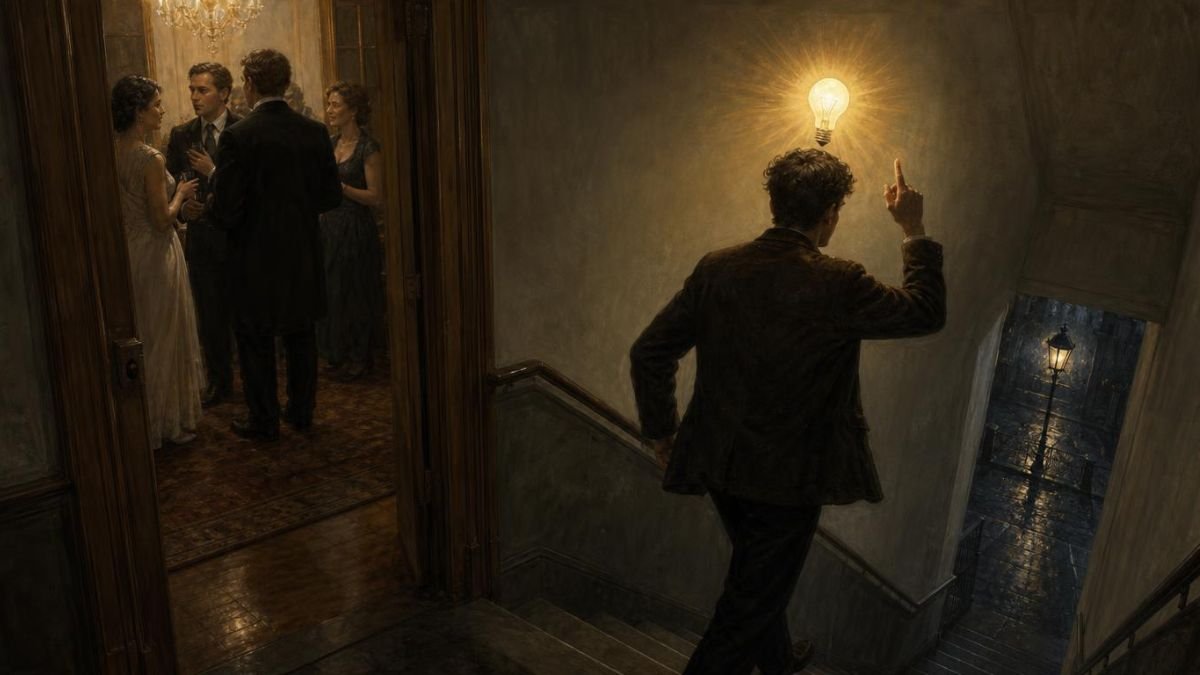
So here's what I'll leave you with. Think of the last time something genuinely woke you — the moment you saw your life clearly and knew exactly what needed to change. And then ask the question that actually matters: how long did you stay awake? And what would it take, this week, to answer the phone instead of thanking it and rolling over?





0 Comments