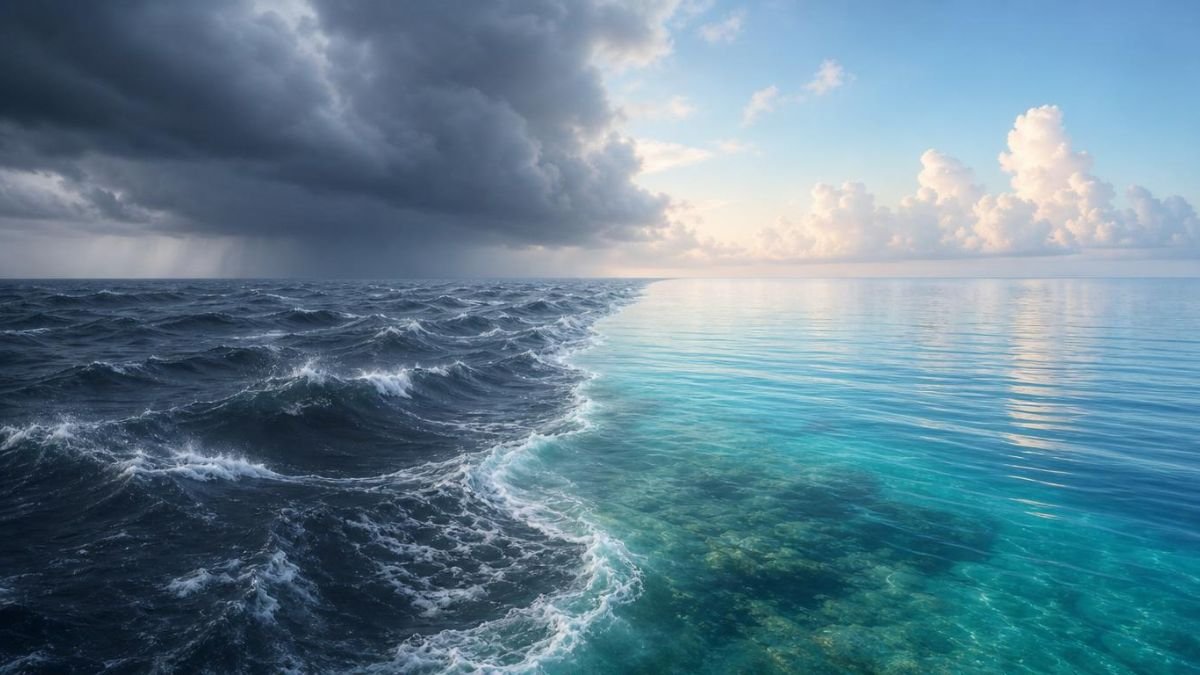
Would you still want to be transformed, if you knew you wouldn’t come out recognizable?
Because that’s the deal this phrase is actually offering, and I don’t think we hear it anymore. We’ve flattened a sea change into a business word — a sea change in policy, a sea change in consumer behavior — meaning simply a big shift, usually a fast one, usually in a quarterly report.
But it comes from a song, and the song is about a drowned man.
It’s from The Tempest. The spirit Ariel sings it to a young prince named Ferdinand, who has just survived a shipwreck and believes his father went down with it. And the song tells him what is happening to his father’s body under the water. That nothing about him fades — instead he undergoes a sea change, into something rich and strange. His bones become coral. His eyes become pearls.
That’s the origin. Not a market correction. A body on the seabed, being turned by the ocean into something else entirely.
And once you know that, three things about the phrase come back to life.
The first is the word suffer. The line is that he suffers a sea change. In the older sense that mostly means to undergo, to be subjected to — but the modern ear hears the pain in it too, and I think that’s a happy accident, because both are true.
The point is the passivity. You do not perform a sea change. You cannot execute one, or implement one, or schedule it for the second quarter. The sea does it to you. You undergo it.
And that runs directly against how we talk about transformation now. Our entire language for change is active and managerial — habits, systems, plans, discipline. And that language is genuinely useful for a range of things. But the deepest changes in a human life have never once worked that way. Nobody plans a grief. Nobody schedules the year that rearranged them. You go under, and the water works on you, and you come out different, and at no point did you have the helm.
The second thing is time. Nothing about this is quick. Coral does not form overnight. This is a slow, submerged, invisible process, happening in the dark, with nobody watching and no evidence available at any point that anything is being accomplished.
Which means that if you’re in one — if you’re currently underwater in some way — you will have no proof it’s working. That’s not a failure of the process. That’s the process. Sea changes offer no progress reports.
And the third thing is the pair of words at the end, which I think might be the most honest description of transformation in the language.
Rich and strange.
Not one. Both.
We want the first word. Everyone wants rich — more valuable, more depth, more worth than before. Bones into coral is an upgrade; pearls are better than eyes, at least by any market measure.
But strange is the price. Strange means unfamiliar. Not recognizable. Not what it was. Coral is more beautiful than bone and it is not bone. You cannot rebuild a skeleton out of it. The transformation is not reversible and it is not partial.
And I think that’s the thing we all quietly hope to avoid. We want to be changed by our hard years and come out recognizable. We want the wisdom without the strangeness. We want to be deepened and still fit back into the life we had, with the same friends, the same jokes, the same sense of what a Tuesday is for.
That’s not what the sea does.
Ask anybody who has come through something enormous — a serious illness, a death, a faith lost or found, becoming a parent — and if they’re honest, there’s a note of estrangement in it. Not always sadness. Estrangement. The old life doesn’t fit. Some friendships quietly end, not through any quarrel, but because you’re no longer speaking from the same place. People say you’ve changed, and mean it as an accusation, and they’re right, and there’s nothing to be done about it.
That’s the strange half. And it’s not a side effect. It’s half the definition.
There’s a fourth thing in the song, and it’s the part that redeems all of this, though I’ve saved it because it only lands once the rest is in place.
Ariel is singing about a drowning. Everyone in the scene believes something has been lost. And the song’s whole argument is: no. Nothing here fades. What looks from the shore like an ending is, from below, a transformation in progress.
Now, I want to be careful with that, because it can curdle into something glib — the idea that every loss is secretly a gift, which is not true and is a cruel thing to say to someone in the middle of one. Some losses are just losses. The song is being sung to a boy about his father, and it doesn’t make it not a shipwreck.
But it does open one possibility, and I’d offer it gently. The state of being submerged — the thing you’re currently calling a wasted year, a collapse, a period where nothing happened — may be the only condition under which certain changes can occur at all. Coral needs the sea. It cannot be made in air.
So here’s what I’ll leave you with. Think of the biggest change you can imagine wanting for yourself — the deep one, the one you’d actually pray for.
And now ask the question the song is really asking. Would you still want it, knowing it doesn’t come as an improvement to the current version of you, but as a replacement of some of it? Are you willing to be strange — or have you only ever been asking to be rich?





0 Comments