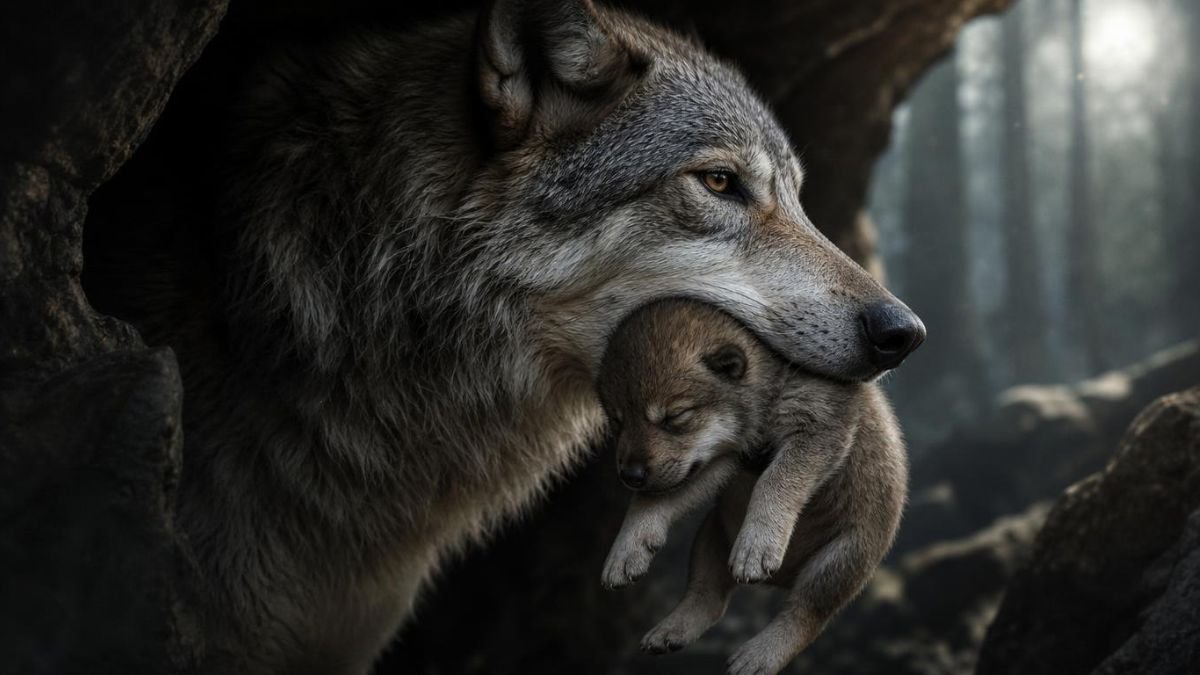
Why would anyone wish you into the jaws of a wolf — and mean it as a blessing?
Because in Italy, that's what you say. Before the exam, before the audition, before the surgery, before the interview that decides the next five years. In bocca al lupo. Into the mouth of the wolf.
And there are rules. You do not say grazie. Thanking someone for this is bad luck — it breaks the spell by acknowledging it as a wish, and a wish acknowledged is a wish overheard by whatever is listening. The correct answer is a curse: Crepi il lupo. May the wolf drop dead.
That's the classic exchange. It comes, most people think, from hunters — a superstition of the kind that lives in every language, where you protect a person by naming the worst thing instead of the best. English tells performers to break a leg. French tells them merde. Spanish theater says mucha mierda, which has its own filthy and wonderful origin in the horse droppings that piled up outside a theater when the audience was large. The logic is identical everywhere: say the good thing out loud and you attract attention. Say the terrible thing and the terrible thing looks elsewhere.
So far, so straightforward. The wolf is danger. You're being sent into it. Your friend hopes it dies.
But there is a second reading, and in Italy it's a live argument, not a settled one. You'll find Italians who insist the reply crepi il lupo is wrong — who answer instead viva il lupo. Long live the wolf.
Their case is this. Look at how a wolf actually uses her mouth around the things she loves. She carries her cubs in it. When the den floods, when the pack moves, when a pup wanders too far, the mother picks it up in the same jaws that crack bone and carries it somewhere safer. For a wolf cub, the inside of that mouth is not the end. It's the safest place in the forest — the one location where nothing in the world can reach you.
Under that reading, the phrase changes completely. In bocca al lupo isn't I hope you survive the danger. It's I hope you are carried. May the thing with teeth be on your side. And to answer may the wolf drop dead would be to wish death on the creature currently holding you.
I'm not going to tell you which origin is historically correct, partly because I don't think anyone can, and partly because the argument itself is the most Italian thing about the phrase — an entire country disagreeing, warmly and permanently, about whether the wolf is a threat or a mother.
Though it's worth remembering that Italy has been ambivalent about wolves for a very long time. The founding story of Rome is two abandoned infants suckled by a she-wolf. The empire that conquered the known world begins with a predator choosing not to eat two babies. Even ancient Romans found this hard to swallow — some of them argued the lupa in the story was a woman, since lupa was also slang for a prostitute. Which only deepens it. At the origin of Rome sits a figure who is either a wolf or an outcast woman, and either way the point stands: the children survived because something the city considered dangerous took care of them.
Now let me give you the fact that made me think the second reading is doing something serious.
Ecologists have a term: the landscape of fear. It came out of studying what happens to a valley when a predator returns to it.
The intuitive story is that wolves reduce the number of elk, and fewer elk means the young trees survive. Some of that is true. But the more interesting finding was behavioral. The elk didn't just decline in number — they changed how they moved. They stopped lingering in the open river valleys where they were exposed and easy to ambush. They browsed and left. And the willows and aspens along those riverbanks, which had been eaten to the ground by animals that had no reason to hurry, began to come back in places.
Now, honesty: the popular version of this story is overstated. You may have seen the video claiming wolves changed the course of rivers. Ecologists have been arguing about it for years, and the real picture is patchier, slower, and tangled up with drought, beavers, bears, and elk that were being hunted by people too. The valley did not transform because of one animal.
But the core idea survived the argument, and it's the one I want. A predator changes a landscape less by what it kills than by where it makes attention necessary. When there is no wolf, everything grazes everywhere, forever, and the riverbanks disappear. Danger, located and known, is what gives a system its shape.
Which is what in bocca al lupo has been saying all along, in four words.
The blessing isn't may nothing threaten you. A life with nothing in it that could go wrong is a valley grazed flat. The blessing is: may you be inside the danger, and may the danger be holding you carefully. Go into the room where it matters. Take the exam that can fail you, the surgery that can go wrong, the love that can leave. Be in the mouth, where the teeth are, where things are real.
And now the complication, because this phrase can be badly misused and I've seen it done.
Not every wolf is a mother. Some jaws are simply jaws. There is a whole industry of people who will tell you that your exhaustion is growth, that the person hurting you is teaching you, that the danger you're inside is secretly carrying you — and they will quote something like this phrase while they say it. The difference between a cub and a meal is not a matter of attitude. It's a matter of relationship. A cub is held: chosen, carried on purpose, going somewhere. Prey is just in the mouth.
So the phrase asks something harder than courage. It asks discernment about which mouth you're in. And discernment is difficult from the inside, in the dark, with the teeth right there, because both situations feel roughly the same on the first day.
Which is exactly where I want to leave you tonight.
Think about the frightening thing you're currently inside — the job, the diagnosis, the city you moved to, the relationship in its hardest year. Ask yourself the only question that matters about it: are you being carried, or are you being eaten? And if you can't tell yet — what would be the first honest sign, and would you let yourself see it?





0 Comments