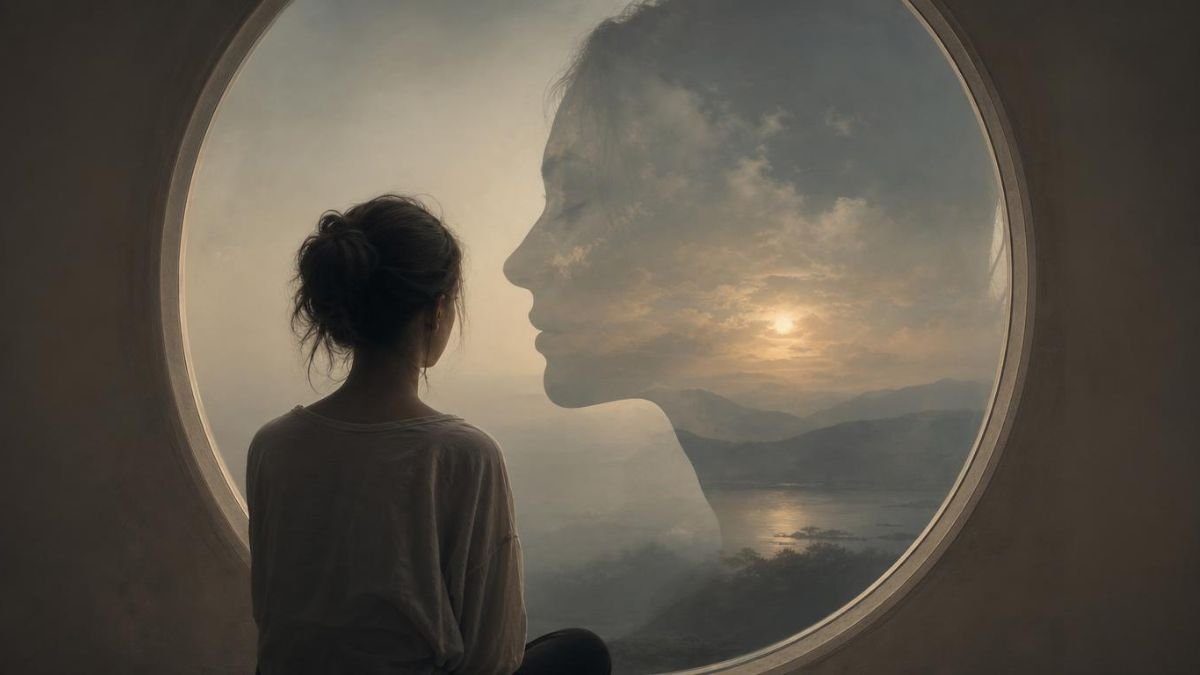
Who exactly is doing the looking, when you look inside yourself?
Hold that, because it's the puzzle at the center of tonight's word, and I don't think anyone has fully solved it.
Introspection. It's Latin and it's beautifully plain: intro-, meaning inward, and specere, to look. The same root gives us inspect, spectator, spectacle, perspective, suspect. To introspect is to look inward. That's all. It's a word about vision, applied to a place where there is no light and nothing to see.
And straight away we hit the strangeness. All the other specere words involve a separation — a spectator and a spectacle, an inspector and a thing inspected. Looking requires distance. But in introspection, you are the looker and the looked-at. The eye is trying to see itself, which is the one thing an eye cannot do.
That's not a technicality. It's the reason introspection is so much harder than it sounds, and so unreliable, and so worth doing anyway.
Let me take the unreliability first, because I think we're far too confident about this.
We assume we have privileged access to ourselves — that whatever else is uncertain, at least we know what's going on in here. But you've almost certainly had the experience of someone who loves you telling you something obvious about yourself that you had not noticed in thirty years. And you objected, and then went quiet, because they were right. Your friends can see your patterns. You're inside them.
Because introspection has a structural problem: you're using the mind to examine the mind, which is like trying to weigh a scale with itself. Every distortion in the instrument is also in the reading. If you're inclined to be harsh with yourself, your introspection will faithfully report that you're a fraud, and the report will feel like objectivity. If you're inclined the other way, you'll produce a very reasonable account in which every difficulty was somebody else's doing. The looking feels neutral from the inside. It never is.
So the first honest thing about this word is that it's not a window. It's a lit room where you're also holding the lamp, and where the lamp only points where your hand already turns.
And there's a second problem, which is that the act of looking changes the thing looked at. Try to observe your own anger, and it shifts. Try to catch yourself being spontaneous, and it's over. Watch yourself falling asleep and you won't. Some of the most important things about you can only operate while unobserved, which means there are rooms in the house you can never walk into, because the light going on is the same as the room emptying.
But I don't want to leave you with the impression that it's futile, because I don't believe that. I think introspection is one of the most important things a person can do — just not for the reason we usually think.
We think its purpose is finding out the truth about yourself, like an investigation with a verdict at the end. And that's mostly the version that goes wrong, because an investigation needs a culprit, and it will find one. That's how introspection curdles into rumination — the same three events turned over for the fourteen-hundredth time, in the dark, at 3 a.m., producing nothing but a slightly deeper groove. Rumination even shares its image with cattle: chewing something already chewed, bringing it back up, chewing it again. And you can always tell the difference, because introspection moves and rumination circles. If you're in the same place you were an hour ago, you're not looking; you're grinding.
So what is it actually for? I think its real purpose is acquaintance. Not verdicts. Familiarity. Getting to know the shape of the place you live, so that when a feeling arrives you can recognize it rather than be operated by it. Knowing, for instance, that this particular flavor of dread always shows up before a certain kind of task — not so you can eliminate it, but so you can say ah, this one again and continue.
That's a completely different activity from putting yourself on trial. And it's why the tone matters more than the content. Introspection done with curiosity produces knowledge. Done with prosecution, it produces only more evidence, because a prosecutor is not looking; a prosecutor is building a case.
There's one more thing about this word I keep coming back to, and it's the loneliness of it.
Nobody will ever come in there with you. Not your closest person, not after forty years. Everything you have ever felt happened in a room that had exactly one occupant, and the same is true of every single person you have ever met. That's the plainest fact of being alive, and it's a little vertiginous when you actually look at it.
But there's a turn in that, and it's the reason I find this word finally hopeful rather than bleak. The more honestly you look at your own room, the more you understand everyone else's. People who introspect well tend to be the most compassionate people around, and it's not a coincidence. They've seen how much confusion and pettiness and fear is in a perfectly decent human interior — their own — and they extend the finding outward. Whereas the person who never looks inside tends to imagine that other people's insides are simpler and worse than their own.
So the way out of the lonely room turns out to run straight through the middle of it.
So here's what I'll leave you with. You are the only person who will ever be inside your own experience, and you're also the lamp, and the walls, and the one deciding where to point. So the question isn't whether to look. It's this: when you go in there tonight, are you going in as an investigator building a case against a suspect you already convicted years ago — or as someone genuinely curious about the only room you'll ever actually live in?




0 Comments