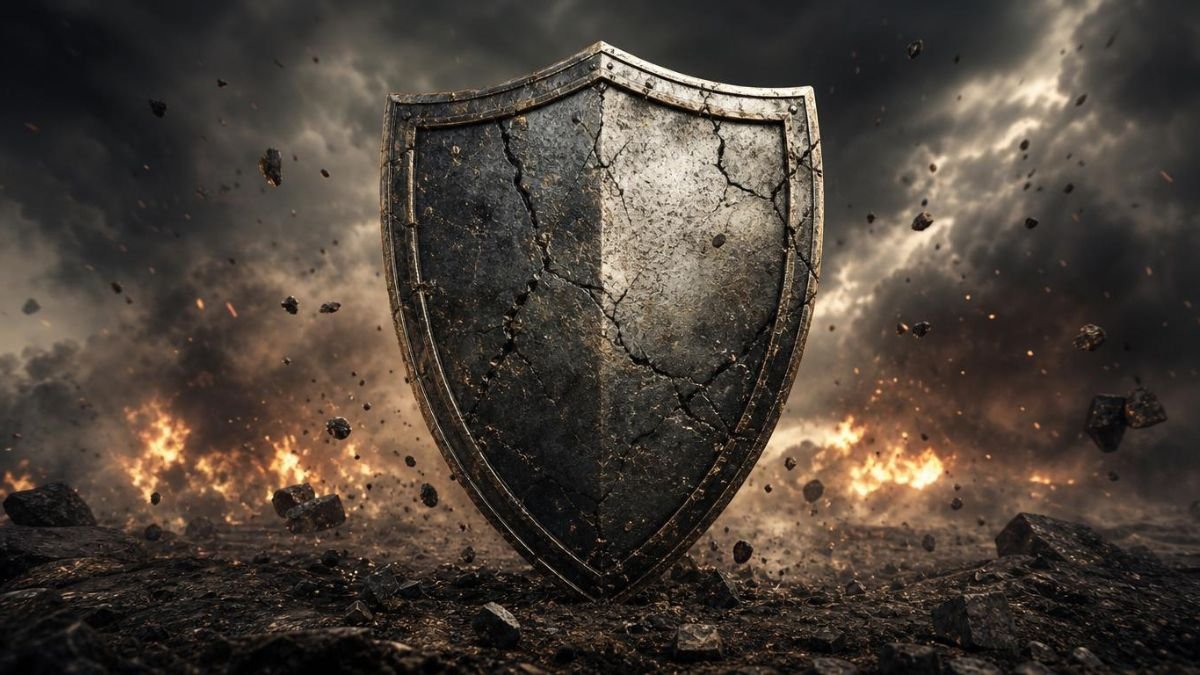
Can you name one single thing in the universe that cannot be destroyed?
Take your time. People usually start with diamonds — hardest natural substance, cuts anything. But hardness isn't durability; a diamond will shatter if you strike it right, and burn in enough oxygen. Steel corrodes. Stone erodes; every mountain on earth is on its way to being sand. Even the stars are temporary — some spectacularly so. Physics is fairly clear that everything currently existing is in the process of coming apart, at speeds that vary enormously and don't change the direction.
So we have a word for a property that, as far as anyone can tell, absolutely nothing possesses. Indestructible. And we use it constantly. Indestructible dog toys. Indestructible phone cases. Indestructible luggage. A word describing a condition that exists nowhere in the physical universe has become a marketing term for suitcases.
Which tells me it was never really about objects.
Look at the word itself. Destructible, from Latin destruere — to unbuild, to unstack. Struere is to pile up, to construct — the same root that gives us structure and construct. So to destroy something is, literally, to unpile it. To take apart the arrangement.
And that's a crucial distinction, because it means destruction has never actually meant annihilation. It means disarrangement. When a house is destroyed, no matter is lost — every brick, every splinter, every gram of it is still on the earth, just no longer in the shape of a house. Nothing was deleted. The order was deleted.
That's what we've always feared, and now the word makes sense. We're not afraid of our matter vanishing; matter doesn't vanish. We're afraid of the pattern coming apart. The specific, improbable, temporary arrangement — this house, this body, this family, this self — being unpiled back into the general stuff of the world.
And there's a hard truth hidden in that: everything that was built can be unbuilt. Structure and destruction are the same word with a prefix. If a thing was assembled, it has seams, and seams can be found. Which means the more elaborate and beautiful the arrangement, the more ways it has to come apart. A stone lasts longer than a cathedral. A cathedral is more precious. Complexity and fragility are the same fact seen from two angles, and this is true of buildings, ecosystems, relationships, and people.
So nothing built is indestructible. Then why does the word feel true when we use it about certain things?
Because we don't actually use it for objects — we use it for spirits and bonds. An indestructible friendship. An indestructible spirit. That woman is indestructible. And I don't think that's loose talk. I think we're pointing at something real, and it's this: some things aren't objects, they're processes, and processes obey different rules.
A flame is a useful example. You can put out a flame in a second — it's about as fragile as anything gets. But fire itself, as a phenomenon, has never been destroyed, because it isn't a thing to be destroyed. It's something that happens whenever the conditions occur. You can extinguish every fire on earth tonight and fire will exist again tomorrow, because fire was never an object. It was a pattern that reality knows how to make.
And I think that's the honest sense in which anything is indestructible. Not the instance. The pattern. Not this friendship — this friendship will end, all of them do, by distance or death. But friendship keeps happening, in every century, in every culture, unteachable and untaught. Kindness has been stamped out by regimes with real thoroughness, and it comes back within a generation, in the same forms, invented from scratch by people who never saw it modeled. You cannot destroy something that reality keeps re-deriving.
So when we call a person indestructible, we're being sloppy — they're not, they're extremely destructible, and if we mean they can't be broken we're setting them up for a bad day. But if we mean that something in them keeps re-forming, that they've been unpiled several times and something in them restacks — that's not a lie. That's just describing a process rather than an object.
There's one more layer, and it's about the past.
Here's the strangest fact I know. The past is genuinely indestructible. Not the memory of it, not the record — those are fragile, and they burn. But the fact. Whatever has happened has permanently happened, and no force in the universe can reach back and make it not have. A summer afternoon in 1997 that nobody now living remembers is still, immovably, something that occurred. You cannot destroy an event after it has taken place. You can only lose access to it.
Which means every good thing that has ever happened to you is, in the strictest possible sense, indestructible. It can be forgotten. It can be denied. It can be taken away from you in the sense that you'll never have it again. But it cannot be made to have not happened. That's beyond the power of anything. Not time, not loss, not even the person who was there with you, if they later decide it meant nothing.
There's a real comfort in that, and it isn't a soft one. When something ends badly, we're tempted to retroactively destroy it — to say it was never real, I wasted those years. But the arrangement came apart; it doesn't reach backwards. Those years occurred. The laughter occurred. Unpiling the house doesn't unmake the nights that were spent in it.
So here's what I'll leave you with. Everything you love is destructible, and you know that, and you love it anyway — which may be the bravest thing human beings routinely do. But somewhere in your life is something that already happened, permanently, beyond the reach of any future. So think about which moment you'd choose. And ask yourself: if that one thing can never be taken out of the record of the universe, does it change how you carry the fact that everything else can be?




0 Comments