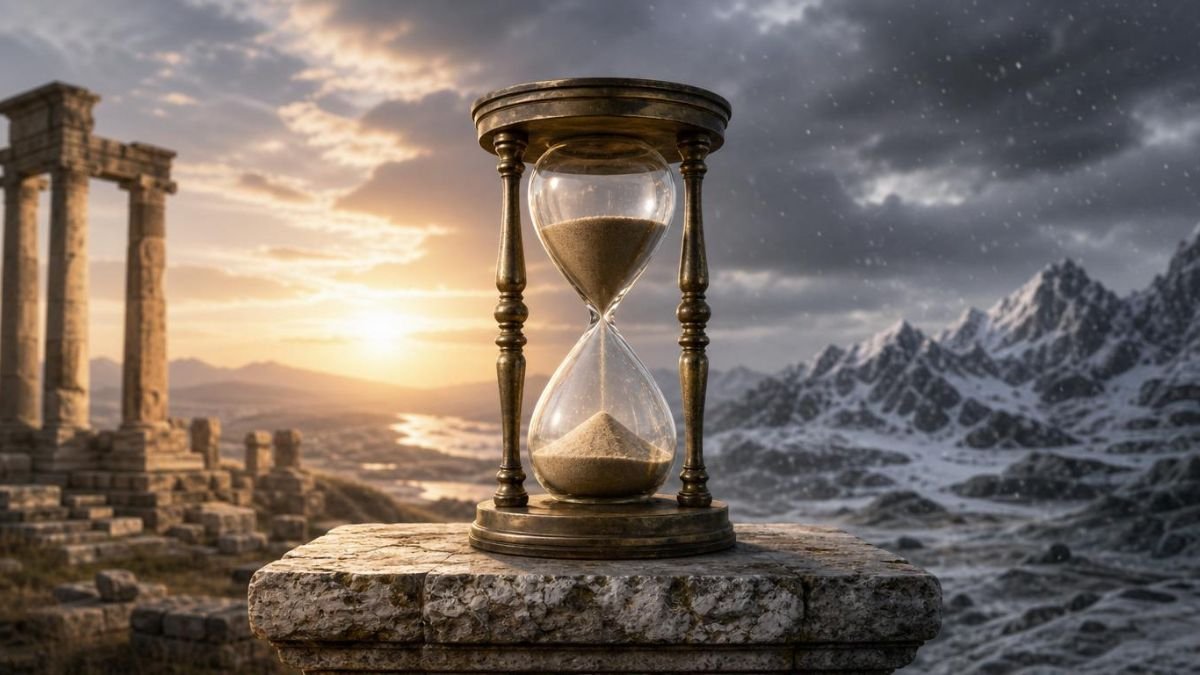
What exactly is time testing?
We use this phrase with such confidence. It stood the test of time. We say it about cathedrals and constitutions, about a marriage at fifty years, about a book still read four centuries after everyone who knew the author died. And it sounds like a description of quality. Like time is a rigorous examiner, and the survivors passed.
But notice: time doesn't test anything. Time has no standards, no preferences, no opinion about your work. It isn't grading. It simply keeps going, and things either remain or they don't, and afterward we walk through what's left and call it a verdict.
So the first honest thing to say is that this isn't an exam. It's an erosion. And what survives erosion isn't necessarily what's best — it's what happened to resist that particular weather.
Consider what we've actually inherited. We have the buildings made of stone, and almost nothing made of wood — not because stone architecture was better, but because stone is bad at burning. We have the writings that someone thought worth copying by hand, over and over, for centuries — which means we have what a small number of monks and scribes found valuable, and we've lost oceans of everything else. The past isn't a curated exhibition of excellence. It's a survival sample, and the survival was governed by durability, luck, and the taste of whoever held the copying pen.
That should make us hold this phrase a bit more carefully. When someone says a tradition has stood the test of time, they're often implying therefore it's true, and that's a leap. Plenty of terrible things have stood the test of time magnificently. Cruelty has excellent longevity. Some ideas persist not because they're right but because they're sticky, or because they served the people in a position to keep repeating them.
So the phrase can be a smuggler. It carries a claim about value inside what looks like a claim about age.
And yet. I don't want to dismantle it entirely, because there's something genuinely true underneath, and here it is.
Time removes a specific thing exceptionally well: it removes what was only ever fashionable.
Every era produces work that succeeds because it is perfectly tuned to its moment — the anxieties, the references, the exact frequency of that decade. And it works brilliantly, and it dies with the decade, because the thing that made it land was context, and context evaporates. So while time is a poor judge of quality, it's a superb detector of dependency. What survives is what was less dependent on its own moment — what was made from material that people in other centuries also happen to have.
That's why the surviving books are almost always the ones about grief, love, envy, mortality, the desire to be known. Not because they were the best-written, but because they were built out of the parts of human experience that don't get replaced. They were made of a material later people still possessed.
So the real question isn't will this last. It's what is this made of, and will anyone in a hundred years still have that material?
And here's the part of this phrase I find most haunting, and it's the word stand.
We didn't say survive the test of time. We said stand. Standing is what a building does, and what a person does under weight. It's not thriving. It's not winning. It's remaining upright while something presses down. Which means the phrase already concedes that time is a load — a thing that pushes, continuously, at everything — and that the highest achievement available is simply not falling.
And nothing stands passively. Every cathedral still standing has been repaired constantly, for centuries, by generations of people whose names are lost. Every long marriage has been rebuilt several times by two people who chose, repeatedly, to do the maintenance. Every enduring idea has been re-argued and re-explained in each new century, or it would have quietly gone. What looks from a distance like a thing that simply lasted is almost always a thing that many people kept carrying, in relay, out of view.
That reframes the whole phrase for me. Standing the test of time isn't a property of the object. It's the record of everyone who bothered.
And there's one more thing, which is the loneliest fact in the phrase.
You do not get the result. This is the only test where the candidate is never present for the grade. Whatever you make, whatever you build, whatever you raise — you will not be in the room when time returns its verdict. The cathedral builders knew they'd never see the roof. Anyone who plants a slow tree is doing something for a stranger. And every parent is, in the plainest terms, working on something whose outcome mostly happens after they're gone.
Which means people have always done this — worked toward a judgment they'd never hear — and that's either the saddest fact about being human or the most generous, and I've decided it's the second.
So here's what I'll leave you with. Everything you're currently building will be evaluated by a jury you'll never meet, using standards that don't exist yet, and you will not be informed. So think about what you're making right now — the work, the family, the small habit of being a certain way toward people. And ask yourself the question the builders had to answer: what would you still bother to do beautifully, knowing you'd never once see it stand?




0 Comments