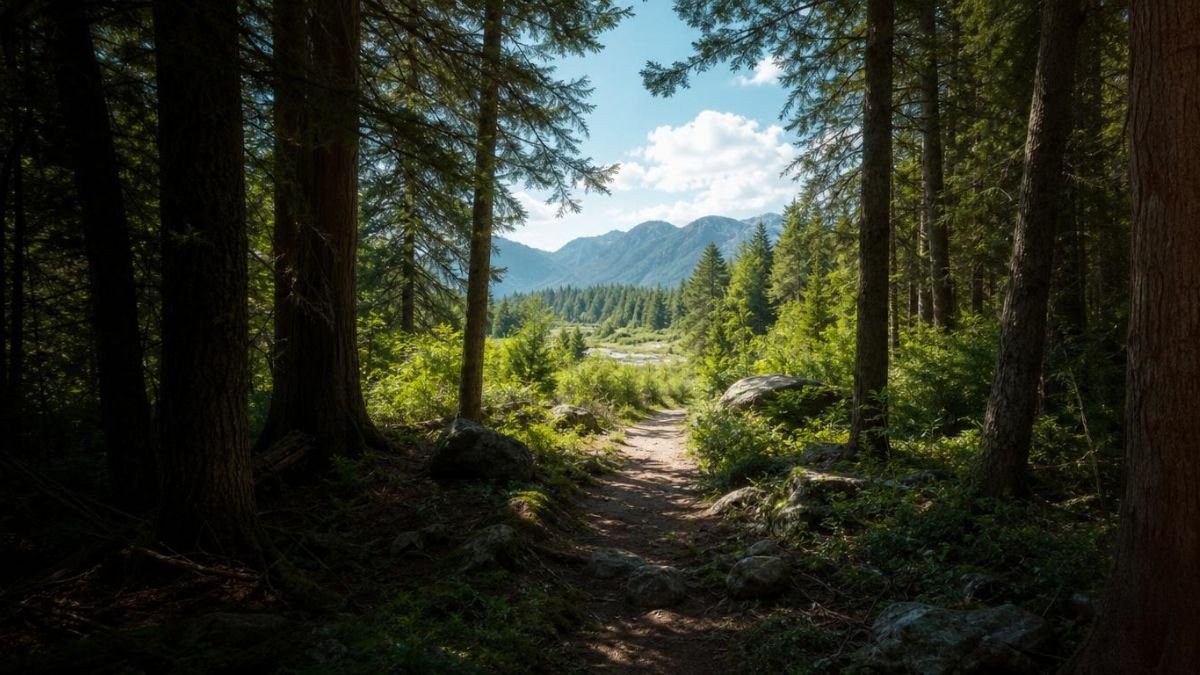
Have you ever felt that first, careful breath of relief — the one you take when you realize the worst might finally be behind you?
There's a phrase for that exact moment, and to feel its full power you have to understand how our ancestors felt about forests. We say someone is out of the woods, meaning they're past the danger, through the worst of it, safe now — the crisis survived, the illness turning, the hard passage behind them. And that image comes from a very old and very real fear: the fear of the woods themselves. Because for most of human history, the forest was genuinely where the danger lived. It was where you got lost. Where the wild animals were. Where the path disappeared and the dark closed in and you couldn't see your way. The woods were the place of peril, of being lost, of not knowing whether you'd make it through. And to come out of the woods — to emerge from the dark trees into open ground and light — was to be, at last, safe.
You can feel the whole story in that image, and it's why the phrase has lasted. Being in trouble is like being in a dark forest. You can't see far ahead. The path keeps vanishing. You don't know how much further it goes or whether there's an edge at all. You just have to keep moving through the trees, through the dark, hoping there's an open field somewhere on the other side. And then — that moment — the trees begin to thin. The light grows. And you step out of the woods into the open, and you can see the sky again, and you can breathe. That's the feeling the phrase holds. Not just safety, but the specific relief of safety after being lost in the dark. The relief of having made it through.
And notice how often we say it in the negative, because that negative version is doing something important. We say: not out of the woods yet. The fever's down, but she's not out of the woods yet. The worst has passed, but we're not out of the woods yet. And that phrasing carries a very particular, very hard-won wisdom. Because one of the most dangerous moments in any difficult passage is the moment you think you're through before you actually are. When you see the edge of the trees and let your guard down too early — and it turns out you weren't out yet, and the woods still had one more stretch of darkness left in them. Not out of the woods yet is the phrase of the wise, the experienced, the ones who know that relief felt too soon can be its own kind of danger.
There's real tenderness in that caution, actually. It's the voice of someone who's been through hard things and knows the shape of them — knows that recovery isn't a single triumphant moment but a slow emergence, that danger doesn't end all at once but thins gradually, and that hope has to be held carefully in that in-between stretch. Not out of the woods yet doesn't mean abandon hope. It means hold it gently. Keep going. Don't stop moving through the trees just because you glimpsed some light. The edge is close, maybe — but close isn't out.
But I don't want to dwell only on the caution, because the phrase also holds a genuine promise, and it's a beautiful one. Woods end. That's the thing. Forests have edges. However lost you are in the trees, however dark it's gotten, however long you've been walking without seeing the sky — the woods are not infinite. There is an out. That's built right into the phrase. We don't say "there's no way out of the woods." We say out of the woods, as a real place, a real destination, an actual other side that people reach. The whole expression assumes the emergence. It takes for granted that the trees end and the open ground begins. And when you're deep in the dark of some hard passage, that assumption is worth holding onto: you are in the woods, yes — but the woods have an edge, and you are moving toward it, even when you can't see it yet.
And there's something about that first breath, out in the open, that the phrase honors so well. Anyone who has come out of a genuinely dark passage — a serious illness, a crisis, a long grief, a stretch of life where you truly didn't know if you'd make it through — knows that the relief of finally being out of the woods is unlike any other feeling. It's not just happiness. It's the specific, weak-kneed, tearful relief of the survivor. The sky looks different when you've been in the dark that long. The open field feels like a miracle. You breathe differently. You don't take the light for granted, not for a while, because you remember too clearly what it was like to be lost among the trees.
So the phrase holds both truths at once, and that's its quiet genius. It urges caution — not out of the woods yet, keep going, don't relax too soon. And it holds out promise — the woods do end, there is an out, the open ground is real. Which is exactly the wisdom you need when you're in the middle of something hard: keep moving, hold your hope carefully, don't declare yourself safe before you are — but never stop believing that the trees will thin, and the light will grow, and one day you'll take that first breath in the open, and know you made it through.
Here's what I'll leave you with, wherever you are among the trees. If the woods always have an edge, however dark it gets in the middle — then in whatever forest you're walking through right now, are you closer to the edge than the darkness is letting you believe? And what would help you keep moving toward the light you can't quite see yet?




0 Comments