Why is it that the bigger the truth, the harder we sometimes work to pretend we can't see it?
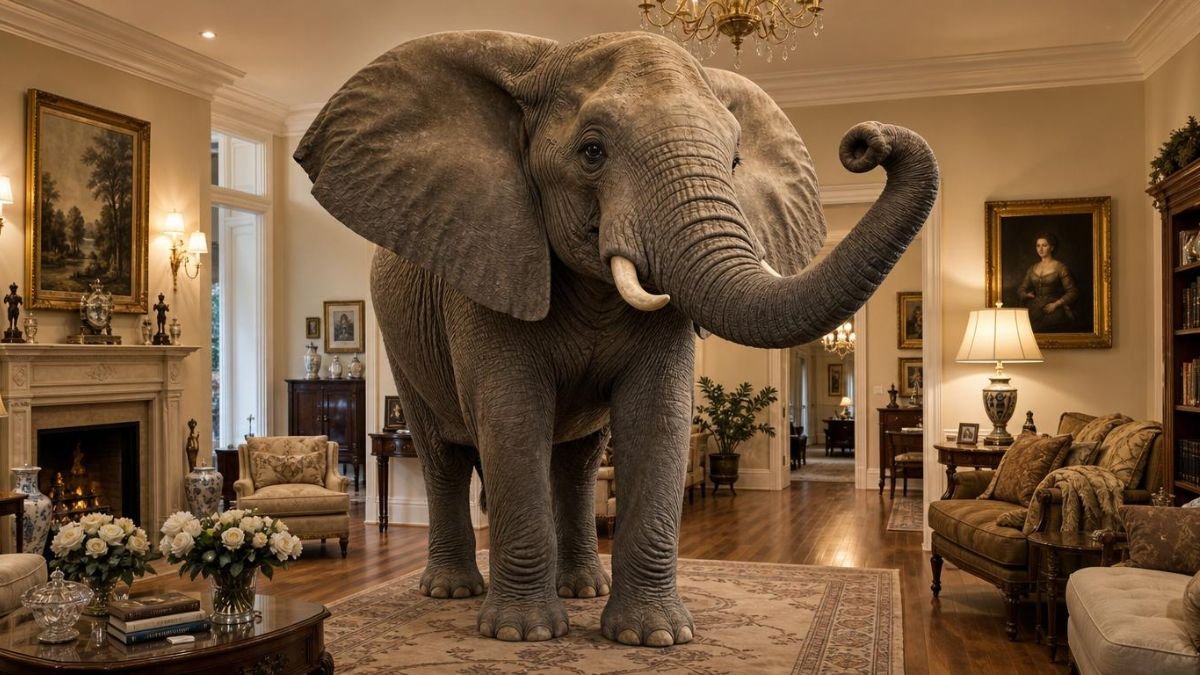
Picture the scene the phrase actually asks you to picture, because we say it so often we've stopped seeing it. A room — an ordinary room, people gathered, conversation flowing. And standing right there in the middle of it, enormous, impossible to miss, is an elephant. Gray, vast, breathing, taking up half the space. And everyone in the room is carefully talking around it. Nobody mentions it. Nobody says, "excuse me, but there's an elephant here." They pass the tea, they make small talk, they step around its feet — and the one thing they will not do is name the giant thing everyone can plainly see. That's the elephant in the room. And once you really picture it, it's one of the most absurd and most human images in the whole language.
Because that's exactly what we do. There's some huge, obvious truth — the thing everyone in the family knows and no one will say, the problem at work that everyone sees and everyone avoids, the fact hanging over a relationship that both people feel and neither will speak. It's not hidden. That's the strange part. An elephant isn't hidden. Everyone can see it. Everyone knows everyone else can see it. And still, by a kind of silent group agreement, nobody says its name. The silence isn't about not knowing. It's about all of us knowing, and all of us conspiring, wordlessly, to act as though we don't.
And I want you to notice how much effort that takes. It would actually be easier to just mention the elephant. Pretending not to see something enormous is exhausting — you have to constantly steer the conversation around it, watch your words, keep the whole delicate performance going. The silence isn't the absence of effort. It's a tremendous, coordinated act of effort, all pointed at not saying one true thing. We work harder to avoid the truth than it would take to simply speak it. That's the paradox sitting at the center of this phrase.
So why do we do it? Why does a whole room of intelligent people agree to pretend? Fear, usually. The elephant is in the room precisely because naming it feels dangerous. It might be painful. It might start a fight, or end something, or force a change nobody's ready for. The unspoken thing is unspoken because speaking it has a cost, and everyone can feel that cost, and so everyone quietly decides that the discomfort of the silence is more bearable than the risk of the words. We choose the elephant. We'd rather live with a giant in the room than pay the price of pointing at it.
But here's what the silence costs us, and it's more than we admit. Because the elephant doesn't leave just because nobody names it. It stays. It takes up space. It shapes everything — the whole conversation bends around it, the whole relationship organizes itself to avoid it — and everyone slowly grows exhausted from the effort of the pretending. The unspoken thing doesn't disappear. It just goes underground and runs everything from there. And often, the not-saying does more damage than the truth ever could have. Families fracture not over the hard thing itself but over the years of pretending it wasn't there. The elephant, left unnamed, doesn't stay quiet. It slowly fills the whole room.
And here's what moves me about this phrase — it contains its own cure, right there in the wording. Because the moment someone finally says it — "can we talk about the elephant in the room?" — something breaks open. The spell lifts. The exhausting performance stops. There's usually a strange relief in the room, even if the truth is hard, because everyone was already carrying it; they were just carrying it alone, in silence, pretending. To name the elephant is to say: I see it too. You're not imagining it. We can stop pretending now. And that naming, that one brave sentence, is often the first honest thing that's been said in a very long time.
It takes courage, of course. The person who names the elephant is breaking an agreement everyone else signed. They're risking the discomfort everyone was so carefully avoiding. That's why we admire it when someone does it well — someone who can walk into the collective silence and gently, honestly, point at the truth everyone was tiptoeing around. It's a kind of leadership, really. Not loud. Just honest. The willingness to say the obvious thing that's become unsayable.
And maybe the deeper invitation of this phrase is to ask, in your own life, right now: what's the elephant? Because there's almost always one. In some relationship, some room, some part of your life, there's probably a large gray truth that everyone can see and no one will name. And the phrase quietly asks whether the silence is really protecting anyone — or whether it's just growing the elephant larger, day by day, while everyone pretends the room isn't getting smaller.
I'm not saying every elephant must be named the moment you notice it. Timing matters, and kindness matters, and some truths need the right moment and the right words. But I am saying this: the elephant never leaves on its own. Silence doesn't shrink it. It only ever gets named, or it stays. And a life with fewer unspoken elephants — a life where the true things can be said out loud — is almost always a lighter, freer, more honest life than one spent forever stepping around the feet of something no one will admit is there.
Here's the question I'll leave standing in the room with you. If the elephant never leaves until someone names it — and if the pretending costs more than the truth ever would — then what is the elephant in your room right now? And what are you afraid would happen if you finally said its name out loud?






0 Comments