- The Seductive Logic of War
- What War Costs — and Who Actually Pays
- The Nationalism Problem
- The Post-War Illusion
- Is There Hope?
- LET'S GET CRITICAL
- FANTASTIC GUEST: LEO TOLSTOY
- EDUSTORY: THE CARTOGRAPHER'S BORDER
- LET'S DISCUSS
- WHAT NOW?
- LANGUAGE FOCUS: VOCABULARY AND SPEAKING
- Speaking Section: The Language of Careful Argument
- LANGUAGE FOCUS: GRAMMAR AND WRITING
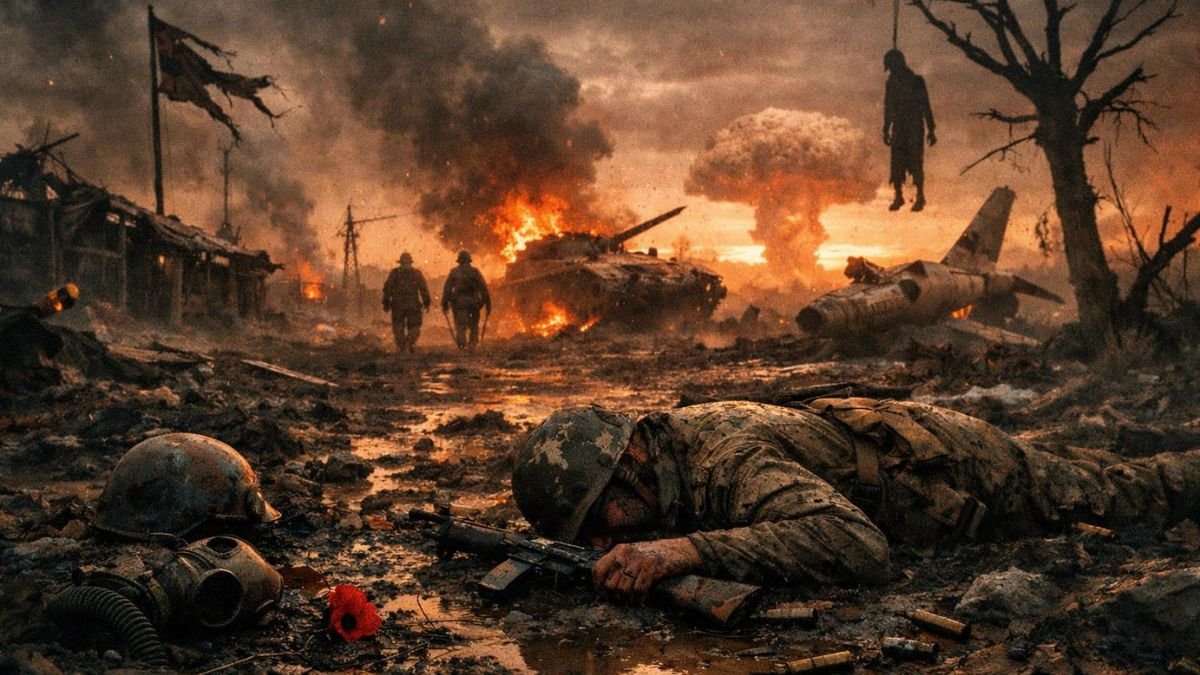
There's a particular kind of insanity in doing the same thing over and over and expecting different results. You've probably heard that definition applied to Einstein, though historians can't quite confirm he said it. What they can confirm — with overwhelming, blood-soaked evidence — is that humanity has been applying this logic to war for roughly ten thousand years.
We know what war does. We've written libraries about it. We've made Oscar-winning films about it. We've built monuments to the dead, passed international laws against the worst of it, and sat in rooms at The Hague pointing fingers at war criminals. We know. And then, with startling regularity, we do it again.
This isn't an anti-war screed. It's something more uncomfortable: an honest examination of why, despite everything we know, armed conflict remains one of humanity's most persistent behaviors — and what that says about us.
The Seductive Logic of War
Let's start with something that rarely makes it into the conversation: war has a logic. It isn't random. People don't start wars because they woke up on the wrong side of history. Wars begin because, at some level, someone believes they will work.
That belief is not always irrational. Historically, there are wars that accomplished something tangible. The Allied victory in World War II ended the Nazi genocide. The American Civil War, for all its horror, ended chattel slavery in the United States. These outcomes were real, and dismissing them would be dishonest.
But here's what we tend to do with those examples: we use them as permanent justifications for a method that, in the vast majority of cases, delivers something far messier and far less conclusive than the textbook outcome. We remember the wars that 'worked' and quietly shelve the ones that didn't — which is most of them.
The Survivorship Bias of Military Victory
Survivorship bias is the cognitive tendency to focus on the cases that made it through a selection process while ignoring those that didn't. In aviation, for example, there's the famous WWII story of engineers who wanted to reinforce the most bullet-riddled parts of returning planes — until a statistician pointed out that they should reinforce the parts with no bullet holes, because planes hit there didn't return at all.
We apply the same distorted logic to war. The wars that 'worked' — that are neat and conclusive and ended with a signed surrender on a battleship — are the ones we study, celebrate, and invoke. The wars that dragged on for decades, produced nothing but rubble and generational trauma, and were eventually abandoned without resolution? Those are the asterisks.
The Vietnam War. The Soviet invasion of Afghanistan. The American invasion of Iraq. The endless cycles of Israeli-Palestinian conflict. The Lebanese Civil War. None of these produced anything resembling the outcome that justified the initial decision to fight. But they produced casualties in the hundreds of thousands, refugee crises, destabilized regions, and PTSD that three generations haven't finished processing.
What War Costs — and Who Actually Pays
The economic case against war is, by now, overwhelming. The Iraq War cost the United States somewhere between two and three trillion dollars, depending on who's counting and whether they're including long-term veterans' care. Afghanistan added another two trillion. For what? Pick your answer carefully, because historians are still fighting about it, which is itself something of a tell.
But economic cost, as staggering as it is, is not the real cost. The real cost is the one that doesn't appear in congressional budget reports.
The Civilian Price Tag
In World War I, roughly 85 to 90 percent of the dead were soldiers. By the time we got to the wars of the late twentieth and early twenty-first centuries, that ratio had essentially reversed: in many modern conflicts, 90 percent of casualties are civilians. War has become, in its modern form, largely a mechanism for killing people who weren't fighting.
Think about that for a moment. The technology of warfare has advanced enormously. We have precision-guided munitions. We have satellite targeting. We have drones operated from air-conditioned rooms thousands of miles away. And yet, somehow, we keep hitting hospitals, markets, schools, and wedding receptions.
This isn't always incompetence. Sometimes it's a feature, not a bug. Collective punishment — the targeting of civilian populations to break the will of an enemy — has a long and dishonorable history in modern warfare. It didn't work in London during the Blitz. It didn't work in North Vietnam. It doesn't work, not in the sense of achieving durable political change, but it keeps getting tried.
The Long Shadow of Trauma
Beyond the physical casualties, war leaves a psychological wound that no armistice can close. The clinical literature on post-traumatic stress disorder — formerly called 'shell shock' in World War I and 'combat fatigue' in World War II, as if renaming it would make it less devastating — is unambiguous. Combat exposure produces lasting neurological changes. Rates of suicide among veterans in the United States consistently exceed those of the general population.
But soldier trauma, as serious as it is, is only part of the picture. The populations on whom wars are fought — the cities bombed, the villages razed, the families displaced — carry psychological wounds across generations. Research on intergenerational trauma has shown that the effects of severe trauma can be transmitted to children and even grandchildren through both psychological modeling and, increasingly, epigenetic mechanisms. The Lebanese, to cite one intimate example, are still navigating the psychological wreckage of a civil war that ended in 1990. Syria will be doing the same for decades to come.
The Nationalism Problem
If you want to understand why wars happen with such depressing regularity, you need to understand nationalism — not the textbook definition, but the lived, visceral experience of it.
Nationalism is, at its core, the belief that your group — defined by language, ethnicity, religion, or some combination thereof — has a special claim on territory, sovereignty, or dignity. It is remarkably effective at motivating people to do things they would otherwise find unthinkable. Young men who would never dream of shooting a stranger will line up to shoot an enemy, once that enemy has been sufficiently categorized as not-us.
The psychologist Jonathan Haidt has written extensively about the role of group identity in moral reasoning, and what he finds is both fascinating and disturbing: when group identity is threatened, people's capacity for impartial moral reasoning diminishes sharply. They become tribal. They begin to interpret the same action as justified when their side does it and monstrous when the other side does.
This isn't a weakness unique to uneducated people or populations with particular political leanings. It affects virtually everyone. It's the water in which we all swim.
The Dehumanization Machinery
Every war requires, as a precondition, a sustained effort to dehumanize the enemy. You cannot get ordinary people to kill other ordinary people without first making the enemy into something other — something threatening, something sub-human, something that has forfeited its claim on moral consideration.
This dehumanization isn't incidental to war; it's essential infrastructure. Propaganda posters, political speeches, news coverage, and cultural narratives all do this work with varying degrees of subtlety. And once the machinery is running, it is extraordinarily difficult to shut off. The dehumanization doesn't stop when the peace treaty is signed — it echoes through decades of mutual suspicion, discrimination, and festering resentment that set the stage for the next conflict.
The Post-War Illusion
Here is perhaps the most persistent myth in the entire discourse around war: that wars end.
They don't, not really. What ends is the organized military combat phase — the part with the artillery and the airstrikes and the front lines. What comes after — the displacement, the economic collapse, the political vacuum, the revenge killings, the emergence of new armed factions, the generation of children growing up with absent fathers and bombed schools — that doesn't get a surrender ceremony. It just slowly becomes the next chapter of a story that never quite concludes.
The Middle East is a living case study in post-war illusion. The Sykes-Picot Agreement of 1916, drawn by British and French diplomats who had limited knowledge of and even more limited concern for the populations they were redrawing borders around, created a set of artificial states that have spent the century since struggling with the contradictions baked into their foundations. The wars we see today in the region are not separate conflicts; they are expressions of an ongoing process of instability set in motion by decisions made over a century ago.
World War I was supposed to be the war to end all wars. It ended in 1918. World War II began in 1939. Make of that what you will.
Is There Hope?
Yes, and it's important to be honest about that too, because despair is not a useful response to complexity.
The good news — and it is real news, supported by data — is that organized, interstate warfare has become significantly less common since 1945. Steven Pinker's work in The Better Angels of Our Nature makes the empirical case that, measured in terms of the percentage of the population killed in war, we live in one of the least violent periods in human history. That's a meaningful fact, and we shouldn't dismiss it.
International institutions, economic interdependence, nuclear deterrence, and the slow spread of democratic governance have all contributed to making large-scale state-on-state warfare less likely than it was a century ago. These aren't perfect mechanisms, and they can clearly fail — but they represent real progress.
The challenge is that they can also be dismantled. Institutions erode. Economic ties can be cut. Democratic norms can be undermined. Nuclear weapons remain with us, and the number of states possessing or seeking them continues to grow. Progress is real, but it is not irreversible.
What remains, then, is the most basic of human tasks: staying honest about what war actually is, what it actually costs, and what it actually achieves — so that when the next politician or general or revolutionary promises that this war, unlike all the others, will finally solve the problem, we can ask the question that survivorship bias and nationalism and trauma have always made so difficult to ask: Are you sure? Because we have been here before. And we know how it tends to end.
Take This Package With You
Read this study package free below, or get the clean, ad-free PDF and EPUB, plus extra worksheets and audio, on Patreon.
LET'S GET CRITICAL
There's a version of the argument you just read that is easy to agree with. War is bad. Trauma is real. Civilians suffer. Nationalism is dangerous. Institutions matter. All of that is true, and all of it is important. But let's not congratulate ourselves too quickly for nodding along, because there are several things the article either skated past or didn't say at all — and some of them complicate the picture considerably.
First, let's talk about the claim that war rarely achieves its objectives. This is true enough as a general statement, but it risks becoming a kind of intellectual comfort food — a position that lets us feel wise without engaging with the hard cases. Because sometimes the alternative to war is not negotiation and flowers; it is genocide. The failure to intervene militarily in Rwanda in 1994 resulted in the deaths of approximately 800,000 people in 100 days. The international community's repeated hesitation over Bosnia in the early 1990s allowed ethnic cleansing to proceed on European soil for years. These aren't hypotheticals or edge cases — they are documented historical catastrophes that happened in large part because the international community was committed to the principle of non-intervention.
So when we say war is futile, we need to ask: futile compared to what? Sometimes the counterfactual is worse, and we owe it to intellectual honesty to say so.
Second, the article invokes the concept of intergenerational trauma, which is a real and important phenomenon, but it's worth noting that the science here is still genuinely contested. Epigenetic transmission of trauma is a fascinating hypothesis with some supporting animal research, but in humans, the evidence is much more complicated and much less established than popular coverage suggests. The psychological transmission of trauma through modeling, family dynamics, and cultural narrative is well-documented. The direct biological transmission through epigenetic mechanisms is far less certain. These are different claims, and conflating them weakens both.
Third, the article cites Steven Pinker's Better Angels thesis — the idea that violence has been declining on a per-capita basis. It's worth noting that this thesis has attracted significant academic criticism. Nassim Nicholas Taleb and others have argued that Pinker's analysis underweights the statistical possibility of rare but catastrophic events, and that the relative peace of the post-1945 era may say more about nuclear deterrence producing a particular kind of unstable equilibrium than about any fundamental shift in human nature or institutional quality. The next large-scale war, if it happens, could be orders of magnitude more destructive than anything in history, precisely because of the weapons available to states today. A declining frequency of war is cold comfort if the variance of outcomes includes civilization-ending events.
Fourth — and this is the one the article most conspicuously avoided — we need to talk about who profits from war. The military-industrial complex is not a conspiracy theory; it is a structural reality of modern economies. Defense contractors, weapons manufacturers, and the financial networks that support them have an institutional interest in the perpetuation of conflict that operates largely independent of any particular political ideology. When a country's economy becomes significantly dependent on weapons production, the political incentives to maintain demand for those weapons are baked into the system. Eisenhower warned about this in 1961, and the warning has only become more relevant since.
The article's emphasis on psychology — dehumanization, nationalism, survivorship bias — is valuable, but psychology can inadvertently become a way of personalizing what is fundamentally a structural problem. Individual soldiers don't start wars. Individual citizens rarely choose them. Wars are typically the products of institutional incentives, resource competition, and elite decision-making that happens at considerable remove from the lived experience of the people who do the dying.
Finally, there's a tension in the article that's never fully resolved: if war is futile and the post-war period is just a prelude to the next conflict, what exactly are we supposed to do with that information? The 'Is There Hope?' section gestures at international institutions and economic interdependence, but it doesn't reckon with the fact that these mechanisms have enormous blind spots. Economic interdependence did not prevent World War I — Europe in 1914 was the most economically integrated it had ever been. International institutions have repeatedly failed to stop atrocities.
None of this is to say the central argument is wrong. The futility of war as a first resort, as a tool of political theater, as a mechanism for solving problems that could be addressed through diplomacy or economic engagement — that case is strong. But the hard version of the question isn't whether we should prefer peace to war in the abstract. It's: what do you do when the alternative to war is something worse, when the institutions designed to prevent war fail, and when the people making the decision to fight have every structural incentive to do so? That's the question that keeps the conversation uncomfortable, and staying with that discomfort is more valuable than any clean conclusion.
FANTASTIC GUEST: LEO TOLSTOY
Danny: Welcome, Mr. Tolstoy. This is genuinely surreal, having you here, given that you are, technically speaking, dead.
Tolstoy: I have been dead for over a century. Yet the wars I wrote about are still being fought. So perhaps death is more relative than either of us would like.
Danny: Fair point. You wrote two of the most important works about war ever produced — War and Peace, and then later your essays and your pacifist writings. But let's start here: you actually fought. You served in the Caucasus and at Sevastopol. What did you see there that changed you?
Tolstoy: I saw young men die for reasons they could not articulate. I saw officers give orders that made no military sense but served their ambitions. I saw what a human body looks like when artillery has finished with it. And I saw something even more disturbing: I saw how quickly a man can stop seeing the enemy as a man. That transition — from human to target — happens so fast it should terrify everyone, but instead it is treated as necessary preparation. It is called patriotism.
Danny: That's striking, because you were still writing romantic passages about battle at the time. In The Raid, for example, there's something almost beautiful about the violence.
Tolstoy: I was young and I was honest only about what I saw, not yet about what it meant. That is not a defense, it is an explanation. Youth mistakes excitement for meaning. The truth came later, as truth usually does — too late for the men who died while I was still being excited.
Danny: By the time you wrote the Sevastopol Sketches, the tone had shifted dramatically. You ended the final sketch with one of the most quietly devastating lines in Russian literature.
Tolstoy: That the hero of the story is truth. Yes. I was trying to say: stop. Stop making monuments of this. Stop making it noble. The hero is not the general, not the nation, not the cause. It is what actually happened, which is that many people died in great pain for very little.
Danny: And yet War and Peace, which is partly a meditation on the madness of war, is also a novel of enormous vitality and life. Was that contradiction intentional?
Tolstoy: Life continues alongside the madness. That is the most unbearable thing. While battles are being fought, children are being born. While villages are burning, someone, somewhere, is falling in love. The novel had to hold both because reality holds both. If I had written only the horror, it would have been a pamphlet. It had to be life — full, overwhelming, contradictory life — to be true.
Danny: Let me push back on something. Your later pacifism — particularly in The Kingdom of God Is Within You — is sometimes criticized as naive. Tolstoy says turn the other cheek, don't resist evil with force, and critics respond: what do you say to someone facing genocide? What do you say to a person whose village is being burned?
Tolstoy: I say that the question is posed correctly but drawn too narrowly. The question is always framed as: once the soldiers are already there and the village is already burning, what do you do? But the real question — the one no one wants to ask — is: how did the soldiers get there? There is an entire chain of decisions, incentives, propaganda, and institutional failures that precede every burning village. My argument was not passive acceptance of evil. It was a refusal to participate in the chain that produces the soldiers in the first place. If enough people refused, at every stage, the chain would break.
Danny: Critics would say that's precisely the kind of argument that sounds beautiful in a study and fails in a trench.
Tolstoy: Every moral principle sounds beautiful in a study. The question is whether it is true. I was not saying it was easy. I was saying it was the only path that did not lead, eventually, back to the same place. Every war that ends in victory contains the seeds of the next war, because victory is not resolution — it is postponement. The defeated do not disappear; they remember.
Danny: That's almost prophetic, given what followed the Treaty of Versailles.
Tolstoy: I died in 1910. I did not live to see it. But I had seen enough to know how the story goes. You humiliate a people, you impose conditions they cannot meet, you build your peace on their ruin — and then you are surprised when they are angry. You should not be surprised. You built the anger.
Danny: Let me ask you about something the article raised: the idea that war persists partly because of who profits from it. The military-industrial complex, as Eisenhower later called it. As someone who came from the Russian aristocracy and was deeply conscious of class, did you see that structural dimension clearly?
Tolstoy: I saw it. The people who decide to go to war are almost never the people who die in wars. This was as true in Napoleon's time as it is now. The nobility decided; the peasants died. The politicians vote; the soldiers fight. The arms manufacturers profit; the widows grieve. This is not an accident or a failure of the system — it is the system functioning as designed. As long as the people who benefit from war are not the people who pay for it with their lives, there is no internal mechanism that makes war stop.
Danny: That's a pretty bleak analysis.
Tolstoy: I was not known for cheerfulness. But bleak and false are different things.
Danny: Fair enough. You converted to a radical form of Christian anarchism later in life, which alienated you from virtually every institution — the church, the state, the intelligentsia. Did you regret the isolation?
Tolstoy: I regretted the arrogance of my youth, which was considerable. I regretted the harm I caused to my family through my contradictions — preaching simplicity while living in a manor house, preaching non-attachment while fighting bitterly with my wife over my manuscripts. I was not a consistent man. I was a man trying, very late and very badly, to align what he believed with how he lived. That is not nothing. It is also not nearly enough.
Danny: One last question. We are, as I speak to you, in a world with nuclear weapons, ongoing conflicts on multiple continents, and a resurgence of authoritarian nationalism in many countries. If you were writing now — what would you write?
Tolstoy: I would write about ordinary people making ordinary choices that add up to catastrophe. I would write about the bureaucrat who signs the form that moves the weapons. The journalist who uses the word 'collateral' instead of the word 'child.' The politician who discovers that a small war is very useful before an election. I would write about them without making them into monsters, because that is the harder and more necessary thing. The monsters are easy to condemn. The ordinary men — the ones who are not evil, just obedient, just ambitious, just afraid — they are who you need to understand.
Danny: That's a much more disturbing project than writing about Napoleon.
Tolstoy: Napoleon was an exception. The men who enable wars are not. That is the problem.
Danny: Mr. Tolstoy, it has been genuinely extraordinary. Thank you for coming back, even temporarily.
Tolstoy: I did not have much choice. The wars kept going without me. At some point, one must say something.
EDUSTORY: THE CARTOGRAPHER'S BORDER
The map was old — not antique in the charming way that fetched money at auctions, but old in the way that meant the borders no longer existed, or had been redrawn so many times that the original lines looked like a first draft of a joke.
Karim found it in his father's study, folded into the back of a book about Ottoman provincial administration. The book had not been opened in years; a fine layer of dust had settled into the crease of the spine. He had come home to help clear out the apartment — his father had died six weeks earlier, quietly, in the room that still smelled of pipe tobacco and newsprint — and now he stood in the middle of the study with the map in his hands, not sure what to do with either of them.
His father had been a geography teacher for thirty-one years. The shelves were dense with atlases, regional histories, demographic surveys, and paperbacks with cracked spines and penciled margins. His father had read in pencil, leaving small, precise annotations in the margins — question marks, underlines, occasional single words: no, or interesting, or why.
Karim set the map on the desk and smoothed it flat with the palms of his hands.
It showed the region as it had been drawn in 1919. Clean lines, confident borders, the names of places that no longer existed under those names. He had grown up about forty kilometers from one of those borders, in a town that had changed hands three times in the twentieth century — Ottoman, French mandate, independent republic — and that now sat in a country whose constitution had not been substantially revised since independence because the political parties could not agree on what its citizens were.
His sister Hana appeared in the doorway.
'The movers come at nine,' she said. 'The kitchen's done. Do you want to keep the books or should I call the university?'
'I'll go through them.'
She looked at the map in his hands. 'What is that?'
'Something he had tucked away.' He held it up. '1919.'
Hana crossed the room and looked. She had her father's way of looking at things — carefully, with a slight tilt of the head, as if approaching from an angle might reveal something frontal inspection would miss.
'He never showed me this,' she said.
'Me neither.'
She sat down in the armchair. It was the armchair in which their father had spent most of his evenings in the last decade, since the hip surgery that had made walking painful and had gradually reduced the radius of his life. There was a permanent impression in the cushion that was, in some obscure way, harder to look at than the empty bed had been.
'He had a student,' Hana said. 'Years ago. Do you remember Michel?'
Karim did, vaguely. A thin boy who had sometimes come to the apartment on Sundays when Karim was in high school. He had spoken with a slight southern accent and eaten everything on his plate with the concentrated attention of someone who was not sure when he would eat again.
'He came to the funeral,' Hana said. 'He was crying more than either of us.'
Karim didn't say anything.
'He told me —' she paused. 'He told me that Baba had once told him something he'd never forgotten. That geography is not neutral. That every map is an argument. That when you draw a line on a piece of paper and say this is a border, you are making a claim about who belongs and who doesn't, and that claim is never purely geographic. It's always also about something else.'
Karim looked at the map. The lines were very straight in places where no natural feature — no river, no mountain range — justified such confidence. Someone had sat at a table, probably in Paris, probably in a room with good light and bad information, and drawn these lines, and then those lines had become reality for the people who lived on the wrong side of them.
'He used to say that,' Karim said. 'To us, I mean. I always thought it was just — teacher talk.'
'Maybe it was teacher talk that was also true.'
He folded the map carefully, following the original creases. Outside, the city made its morning sounds — a truck engine, the call to prayer from the mosque three streets over, a child shouting something cheerful and unintelligible from a balcony.
'Michel also said,' Hana continued, 'that Baba had told him: when you want to understand why people are fighting, look at the map. Not for the answer, but for the question. The map will tell you what someone decided, once, that was worth fighting over. And usually what they decided was: this is mine.'
Karim set the map on the stack of books he intended to keep.
'Did he ever talk to you about the war?' Karim asked. 'His war, I mean. The civil war.'
His father had been twenty-three when the civil war began. He had been forty when it ended. Seventeen years. He had never spoken about it directly — not to Karim, not as far as Karim knew to anyone. There were photographs from before it, photographs from after it, and a gap of seventeen years where the photographs stopped.
'Once,' Hana said. 'He was sick, the winter before last, and I was staying here. He woke up in the night and I thought he was confused, feverish. He started talking about a boy from his neighborhood. A boy called Rami. They had been friends since they were children. When the militias started dividing the city, Rami's family was on the wrong side of a checkpoint. Baba tried to explain — the checkpoints were everywhere, the city was being cut into pieces, people who had lived beside each other for decades were suddenly on opposite sides of something they hadn't chosen.'
She stopped. In the armchair, she looked briefly very young.
'He said that Rami came across once, to find out if Baba's family was safe. There was a man at the checkpoint who recognized Rami from school — recognized him, knew his name, had been to his birthday party as a child. And the man stopped him. And Baba never saw Rami again.'
The room was very quiet.
'He said the man at the checkpoint wasn't cruel. That was what he kept saying. He wasn't cruel. He was afraid. He had decided that being afraid was enough justification for what he did. And that maybe that was the most frightening thing he had ever learned — not that people do terrible things out of cruelty, but that they do terrible things out of fear, and fear is everywhere, and most people think their fear makes them sympathetic rather than dangerous.'
Karim looked at the stack of books. Thirty-one years of geography classes. Thousands of students who had learned, in a room with maps on the walls and a teacher who annotated in pencil, that lines are arguments, that borders are claims, that geography is not neutral.
'Do you think he forgave himself?' Karim asked. 'For surviving.'
'I think he tried to do something useful with it,' Hana said. 'Which is different, but maybe it's all anyone can do.'
He picked up an atlas — Europe, 1938. His father had written one word in the margin on the first page, next to a map showing the continent a year before the war that would redraw it entirely: fragile.
Karim put it in the keep pile.
Outside, the child on the balcony was still shouting. Whatever it was, it sounded like something worth shouting about — the uncomplicated urgency of childhood, full of things that mattered and nothing yet broken beyond repair.
He picked up the next book. His father had been here, in this room, with these books, for decades — thinking about lines and what they meant, teaching children to look at maps with something more than certainty.
He thought: it is not nothing.
He thought: it is also not enough.
He put the book in the keep pile anyway.
AUTHOR'S COMMENTARY
I want to tell you something about where this story came from, and it requires being honest about a few things I don't usually say out loud.
The map is real, or something like it. In the houses of people from this part of the world — Lebanon, Syria, Palestine, Iraq — there are often objects like this: things tucked into books or folded at the back of drawers that represent a history nobody quite knows how to speak about. The physical artifact is a way of holding something that can't be held in words. I gave it to Karim because I wanted the story to begin with an object that was also an argument, before anyone in the story had said a word.
The father is, in some ways, the story's real subject, though he never speaks. He is present entirely through what he left behind — the books, the penciled margins, the map, the story about Rami that Hana overheard in a fever-night. I made this choice deliberately. One of the things I find most true about grief and about the aftermath of collective violence is that the people who experienced it most directly often don't — can't — speak about it directly, and so what they pass on is oblique: a habit of thought, a way of looking at maps, a single word written in a margin. The father's legacy to his children is not a narrative but a method. Geography is not neutral. That is what he gave them, and it turns out to be more useful than any explanation.
Michel, the student at the funeral, exists to say something I couldn't have Karim or Hana say themselves without it feeling forced: that what the father taught mattered, that it got out into the world, that the work of a geography teacher who spent thirty-one years trying to make students think carefully about lines and claims and borders — that this is not nothing. I am suspicious of stories that end in clear affirmation, but I am equally suspicious of stories that perform meaninglessness in order to seem serious. I wanted something more uncomfortable: the possibility that it mattered, alongside the certainty that it was not enough.
The checkpoint scene — the story of Rami — is the moral center of the story, and it contains the thing I most wanted to say about how wars work at the human level. Not the geopolitics, not the arms contracts, not the ideological frameworks. The man at the checkpoint who was not cruel. That detail cost me something to write, because cruelty is easier. Cruelty has a face you can identify and condemn. Fear is harder, because fear is everywhere, and because the story it tells about itself is almost always sympathetic: I was afraid, I had to protect my family, I didn't know what would happen. The terrible thing about ordinary people in extraordinary circumstances is that they are ordinary.
The child shouting on the balcony at the end is the only unambiguously living thing in the story. Everything else is inheritance — grief, books, maps, stories told in the dark. The child doesn't know any of this yet. That is what the child represents: the moment before the lines are drawn, before the fear sets in, before someone at a table with bad information decides where the borders go. I didn't resolve anything with it. I just wanted it there, as a reminder that the beginning is always available, even when the middle is this complicated.
The word 'fragile,' written in the margin of a 1938 atlas next to a map of Europe a year before the war — that is the father's most eloquent statement in the whole story, and he is dead when it is found. I think that's right. Some things can only be seen in retrospect. Some warnings are only legible after the thing they were warning about has already happened. But they are still worth writing down. They are still worth finding.
LET'S DISCUSS
You've just spent time with something substantial — an article, a critical challenge, a conversation with one of history's most complicated literary voices, and a story that tried to say something true without announcing what it was saying. The only way to make all of that actually stick — the only way to move from reading to thinking to owning — is to talk about it. Seriously. Out loud, wherever the conversation takes you.
Five Discussion Questions
Question 1:
The article argues that war persists partly because of survivorship bias — we remember the wars that 'worked' and forget the ones that didn't. But is there a meaningful distinction between wars of defense and wars of choice? Does a Ukrainian defending their city from invasion and an American soldier deployed to Iraq represent the same phenomenon? How do you think about that distinction, and does it complicate the futility argument?
Think about this in terms of who gets to choose, who bears the cost, and whether 'futility' is the same concept when the alternative is occupation or extermination versus when the alternative is simply a different foreign policy.
Question 2:
Tolstoy argued that the real question is not what to do when soldiers are already burning the village, but how to break the chain of decisions that gets soldiers to the village in the first place. Is that a practical argument or a beautiful abstraction? Can you think of a historical example where the chain was actually broken before the conflict began — and if so, what made that possible?
Question 3:
The story's father chose to respond to living through a civil war by spending thirty-one years teaching students to think carefully about maps and borders. The story suggests this 'is not nothing' but 'is also not enough.' Where do you land on that assessment? What would 'enough' even look like for someone in that position — and is 'enough' a fair standard to apply?
Question 4:
The critical thinking section raises the Rwanda and Bosnia examples — cases where non-intervention produced catastrophic results. Does this genuinely complicate the argument against war, or does it represent a different category of action (intervention to stop atrocity versus war of aggression)? At what point, if any, does military force become the only available tool — and who gets to make that call?
Question 5:
Tolstoy said the most important stories to tell now are not about monsters, but about ordinary people — the bureaucrat who signs the form, the journalist who uses the word 'collateral' instead of 'child' — making ordinary choices that add up to catastrophe. Can you think of an example from recent history where this dynamic played out? And what does recognizing it change about how you think about moral responsibility in wartime?
WHAT NOW?
A Balanced Framework: Living in a World You Didn't Build
The history of war is not a museum exhibit. It is the ongoing context in which you live, pay taxes, consume news, vote (or don't), and raise children (or don't). The question isn't just 'was this war justified?' — it's 'what do ordinary people do with this knowledge in ordinary life?'
The framework below doesn't ask you to become a pacifist or a foreign policy analyst. It asks you to do something harder: think more carefully, more honestly, and with more awareness of your own blind spots.
Five Core Principles
Principle 1: Distinguish between endorsing peace in the abstract and grappling with real choices.
Saying 'war is bad' costs nothing. The real intellectual work is in the hard cases — where non-intervention also has catastrophic consequences, where the alternatives to military force are genuinely limited. Don't let the easy agreement substitute for the hard thinking.
Principle 2: Notice dehumanization when it happens — including when you're doing it.
This means paying attention to the language used about enemy populations in the media you consume, the memes you share, and your own private reactions. Dehumanization is how ordinary people become capable of supporting extraordinary violence.
Principle 3: Follow the money.
When a conflict begins or escalates, ask who benefits materially from its continuation. This is not conspiracy thinking — it is basic structural analysis. Defense contractors, energy interests, and political elites with electoral incentives are always part of the picture.
Principle 4: Be suspicious of clean narratives.
Wars are almost never as simple as the coverage suggests. Every conflict has a history that predates the event that triggered it, and the trigger is almost never the actual cause.
Principle 5: Recognize the difference between proximity and ignorance.
People who have lived through wars often know things about them that those who have only read about them don't. Seek out those voices, especially when they complicate the narrative you already believe.
Seven-Day Action Plan
Day 1: Read one piece of journalism from a media outlet in a country currently experiencing armed conflict. Not about the conflict as reported by outsiders — find local journalism, translated if necessary.
Day 2: Pick a war from the past century that you think you know well. Now find one account of it written from the perspective of the losing side, or from civilians caught in the middle. Spend thirty minutes with it.
Day 3: Watch or read something about a conflict that ended in the 20th century and trace one single consequence of that conflict that is still visible today — a border, a refugee community, an unresolved territorial dispute.
Day 4: Pay attention to the language used in one piece of war coverage you encounter. Count the euphemisms: 'collateral damage,' 'neutralized targets,' 'military assets.' Translate each one back into plain language.
Day 5: Find the name of one organization working on conflict prevention, post-conflict reconciliation, or civilian protection. Read what they actually do, not just their mission statement.
Day 6: Have a conversation with someone who disagrees with you about a current conflict. Don't try to convince them. Try only to understand the specific factual or values-based premises that lead them to their position.
Day 7: Write one paragraph — just for yourself — about what you would be willing to do in a world where the alternatives to force were exhausted. Not what you think you should say. What you actually think.
LANGUAGE FOCUS: VOCABULARY AND SPEAKING
Let's talk about the language in this piece, because some of it is genuinely doing heavy lifting, and if you move through it too quickly you'll miss why certain words were chosen over simpler alternatives.
The first term worth unpacking is survivorship bias. We used it to describe the cognitive tendency to focus on examples that made it through a selection process — in this case, wars that had clear, justifiable outcomes — while ignoring the much larger population of wars that didn't. In everyday life, this comes up constantly. When someone tells you that starting a business is a great idea because they know three successful entrepreneurs, they're exhibiting survivorship bias — they're not counting the much larger number of businesses that failed and therefore aren't in the room making the case. The way to use this phrase is specific and powerful: 'That's survivorship bias — you're only looking at the outcomes that support your point.'
Dehumanization is a term with clinical roots in social psychology that has entered the general vocabulary, and its meaning in context is precise: the psychological and rhetorical process by which an outgroup is systematically stripped of its perceived humanity, making violence against that group easier to justify. The important thing to understand about dehumanization is that it is not just something that happens in wartime propaganda — it operates in milder forms in ordinary political and social discourse, whenever a group is described in terms that deny their individuality, complexity, or moral equivalence. If you want to use it accurately in conversation, you'd say: 'The way that community is being described in the media is starting to feel like dehumanization — there's no sense of actual people, just a category.'
Intergenerational trauma is a phrase you'll encounter in both psychological and cultural contexts. It refers to the transmission of the psychological effects of severe trauma from one generation to the next. In everyday use, people often invoke this phrase to describe patterns within families or communities where the traumatic experiences of parents or grandparents shape the emotional landscape, attachment patterns, and worldview of descendants who never directly experienced the original trauma.
Collective punishment is a term from international humanitarian law that describes the practice of penalizing a group for the actions of individuals within that group. It is prohibited under the Geneva Conventions. 'What's being described as a military operation looks a lot like collective punishment' is a sentence that says something specific and serious.
Counterfactual is a word the article implied without using directly. A counterfactual is a hypothetical consideration of what would have happened if circumstances had been different. 'What's the counterfactual?' is one of the most useful questions you can ask in any historical or political argument, because it forces the conversation past what happened and into the much more difficult territory of what the alternatives actually were.
Epigenetics is a term from biology that has migrated into psychological and cultural discourse. Technically, it refers to changes in gene expression that don't involve alterations to the DNA sequence itself — changes that can be influenced by environmental factors. Using the term carefully means acknowledging both its significance and its ongoing scientific uncertainty.
Propaganda, used with precision, is not just persuasive content or biased reporting. It is the systematic, large-scale use of media and communications to shape political attitudes and behaviors, typically in service of state or institutional power.
Armistice is often confused with peace treaty. An armistice is an agreement to stop fighting — it is not a resolution of the underlying conflict. The armistice of November 1918 stopped the guns but left the political and economic conditions that would fuel the next war entirely unresolved.
Atrocity carries moral weight — calling something an atrocity is not merely describing it, it is judging it. Use it when you mean it.
Deterrence — a concept central to nuclear strategy — is the prevention of an action by demonstrating that the costs of that action would outweigh any possible benefit. The problem is that it assumes rationality, and only works until it doesn't.
Speaking Section: The Language of Careful Argument
One of the most valuable speaking skills you can develop — especially when discussing complex, morally weighted topics like war — is the ability to make a strong claim while acknowledging the limitations of your own argument. This is not weakness. It is credibility. People who admit complexity are far more persuasive than people who don't.
Try these sentence frames in your speaking practice: 'The evidence generally supports X, although it's worth noting that Y complicates the picture.' 'I think the strongest argument here is X, but the counterargument — which I take seriously — is Y.' 'This is a case where the survivorship bias is really obvious if you look at it from...' 'What's missing from that analysis is the counterfactual — what would have happened if...'
Speaking Challenge: Choose one of the discussion questions from the Let's Discuss section. Record yourself speaking about it for three minutes without stopping. In the first minute, state your position clearly. In the second minute, present the strongest counterargument you can think of. In the third minute, respond to that counterargument. Do not read from notes. Listen back and notice where your language became vague or evasive — those are the moments to work on.
LANGUAGE FOCUS: GRAMMAR AND WRITING
Writing Challenge: The Conditional Argument
Here is your prompt: Write 400 to 600 words responding to this question: 'Is there ever a situation in which war is not only justified but necessary?' You may argue yes, no, or take a nuanced position. But whatever you argue, you must engage with at least one strong counterargument.
This is a prompt about war, but it's also a grammar lesson in disguise, because the structures you need to write a rigorous argument are specific and worth learning explicitly.
The Four Conditionals
The first structure you need is the conditional. 'If X, then Y' is the skeleton of nearly every argument about policy or ethics. In academic writing, English uses several conditional forms, and choosing the right one matters.
The zero conditional ('If you don't intervene, atrocities continue') describes a situation you regard as a general truth or reliable pattern. The first conditional ('If diplomatic channels fail, military options become more viable') describes a real and plausible future scenario. The second conditional ('If there were a genuine alternative, war would be unnecessary') is hypothetical — it's used when you're imagining a different reality from the one you think actually exists. The third conditional ('If the international community had intervened in Rwanda earlier, the death toll would have been lower') is the counterfactual — what would have happened if things had been different.
Concession and Rebuttal
The second structure you need is concession-and-rebuttal. This is the 'although...however' or 'while it's true that...nevertheless' pattern, and it is the grammatical backbone of intellectual honesty. 'While it is true that military intervention can stop atrocities in the short term, the historical record suggests that the long-term political costs are rarely accounted for in the decision to intervene' is a more persuasive sentence than simply asserting that intervention is complicated, because it shows the reader that you have considered the strongest version of the opposing argument and are responding to it, not ignoring it.
Evidence Integration and Hedging
The third element is evidence integration. Don't just assert — ground your claims in the article, in the Tolstoy interview, in the critical thinking section, or in your own knowledge. The structure is: claim + evidence + analysis.
Finally, pay attention to your hedging language. Academic and journalistic writing in English uses hedges — words like 'suggests,' 'appears to indicate,' 'is consistent with,' 'may,' 'tends to' — to accurately represent the degree of certainty of a claim. Saying 'war never works' is overclaiming; the evidence doesn't support the absolute. Saying 'war rarely achieves its stated objectives in the long term' is more defensible and, paradoxically, more persuasive. Learn to calibrate your language to the strength of your evidence.
Take This Package With You
If this package helped you, you can take it with you. Become a Companion on Patreon for $5 a month to get the clean, ad-free PDF and EPUB, along with extra worksheets, workbooks, and audio. Everything here stays free either way.





0 Comments