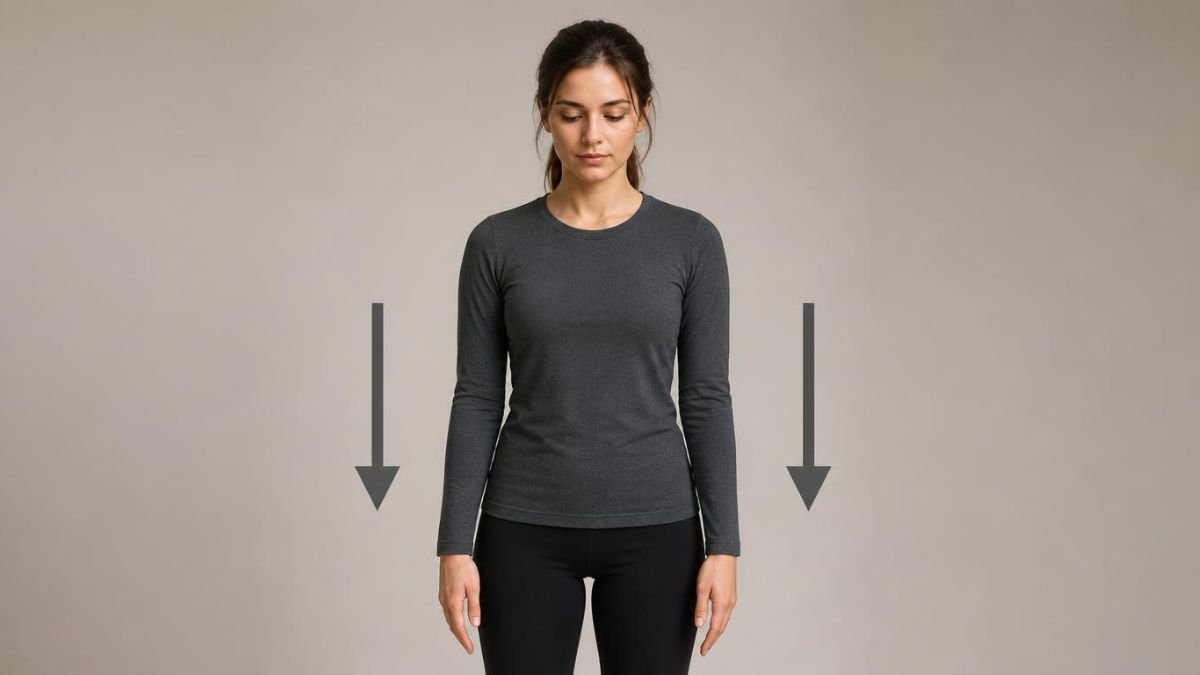
Does giving up start in your mind, or does your body get there first?
Russian has an answer, and it's not the one most of us would give.
Опустить руки. Opustit' ruki. To lower the arms.
That's what Russian says when someone gives up. Not that they lost hope, not that they stopped believing. Their arms came down. The tools slipped. The fight went out of the shoulders before it went out of the head.
And once you notice it, you'll notice it's the truer sequence. Watch someone receive bad news. The body reports first, every time. The hands open. The shoulders drop. Whatever they were holding gets set down or simply released. The mind arrives at the conclusion several seconds later and takes credit for a decision the body already made.
The expression lives inside a family of gestures. Its direct opposite is засучить рукава, zasuchit' rukava, to roll up your sleeves, which is also about arms, also about what the limbs do before the will announces itself. And the single most common piece of encouragement you'll hear in Russian is не опускай руки, don't lower your arms. Not don't give up in the abstract. Keep them up. Hold the position.
But the detail that stops me is grammatical, and it's the reason I wanted to talk about this phrase at all.
There is a second form: руки опускаются. Ruki opuskayutsya. The arms are lowering themselves.
It's reflexive. There's no one performing the action. The arms are not being lowered by you, they are simply going down, the way rain falls. Russian has a whole architecture for this, a grammar of things that happen inside a person without that person authorizing them. And it uses that architecture for despair.
Which means the language quietly acknowledges something most self-help vocabulary will not. Sometimes you did not decide to give up. It arrived. You woke up and the arms were already down.
Now, the research, because this is where it gets remarkable.
In 1967, Martin Seligman and Steven Maier ran the experiments that produced the term learned helplessness. Animals exposed to unavoidable shocks stopped trying to escape, and continued not trying even when escape became available. The finding entered the culture permanently. People learn to be helpless. It shows up in every discussion of depression, poverty, abuse, and burnout since.
Then, roughly fifty years later, the same two researchers published a correction.
The neuroscience had caught up, and it said the original interpretation had the mechanism backward. Passivity in the face of prolonged adversity is not learned at all. It is the default, the unlearned baseline response, produced by activity in a brainstem structure called the dorsal raphe nucleus. It requires no education whatsoever.
What the animals actually learn, when circumstances permit, is control. A region of the prefrontal cortex detects that an action produces an effect, and then inhibits the default. That's the learned part. Not the collapse. The holding up.
Consider what that means for the phrase. Lowering your arms is not a skill you acquired. It's what happens in the absence of an active, effortful, learned signal telling the arms to stay up. Which is exactly what the Russian reflexive was saying all along. Руки опускаются. Nobody lowered them. The thing holding them up stopped.
And that changes what the encouragement means. Не опускай руки is not asking you for optimism. It's asking for the harder, learned, physical thing.
It also explains why willpower is such a poor tool here, and why the standard advice fails people. You cannot argue yourself out of a brainstem default. What builds the inhibiting signal is evidence of control, and evidence means an action that visibly produced an effect. Small is fine. Small is actually the point. One made bed, one answered message, one walk to the corner. Not because those things solve anything, but because the part of your brain that keeps your arms up needs proof that your actions still land somewhere, and it will accept very modest proof.
Which is a strangely hopeful thing to find at the bottom of a phrase about defeat.
Before we get to the argument, one more thing about the words themselves.
Russian has an ordinary verb for surrender, сдаться, sdat'sya, and it belongs to war. Surrender implies an opponent, a moment, terms, someone standing opposite you to receive your weapon. There's a ceremony in it, and an audience, and a clear before and after.
Опустить руки has none of that. No opponent. No ceremony. Nobody arrives to accept anything. The arms simply come down in an empty room, and the day continues exactly as it was, and no one is notified.
That's the more common shape of defeat, and I think Russian knows it. Most people who give up do not surrender to anything. They just stop holding the thing up, on an unremarkable Tuesday, and the world registers no event at all.
And the reflexive form offers something else, something almost merciful. It lets you say руки опускаются without confessing a character flaw. The arms are lowering. Not: I am weak. Not: I have failed. Just a description of what is happening in the body, stated plainly, the way you'd report weather.
There's a real generosity in a language that gives you a way to name despair without requiring you to plead guilty to it first.
Now the honest complication, because this phrase can be weaponized and often is.
There are fights that deserve to be dropped. There are jobs, projects, arguments, and relationships where lowering your arms is the single most intelligent act available, and continuing to hold them up is not courage but inertia wearing a costume. Не опускай руки has been said to a great many people who should have put the thing down years ago, and it has kept them holding a weight that was never theirs.
So I'd draw the line here. There's a difference between setting something down and letting it fall.
Setting it down is a decision, made with your eyes open, with a reason you could explain out loud. Letting it fall is the default arriving unopposed while you narrate it afterward as a choice. Both end with your arms at your sides. Only one of them is yours.
So here's what I'll leave you with. Somewhere in your life, your arms are currently down.
Did you put them down, or did they simply lower while you were looking elsewhere? And if you cannot tell the difference from the inside, what would you have to do this week to find out?







0 Comments