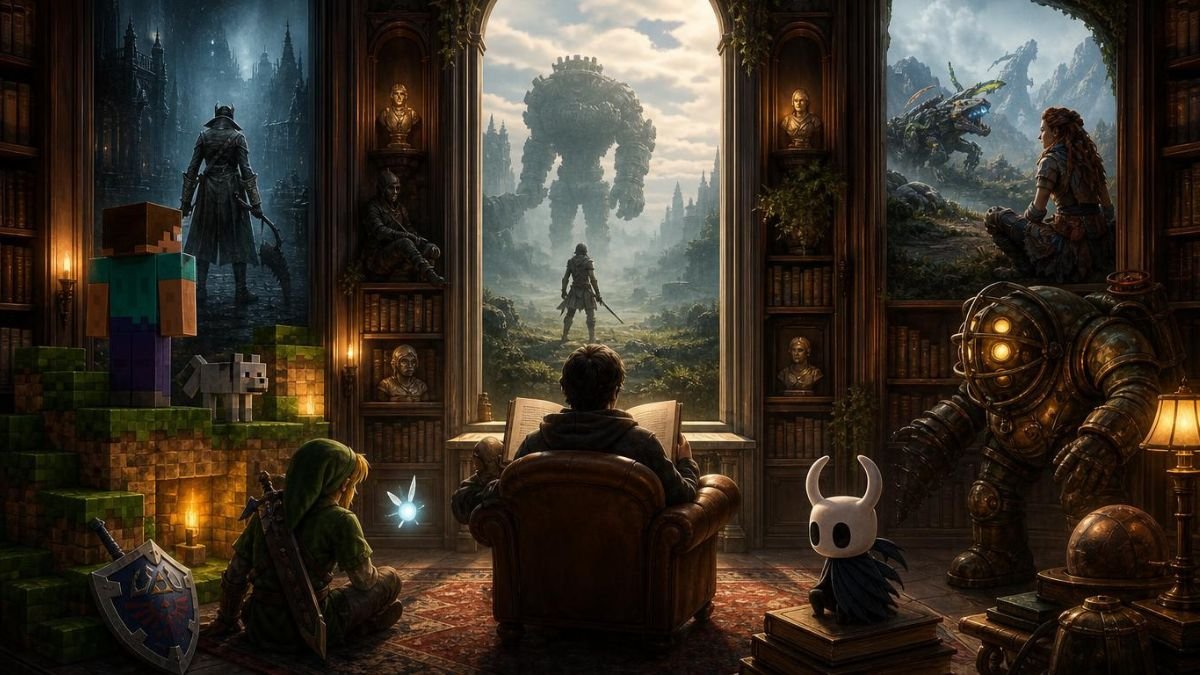
- The question people keep asking, and the better one underneath it
- Build it with me: the vocabulary of stories
- The verb is the theme
- Build it with me: causative verbs, or the grammar of agency
- When the story and the game disagree
- Build it with me: contrast, concession, and unpacking jargon
- The case against, honestly
- Build it with me: arguing without flattening the other side
- What this means if you're learning English right now
- Build it with me: second person, present tense
- Your Build
- Where this leaves us
Let me ask you something, and I'd like a real answer rather than a polite one.
What's the last story that made you feel guilty?
Not sad. Sadness is easy and every medium can produce it. I mean guilty. That specific, uncomfortable, slightly hot feeling that you have done something and would rather not discuss it.
Take a moment with that, because for a lot of people nothing comes to mind at all, and for a lot of other people the thing that comes to mind is a video game, and both of those facts are interesting.
Here's why. Guilt requires an action. You cannot feel guilty about something you merely witnessed. Sympathy, horror, grief, all available from a page. But guilt needs a verb with your name attached to it, and for most of the history of storytelling, the audience has had no verbs. You read. You watch. You are, structurally, an observer, and every effect the work produces has to travel to you through that one narrow channel.
Then a medium arrives where the audience acts, and something changes that we still don't have very good vocabulary for.
That's today. Video games as modern literature. Not the shouting match version of the question, which nobody has ever won, but the interesting version underneath it. And as always, we're going to build the English while we go, because it turns out this topic has a grammar, and the grammar is going to sneak up on you.
The question people keep asking, and the better one underneath it
"Are video games literature?" is a bad question, and I want to explain why before we replace it.
It's bad because it's really a question about status. Whoever asks it is usually either trying to promote games into a respectable category or keep them out of one, and the answer will be decided by the definition you picked before you started. Define literature as printed prose fiction and you're done in one sentence. Define it as the serious artistic use of language and you've conceded the point before the argument begins.
We've had this exact fight before, several times, and it always looks the same from a distance.
In the eighteenth century, the novel was a suspect form. There was genuine, published, widely shared concern that reading fiction, particularly by young women, produced overheated imaginations and a distaste for actual life. The novel was escapist, sensational, commercially motivated, and beneath the attention of serious minds.
Early cinema was a fairground attraction, mechanical and vulgar, a thing you paid a nickel for.
And in 1954 the psychiatrist Fredric Wertham published a book arguing that comic books were manufacturing juvenile delinquents. A United States Senate subcommittee held hearings. An entire industry restructured itself around the panic.
Every one of those forms is now taught in universities. The pattern is so consistent that when you see a new medium being denied the status of art, the safest prediction is that it will have it within forty years and everyone will forget the argument ever happened.
But I don't want to lean on that too heavily, because it's a cheap move. "They laughed at Galileo" proves nothing about you. The fact that a category has expanded before doesn't mean it should expand again. So let's get to the real question.
Here it is: what happens to a story when you can move inside it?
In 1997, a Norwegian scholar named Espen Aarseth published a book that needed a new word for this, and the word he built was ergodic. It comes from two Greek roots, ergon, meaning work, and hodos, meaning path. Ergodic literature is literature where traversing the text requires nontrivial effort. Where getting from one end to the other is itself something you do, and where a different reader, doing different work, gets a different text.
I'll be honest with you about the word. Half the time I think it's exactly right and the other half I think it's the kind of term that exists to make a simple observation sound expensive. I've never fully settled it. But the underlying idea holds: with a novel, the work of reading is the same for everyone. With a game, the work is the medium.
Build it with me: the vocabulary of stories
First build, and it's foundational because these words are everywhere in this conversation and they misbehave.
Flat draft:
"Video games are a new kind of literature."
Not wrong. But there's a grammatical error waiting for anyone who pushes on it, and a conceptual one too.
Literature is uncountable. There are no literatures. It also has two distinct senses that C1 learners often collapse. The first is creative writing of enduring value. The second is entirely different: the body of published work on a subject. The literature on sleep is inconsistent. That second sense takes the, always. If you're a researcher, you do a literature review, and that's the only place a determiner shows up comfortably.
Fiction is uncountable too. Not a fiction, except in one lovely idiomatic sense meaning a convenient falsehood everyone agrees to maintain. The fiction that anyone reads the terms and conditions. Worth having, but know that you're doing it.
Media is the plural of medium. So it's a medium, and two media. When people say a media, that's an error, though it's now common enough that it may win eventually. And the media meaning the press is a separate, collective usage that's fine.
Now three words people use as though they're identical:
Story is what happened.
Plot is how it's arranged.
Narrative is the act of telling.
E. M. Forster made the classic version of this distinction in 1927, and the illustration is worth stealing. Say that the king died and then the queen died, and you have a story: one thing, then another thing. Say that the king died and then the queen died of grief, and you have a plot, because now there's causation holding the two events together. That word of grief is the whole difference.
And a spelling one, because it's embarrassing and easy.
Canon, one N, is the body of works treated as central to a tradition.
Cannon, two Ns, fires at things.
Writing about the literary cannon suggests a very different kind of criticism than you intended.
Now let's rebuild:
"The question isn't whether games belong in the canon. It's what a story becomes when the audience has verbs."
I like that one. Verbs is doing a lot of work and I'm slightly worried it's too clever, in the way that a phrase can be so pleased with itself that it stops communicating. Say it aloud. Does it land, or does it just glitter?
Prepositions, quickly, because these three come up constantly here:
A novel by Tolstoy.
A book about grief.
A film based on a novel, never based of or based in.
An adaptation of something.
The verb is the theme
Now the central idea of the episode, and the one I'd most like you to carry out.
Ian Bogost, a game designer and philosopher, published a book in 2007 arguing that games make arguments through processes. Not through their dialogue or their cutscenes, but through their rules. He called it procedural rhetoric: persuasion by system.
Here's what that means in practice.
There's a game from 2013 called Papers, Please. You are an immigration officer at a border checkpoint in a fictional Eastern Bloc country. Your job is to check documents. Passports, work permits, expiration dates, the correct seal in the correct corner. You are paid per person processed. Your family needs heat and medicine.
The game contains almost no speeches about authoritarianism. It doesn't need any. It gives you a quota and a stack of paperwork and a queue of people with sad, specific stories, and then it lets you find out, personally, at what point you start waving people through because you're tired, and at what point you start turning away people with legitimate claims because a mistake costs you money and your son is sick.
You do not learn that bureaucratic complicity is easy. You perform it. And then you sit there afterward with the entirely accurate feeling that you have discovered something about yourself that you were not looking for.
That's what no essay can do. An essay can tell you the threshold exists. Only a system can show you where yours is.
Or take Shadow of the Colossus, from 2005. You are killing sixteen enormous creatures to save someone you love. That's the whole game. And the design does something quietly devastating: the colossi are slow, mostly peaceful, and beautiful, and killing them takes an exhausting amount of climbing and effort, and when each one falls the music turns mournful rather than triumphant. You win, repeatedly, and every victory feels worse than the last. The game never once tells you that what you're doing is wrong. It just makes the doing feel like grief.
The verb is the theme. Hold onto that phrase. It's the most useful thing I know about this medium.
Build it with me: causative verbs, or the grammar of agency
Here's the surprise I mentioned. This topic has a grammar, and it's causatives: the structures English uses to talk about one thing making another thing happen. Which is, when you look at it, precisely what a game does to a player.
Flat draft:
"The game makes you to feel guilty."
There's the error, and it's one of the most persistent in advanced English. Make takes a bare infinitive. No to.
"The game makes you feel guilty." ✓
Now here's the family, and the traps are in the pattern:
Make + object + bare infinitive. It makes you hesitate.
Have + object + bare infinitive. It had me questioning everything.
Let + object + bare infinitive. It lets you refuse.
Get + object + to + infinitive. It got me to reconsider.
Force / compel / allow / permit + object + to + infinitive. It allows you to walk away.
So make and let refuse the to, and get insists on it, which is the trap, because make and get feel like close cousins and behave in opposite ways.
And now the detail that separates C1 from C2, and it's genuinely elegant. Put make in the passive and the to comes back:
"I was made to feel complicit."
Active: made me feel. Passive: was made to feel. Nobody teaches this and everybody gets it wrong. Say both aloud, back to back, twice.
Now let's build upward from the flat version:
"The game makes you feel guilty." (Fine. Generic. Could describe anything.)
"The game doesn't describe complicity. It hands you the stamp." (Better. Concrete, and the mechanism is visible.)
"Papers, Please has no argument about bureaucracy. It has a quota, and it lets you discover your own threshold." (This is the one I'd keep.)
Pause here and build your own. Take any game, film, or book that changed how you saw something, and write one sentence using a causative that names the specific mechanism. Not it made me think, which is what everyone says and means nothing. Name what it had you do.
Take your time. This one is worth thirty seconds of silence.
False synonyms, since we're in this territory and the distinctions matter:
Guilty: you did something wrong.
Responsible: the outcome traces back to you, wrongdoing or not.
Complicit: you participated in someone else's wrongdoing, often by not stopping it. This is the word Papers, Please is built around, and it's the one most learners lack.
Culpable: formal, legal, deserving of blame.
Complicit is worth adding to your active vocabulary this week. It's precise, it's current, and it names something the other three don't.
When the story and the game disagree
Now for a concept with a slightly forbidding name and a very simple idea underneath.
In 2007, a designer named Clint Hocking wrote a blog post about BioShock, and in it he coined the term ludonarrative dissonance. Ludo from the Latin for play, narrative meaning the told story, dissonance borrowed from music, where it means notes that clash.
Which is a technical way of saying: the gameplay and the story are telling you different things, and you can hear the clash.
It happens constantly, usually by accident. A game gives you a protagonist described as a reluctant, decent person, and then has you kill four hundred people over the course of an afternoon, and the two facts sit there refusing to reconcile. Once you can name that, you notice it everywhere, including in films where a character's stated values and demonstrated behavior have never been introduced to one another.
But the interesting cases are the deliberate ones. BioShock itself has a moment, and I'll be careful here because it's nearly twenty years old and still worth meeting cold, where the game reveals that the thing you have been doing without question all along, following instructions, is the theme. A three-word phrase you've been hearing politely throughout turns out to have been a mechanism. And the game's argument about free will lands with a force that no dialogue could produce, because the evidence it presents is your own play history.
Spec Ops: The Line, from 2012, does something similar and harsher, retelling Heart of Darkness in a modern military setting and gradually making clear that the player's appetite for the mission is part of what it's examining. Not everyone thinks it succeeds. I go back and forth. But it's trying something a novel structurally cannot try, which is to use the audience's own enthusiasm as evidence.
Build it with me: contrast, concession, and unpacking jargon
Flat draft:
"The story says one thing but the gameplay says another thing."
Serviceable. Repetitive. Says twice, thing twice. Let's find the range.
Concession and contrast connectors, roughly from plain to elevated:
But: universal, invisible, never wrong.
Yet: slightly more literary, implies surprise. Quiet, yet insistent.
Whereas: for direct, balanced opposition. Formal. The story asks for sympathy, whereas the mechanics reward efficiency.
While: same job, softer, and beware: it also means during, so context has to disambiguate.
Even as: for simultaneity plus contradiction. It condemns the violence even as it stages it beautifully. This one is excellent and underused.
For all its: concedes a virtue before an objection. For all its ambition, the ending doesn't land.
Notwithstanding: formal, and I'd use it about once a year.
My build:
"The story asks you to feel one thing even as the mechanics reward the opposite. There's a name for that gap, which tells you how often it happens."
Error repair, and these three are stubborn:
Contradict is transitive. The mechanics contradict the story. Never contradict with.
Conflict takes with. The mechanics conflict with the story. So one takes a preposition and the other refuses it, and they mean nearly the same thing. English does this to be difficult.
Differ from, not differ than. Differ with exists but means to disagree with a person.
And a rhetorical skill worth naming, because you'll need it constantly in professional English: unpacking a technical term without condescending. The move is a short apposition, then plain restatement. Ludonarrative dissonance, which is a technical way of saying the gameplay and the story are contradicting each other. Notice the structure: name the term, then a relative clause beginning which is, then the plain version. It respects the listener and saves them, and it's one of the most useful sentence shapes in the language.
The case against, honestly
I want to give the other side a real hearing, because the version of it that circulates online is a straw man and I don't want us beating one.
In April 2010, the film critic Roger Ebert published a piece arguing that video games can never be art. He was mocked relentlessly for it, and he later admitted he shouldn't have made a declaration about a medium he hadn't spent time inside. But his actual argument was better than the mockery suggested, and it hasn't gone away.
The strongest version runs like this. Art depends on authorial control. A novelist chooses every word, every ordering, every withheld piece of information, and the meaning of the work lives in those choices. The moment you hand the audience meaningful agency, you dilute that control. If the reader can decide how the sentence ends, the sentence is no longer a made thing. Games are not failed literature; they're a different category, closer to sport or play, where the pleasure comes from participation rather than from the reception of something crafted.
There's a second objection, and I find it harder to dismiss. Most games are not doing any of this. The medium is enormous, industrially produced, and overwhelmingly built around retention and monetization. Selecting Disco Elysium to represent games is a bit like selecting Proust to represent print. True, but not a description of the field.
Here's my honest position. I think the first objection is answerable, because constrained agency is still design. A well-built game controls the space of possible experiences precisely, the way a sonnet controls a poem. But I don't think it's been fully answered, and I notice I want it to be false, which is exactly the condition under which I should be most careful.
The second objection I think is simply true and doesn't damage the case, because the same is true of every medium that has ever existed.
Build it with me: arguing without flattening the other side
Flat draft:
"Some people say games aren't art, but they're wrong."
Two failures here. It's vague about who some people are, and it's a straw man, which costs you credibility with exactly the audience you were trying to persuade.
The upgrade is steelmanning: stating the opposing case in its strongest form before answering it. Here are the structures:
Granted, X. Still, Y. Crisp, slightly formal, very effective in speech.
It's true that X. And yet Y. The strongest version of the objection is X. Excellent opener. Signals fairness immediately.
I want to give this its due. X, and I don't think that's been fully answered. Use when you're conceding rather than refuting, which is more often than most people admit.
My build:
"The strongest version of Ebert's objection is that authorship and agency are in tension, and handing choices to the audience costs you control over meaning. I think that's answerable. I don't think it's been answered, and I notice I want it to be false."
Error repair, three high-frequency ones:
Argue that introduces a claim. He argued that games can't be art.
Argue about or over takes a topic.
Argue with takes a person. Mixing these produces sentences that read as slightly unhinged.
Criticism, critique, and critic.
A critic is a person.
Criticism is either negative judgment or the whole scholarly discipline, as in literary criticism, and context alone tells you which.
Critique is a detailed formal analysis, noun or verb, and it carries no automatic negativity. Saying I have a critique of your argument is far more collegial than I have criticism.
Skeptic, with a K, in American English. Sceptic is British.
What this means if you're learning English right now
Let me bring this somewhere practical, because there's an application here that isn't obvious.
Disco Elysium, released in 2019, contains roughly a million words of dialogue. That's several long novels. You play a detective whose various mental faculties are separate characters who argue with you in your own head, and the prose is genuinely excellent: literate, funny, politically serious, willing to be strange.
For an advanced learner, that's an unusual resource. It's a million words of rich English that you encounter at your own pace, that you have a reason to understand, and that you can reread without embarrassment because rereading is built into the form. Games are among the few environments where you'll voluntarily process large volumes of demanding text because you want to know what happens next, which is the condition under which language actually sticks.
I'd add a caution. Games teach you registers unevenly. You can emerge with an excellent vocabulary for combat, betrayal, and cosmic dread, and no idea how to open a bank account. Balance accordingly.
Build it with me: second person, present tense
One last build, and it's a register games made ordinary.
Notice how games narrate. You wake up. You are holding a stamp. You have a quota. Second person, present tense, and it's so natural in a game that you stop hearing it.
In prose it's rare and slightly risky. Italo Calvino built a whole novel around addressing the reader directly. Jay McInerney wrote Bright Lights, Big City entirely in second person, and part of its effect is that the you feels like a man refusing to say I about his own life.
Try this. Take a memory of yours, something ordinary, and write it twice.
First: past tense, first person. I walked into the room and realized I'd forgotten his name.
Then: present tense, second person. You walk into the room. You realize you've forgotten his name.
Pause and actually do it before I say the next part.
Here's what I notice when I do this, and I'd like to know whether you notice the same. The past tense version is a report. Something concluded and survivable. The second-person present version puts you back inside it with no exit and no hindsight, which is uncomfortable, and which is exactly why games use it.
Error repair, narrative tenses:
Used to works for past habits and past states. I used to be scared of the dark.
Would works for repeated past actions only, not states. Every summer we would drive to the coast ✓. I would be scared of the dark ✗ in that habitual sense.
And use the past perfect to reach behind your narrative present. I walked in and realized I had forgotten his name. The had is what marks the earlier layer.
Your Build
Three prompts, and one difficult optional fourth.
One. Take any story in any medium that changed something in you, and describe the mechanism in one sentence using a causative verb. Not it made me think. Name the specific thing it had you do, or watch, or decide. Check that make and let have no to and that get does.
Two. Steelman the case against your own position on something you care about. Open with The strongest version of the objection is, state it as generously as you can manage, and then respond using either Granted, X. Still, Y or the harder move: and I don't think that's been fully answered.
Three. Write one paragraph of a memory in second-person present tense, then rewrite it in first-person past. Then answer honestly: which one is truer, and which one is more comfortable, and are those the same answer?
And the hard one, if you want it. Make the case that some medium you personally dislike is doing serious artistic work. Reality television, advertising, sports commentary, whatever you'd normally dismiss. The rule is that you can't be sarcastic and you can't hedge your way out. I find this exercise genuinely difficult and I fail it more often than I'd like, usually by getting to the end and discovering I've written a very polite insult.
Where this leaves us
I don't know whether literature is the right word, and I've been going back and forth on it for the entire time I've been putting this together.
Part of me thinks it's the wrong frame entirely, that reaching for the older, more respectable category is a small act of insecurity, and that a medium capable of making an argument out of your own behavior doesn't need to be adopted by the novel to be taken seriously. Another part of me thinks the word is exactly right, that literature has always meant the serious artistic use of language wherever it turns up, and that guarding the border more tightly than the medium requires has never once made anyone smarter.
What I'm confident about is the thing underneath the argument. Something new happened when the audience got verbs. Not better, necessarily, and not a replacement for anything. Different, and not yet fully described.
And here's what I'd leave you with. The next time a story moves you, in any medium, try to name the mechanism rather than the feeling. Not it was powerful, which tells us nothing, but what specifically it did to produce that. What it withheld. What it asked of you. What it had you do.
That question will make you a sharper reader of everything. It will also, I suspect, make you slightly harder to manipulate, which in the present moment is not a small thing to walk away with.






0 Comments