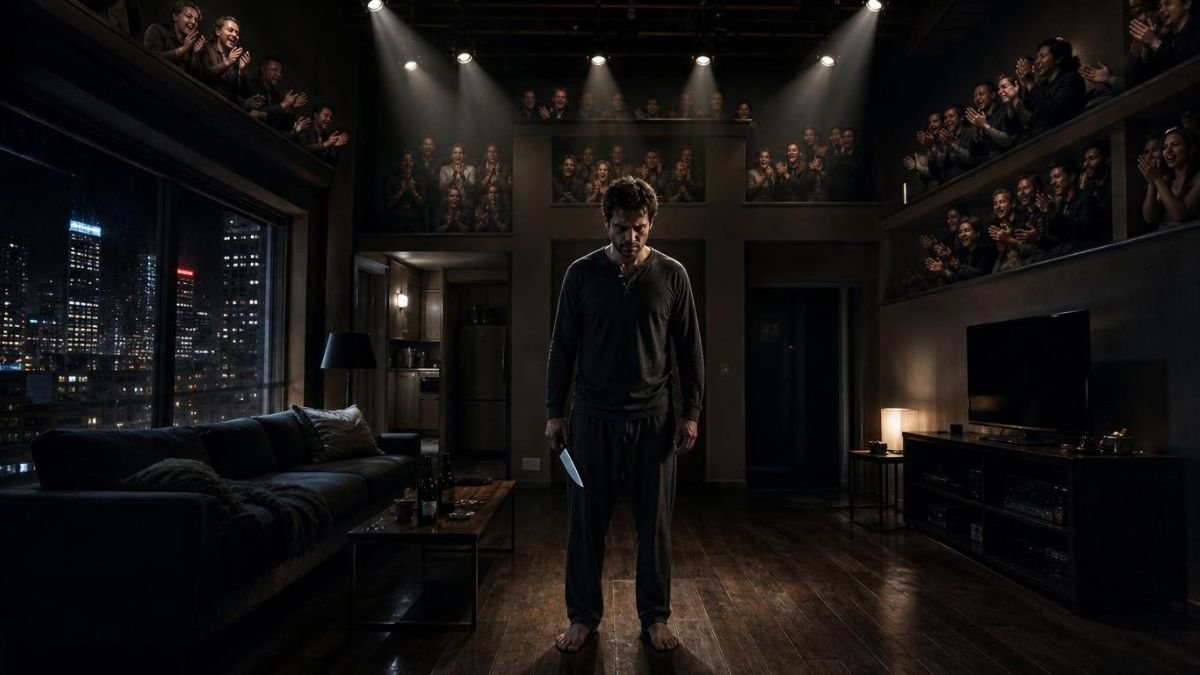
Declan Voss hasn’t laughed in months. Not since the divorce, the restraining order, the bare apartment that echoes with everything he’s lost. But something in his apartment has found its sense of humor. It starts small—a faint ripple of studio laughter when his thoughts drift to dark places. Then it grows louder, more enthusiastic, as if an invisible audience is cheering him toward the worst version of himself. The laugh track knows what he’s thinking. It knows what he wants to do. And the standing ovation? That only comes when he’s ready to act on it. What happens when the audience demands an encore?
The Laugh Track
The first time Declan Voss heard the laughter, he was holding a kitchen knife and thinking about his ex-wife’s throat.
Not seriously. Not really. The thought had arrived the way such thoughts always did—unbidden, electric, a spark jumping across the frayed wiring of his exhausted mind. He’d been slicing a bell pepper, the blade catching the fluorescent light, and somewhere between the second and third cut, the image had simply materialized: Sloane’s neck, pale and exposed, the way she tilted her head when she was annoyed with him. The knife pressing in.
He’d shaken it off. He always shook them off. His therapist, Dr. Ostrander, had a name for them—intrusive thoughts. Ego-dystonic ideation. Mental hiccups. Everyone has them, Declan, she’d said in that measured, tea-sipping voice of hers. The fact that they disturb you is evidence that you’re not a danger to anyone.
But then came the laughter.
A bright, warm burst of it—the kind you’d hear on a television sitcom. Perfectly timed. Perfectly pitched. A studio audience of maybe two hundred people, all reacting to the same invisible punchline.
Declan froze. The pepper rolled off the cutting board and onto the floor. The laughter faded like a wave retreating from shore, leaving a silence that felt heavier than the one before it.
He stood there for a full thirty seconds, knife still raised, listening. The apartment offered nothing back. Just the hum of the refrigerator and the muffled bass of his downstairs neighbor’s music.
He checked his phone. Nothing playing. He checked the television—off. The laptop on the coffee table—closed. Even the smart speaker on the kitchen counter sat dormant, its ring light dark.
“Jesus,” he muttered, and went back to the pepper.
* * *
The apartment was a one-bedroom in Bridgewater Heights, a complex that marketed itself as “urban living reimagined” but was really just overpriced drywall with stainless steel appliances. Declan had moved in four months ago, after the judge signed the final decree and Sloane got the house in Maple Ridge. The house they’d painted together. The garden she’d planted while he drank on the porch and pretended he was fine.
He wasn’t fine. He hadn’t been fine for a long time. The drinking had stopped—one thing he could claim victory over—but the thoughts hadn’t. They came at odd hours, riding in on waves of anger or grief or the particular brand of self-loathing that hit hardest at 2 AM. Thoughts about Sloane. About her lawyer. About the barista who’d given him the wrong order three days in a row, as if the universe itself were testing his patience.
Violent thoughts. Ugly ones. The kind you bury so deep they become part of your geology.
Dr. Ostrander said they were normal. She said a lot of things were normal.
The laughter didn’t feel normal.
* * *
It happened again the next evening.
Declan was washing dishes—one plate, one fork, one glass, the bachelor’s trifecta—when a car alarm went off in the parking lot below. The sound drilled into his skull like a corkscrew, and the thought arrived fully formed: walking down there, finding the car, putting a brick through the windshield. Watching the glass cascade inward like a crystalline waterfall. Then finding the owner. Making them understand what their noise had done to him.
The laughter erupted.
Louder this time. Fuller. He could almost parse individual voices within it—a woman’s high-pitched giggle, a man’s deep belly laugh, the scattered applause of people genuinely delighted. It lasted three seconds, maybe four, then cut off with the precision of an audio engineer hitting a fader.
Declan spun around, water dripping from his hands onto the floor. The apartment stared back at him, indifferent. The same beige walls. The same IKEA furniture. The same dying pothos plant on the windowsill that he kept forgetting to water, much like he’d kept forgetting to water his marriage.
He went to the front door and opened it. The hallway was empty. He pressed his ear against the wall shared with his neighbor’s unit. Nothing but the ghost of bass vibrations.
Back inside, he stood in the center of the living room and said, very clearly: “If someone is doing this, it’s not funny.”
The apartment said nothing.
He thought about the brick through the windshield again. Nothing happened. The thought had cooled, lost its charge. He waited, almost willing the laughter to return, but it didn’t. Whatever trigger he’d pulled had already been released.
* * *
Over the next three days, Declan conducted experiments. He didn’t call them that—calling them experiments would mean admitting something was happening that required investigation—but that’s what they were.
He sat on the couch and thought about pleasant things. His childhood dog, a golden retriever named Biscuit. Summer afternoons at his grandmother’s lake house. The feeling of clean sheets after a long day.
Silence. Nothing but the refrigerator and the distant traffic.
Then he let his mind drift. He thought about his boss, Merritt, who’d passed him over for promotion twice in eighteen months. He imagined Merritt’s smug face, the way he laughed at his own jokes in meetings. He imagined grabbing Merritt by his expensive tie and slamming his head into the conference table. Once. Twice. Until the polished mahogany was slick with—
The laughter roared.
It was the biggest burst yet, a full-throated explosion of delight. He could feel it in his chest, vibrating through the floorboards, bouncing off the walls. Someone in the invisible audience whistled. Someone else clapped rhythmically, the way you clap when you want a performer to keep going.
Declan’s heart hammered. He killed the thought immediately, shoved it into the dark drawer where such things lived, and the laughter died with it.
He was shaking. Not from fear—from something worse. From the dawning recognition of a pattern.
Pleasant thoughts: silence.
Violent thoughts: applause.
And the more vivid the violence, the louder the applause.
* * *
He told Dr. Ostrander about it at his Thursday session, sitting in the leather chair that always made him feel like a fraud. She listened with her usual careful expression, fingers steepled, nodding at intervals that seemed calculated to encourage continuation.
“How would you describe the sound?” she asked.
“Like a laugh track. Exactly like a laugh track from a TV show. Studio audience, multiple people, perfectly timed.”
“And it only occurs when you’re experiencing intrusive thoughts?”
“Only when they’re violent ones. Specifically violent. Not sad thoughts, not anxious thoughts. Just the…” He searched for the word. “The ugly ones.”
She wrote something in her notebook. “Auditory phenomena can accompany periods of extreme stress. You’ve been through a significant life transition. The divorce, the move, the isolation. Sleep deprivation alone can produce—”
“I’m sleeping fine.”
“You told me last week you wake up at 3 AM most nights.”
“I said I wake up sometimes. That’s different.”
She studied him the way she always did—not unkindly, but with the detachment of someone observing an organism under glass. “Declan, I want to ask you something, and I need you to be honest. Are the intrusive thoughts increasing in frequency?”
He looked at the ceiling. “No.”
That was the first lie.
* * *
They were increasing. Not just in frequency but in specificity. Where the thoughts had once been vague—a flash of violence, a momentary impulse—they were now arriving with narrative structure. Beginnings, middles, ends. He’d think about a confrontation with the rude woman at the grocery store and his mind would unspool the entire scene: the approach, the words exchanged, the escalation, the moment his hands found her collar, the sound she’d make.
And every scene got its laugh track.
The laughter had evolved too. It was no longer a single burst but a layered response system, as sophisticated as anything on network television. Small violences—a shove, a slap—earned light chuckles, the polite amusement of an audience watching a setup. Medium violences—a punch, a chokehold—drew solid laughs, appreciative and warm. And the big ones—the ones he tried hardest not to think about, the ones involving blades and darkness and the wet, yielding geography of human anatomy—those got the full treatment. Uproarious laughter. Applause. Cheers. The kind of response sitcom writers would sell their souls to achieve.
He started to notice something else, something that made his blood run cold.
The silence between the laughter was getting harder to bear.
The quiet stretches of his apartment—the minutes and hours where he thought about nothing in particular or focused on mundane tasks—had begun to feel oppressive. Empty. Like a stage between scenes, waiting for the performer to deliver. And somewhere deep in the caverns of his psyche, a terrible instinct was forming: the silence was a prompt. A cue. The audience was waiting, and he was the only act.
* * *
Friday night. The apartment was dark except for the television, which cast its blue light across the room like a wound. Declan sat on the floor with his back against the couch, a glass of water in his hand because he didn’t trust himself with anything stronger.
He was thinking about Sloane.
Not violently. Not yet. He was thinking about the way she’d looked at him during the last court hearing, her eyes holding something worse than anger. Pity. She’d pitied him. The man who’d thrown a chair through their bedroom window during an argument about takeout. The man who’d punched the bathroom mirror so hard he’d needed eleven stitches. The man who’d never hit her—never, not once—but who’d hit everything around her until the distinction felt like semantics.
The thought crept in like a tide.
What if he went to the house? What if he parked down the street, waited for the lights to go off, used the spare key hidden under the third flagstone in the garden path—the one she didn’t know he knew about? What if he went inside and—
The laughter exploded.
Not from a distant point in the apartment. Not from the walls or the ceiling or the floor. From everywhere. From inside his skull. It was deafening, joyous, ecstatic—a standing ovation of two hundred invisible people losing themselves in absolute delight. He could feel their approval like heat on his skin, like sunlight after a long winter, and for one horrifying moment, he leaned into it.
The thought expanded. He saw himself in the house. In the bedroom. Sloane asleep, her hair fanned across the pillow. His hands reaching—
The audience went wild. Someone screamed with laughter. Someone stomped their feet.
Declan hurled the glass of water against the wall. It shattered, and the laughter stopped instantly, replaced by a ringing silence that felt like punishment.
He was on his feet, chest heaving, water dripping down the beige paint. His hands were shaking. His whole body was shaking. He looked at his reflection in the dark television screen—a hunched figure in a dim room—and saw what the audience saw.
A man on the verge.
Entertainment.
* * *
He didn’t sleep that night. He sat in the kitchen with every light on, staring at the wall, breathing in controlled intervals the way Dr. Ostrander had taught him. Four counts in. Seven counts hold. Eight counts out. But the breathing exercises were designed for anxiety, for panic attacks, for normal human distress. They weren’t designed for this.
At 4 AM, he called the only person who still answered his calls: his brother, Foster.
“Dec?” Foster’s voice was thick with sleep. “It’s four in the—”
“I need you to listen to me. Something is happening in my apartment. I’m hearing things. Laughter. Like a TV laugh track.”
A pause. “Are you drinking again?”
“No. I’m not drinking. I’m not drunk. I’m not—” He pressed his palm against his forehead. “It only happens when I think certain things. Bad things. Like it’s rewarding me for—”
“Declan.” Foster’s voice had shifted into the careful register he used when he thought Declan was spiraling. “Have you called Dr. Ostrander?”
“She thinks it’s stress. She thinks I’m—”
“Maybe she’s right.”
“She’s not right. Something is in this apartment. Something is listening to my thoughts and it—it likes the violent ones, Foster. It wants them. It’s trying to get me to—”
“Declan, listen to me.” Foster’s voice was firm now, brotherly in a way that made Declan’s chest ache. “You’re going through hell. The divorce, the anger stuff, being alone—it’s a lot. But this sounds like something a doctor needs to hear, not me. Can you promise me you’ll go in tomorrow? Actually go in, not just call?”
Declan closed his eyes. “Yeah.”
“Promise me.”
“I promise.”
He hung up and sat in the bright kitchen, listening to the hum of the refrigerator. The silence pressed against him like a held breath.
Then, very faintly, from somewhere that wasn’t quite inside the apartment and wasn’t quite inside his head, he heard it.
A single person clapping. Slow. Rhythmic. Patient.
As if to say: Go on. We’re waiting.
* * *
He didn’t go to Dr. Ostrander. Instead, he went to the hardware store.
The logic was simple, almost childishly so: if the sound was real—physically real, coming from speakers hidden in the walls or some prank device planted by a previous tenant—then he could find it. Eliminate it. Take back control.
He bought a stud finder, a drywall saw, and a flashlight powerful enough to illuminate the inside of the walls. Back at the apartment, he started with the living room. He ran the stud finder along every surface, marking the studs with a pencil, then cut careful rectangles between them and shined the flashlight into the dark cavities.
Nothing. Insulation. Wires. Dust.
He moved to the bedroom. The kitchen. The bathroom. He dismantled the ceiling fan. He pulled the covers off every electrical outlet. He even crawled into the small attic access panel above the hallway closet and swept the flashlight across the crawlspace, finding nothing but mouse droppings and fiberglass.
By evening, his apartment looked like it had been searched by police. Rectangles of missing drywall exposed the building’s skeleton. Outlet covers lay scattered like fallen teeth. And Declan sat in the middle of it all, saw in one hand, flashlight in the other, covered in white dust, and thought: This is what crazy looks like.
The thought arrived instantly, as if it had been waiting: And this is what crazy does.
He imagined the property manager, Lennox, seeing the damage. Imagined Lennox’s face. Imagined wrapping his hands around Lennox’s throat and squeezing until the man’s eyes bulged and his face went purple and—
The laughter was enormous. Thunderous. The biggest response yet. It shook the exposed studs and made the loose drywall rattle. The audience howled. They shrieked. They wept with laughter. And somewhere in the cacophony, Declan heard something new: a voice. Just one, rising above the rest, clear as a bell.
“More!”
He screamed. He actually screamed, a ragged, animal sound that tore his throat raw. The laughter stopped. The silence rushed back in, filling the gutted apartment like floodwater.
His phone buzzed. A text from the building manager: Multiple noise complaints. This is your second warning.
Declan looked at the drywall saw in his hand. At the teeth of it, fine and sharp and designed to cut through things that weren’t meant to be cut through.
He set it down. Very carefully. Very deliberately. And he didn’t pick it up again.
* * *
The next morning, he found the recording.
He’d forgotten about the security camera—a cheap one he’d mounted above the front door after moving in, more out of post-divorce paranoia than any real security concern. It recorded to a micro SD card, capturing twelve-hour loops that wrote over themselves every three days.
He pulled the card and plugged it into his laptop. Scrubbed through the footage from the previous night, fast-forwarding through hours of the empty hallway, until he reached the timestamp of 11:47 PM—the moment he’d heard the thunderous laughter during his demolition of the walls.
On the screen, he watched himself on camera from the hallway angle. The audio was thin, compressed, but clear enough.
At 11:47, he saw himself go rigid. Saw his mouth move as the violent thought formed. And then—
Nothing.
No laughter. No sound at all beyond the ambient hiss of the recording. On the footage, Declan reacted to something that wasn’t there. He watched himself flinch, cover his ears, scream at an empty room. The camera saw a man losing his mind in perfect silence.
He watched the footage three more times. Then a fourth. On the fifth viewing, he noticed something he’d missed.
At the exact moment the laughter had started—the laughter only he could hear—his eyes on the recording did something strange. They shifted. Not left or right, not up or down, but inward, as if focusing on something behind his own face. And for a single frame, less than a thirtieth of a second, his pupils dilated to the edges of his irises.
Like someone had turned on a light inside his skull.
* * *
He destroyed the laptop. Not on purpose—he threw it across the room in a moment of pure, white-hot terror, and it hit the edge of the kitchen counter and cracked in half. The violence of the act registered a beat later, and with it came the laughter, warm and congratulatory, like friends celebrating a toast.
Declan sank to the floor. He pressed his palms against his eyes and tried to think. The laughter was inside him. It had always been inside him. Not speakers in the walls, not a prank, not a hallucination produced by stress and sleeplessness. Something was living in his mind, and it was laughing at the worst parts of him.
No. Not laughing at them.
Laughing them on.
Encouraging them.
Feeding them applause the way you’d feed treats to a dog learning a new trick.
He thought of Dr. Ostrander’s explanation: Intrusive thoughts are normal. They don’t define you. But what if something had heard those thoughts and disagreed? What if something had decided that the intrusive thoughts were the real Declan—the one worth watching—and was doing everything in its power to coax that Declan onto the stage?
On the floor of his demolished apartment, surrounded by drywall dust and the broken halves of his laptop, Declan realized the truth.
The laugh track wasn’t punishing him. It wasn’t haunting him. It was training him.
And it was working.
* * *
He tried to leave. That was the logical thing—the sane thing. Pack a bag, drive to Foster’s house three hours north, sleep on the pull-out couch, and figure out the rest later. He made it as far as the parking lot.
The silence in the car was absolute. No engine hum could fill it. No radio station, no podcast, no music. The silence sat in the passenger seat like a presence, and Declan felt its weight—the anticipation of an audience that had bought their tickets and was waiting for the curtain to rise.
He drove two blocks. At the first red light, he watched a jogger cross the intersection—a young woman with earbuds in, ponytail swinging—and the thought came like a bullet: the car, the accelerator, the impact, the sound.
The laughter erupted, richer and more intimate than ever, as if the audience were sitting in the back seat, leaning forward, breath hot against his neck.
He slammed the car into park in the middle of the road. Horns blared behind him. The jogger disappeared around a corner, oblivious. The laughter faded, but slowly this time, reluctantly, the way a crowd disperses after an encore.
Declan turned the car around and drove back to Bridgewater Heights. He parked. He went inside. He sat on the couch in his gutted living room and stared at the exposed studs.
The thing was—the truly terrifying thing—he understood now why he’d come back. It wasn’t because the laughter followed him. It was because the silence outside the apartment was worse. At least here, he wasn’t alone.
The audience was always here. Waiting. Watching. Ready to love him for the things no one else could love him for.
* * *
Saturday, 11 PM. Then Sunday, midnight. Then Monday, 3 AM. Time compressed and expanded in ways that defied clocks. Declan stopped eating. Stopped sleeping. Stopped calling Foster or Dr. Ostrander or anyone. The world outside the apartment became theoretical—a concept he’d once subscribed to but had since abandoned.
The thoughts came freely now. He didn’t resist them. He couldn’t. Resistance was exhausting, and the laughter was warm, and the silence was cold, and somewhere along the way, the math had changed. The thoughts were no longer intrusions. They were performances. And Declan was no longer their victim.
He was their author.
He sat in the dark and thought about Merritt. The laughter was a gentle ripple—a warm-up act. He thought about Lennox. A bigger laugh. He thought about the jogger, and the audience leaned in, greedy and delighted. He thought about Foster. The laugh was uneasy here, shifting, as if the audience wasn’t sure about this direction. He thought about Sloane.
The standing ovation shook the building.
He let the thought unspool. The spare key under the third flagstone. The back door. The creak of the fourth stair. The bedroom at the end of the hall. The shape under the blankets. His hands, steady now, steadier than they’d been in months. The audience was with him—every step, every breath, every heartbeat synced to theirs. He felt their love like a narcotic, like the first drink after a long dry spell, and he understood with a clarity that was almost peaceful that this was what they’d been waiting for.
The finale.
The big act.
The one that would bring the house down.
* * *
He got his keys. He walked to the car. He drove.
The night was clear and cold, the kind of November night where the stars looked close enough to cut yourself on. The highway was empty. The silence in the car was perfect—not the cold, punishing silence of before, but the charged silence of a theater in the moment before the lights go down. Full of promise.
Maple Ridge was forty-five minutes away. He drove the speed limit. He didn’t turn on the radio. The audience was quiet, respectful, the way they get during the serious part of the show.
He turned onto Sloane’s street at 1:14 AM. The houses were dark. He parked three doors down, under a burned-out streetlight, and killed the engine. The house—their house, once—sat at the end of the cul-de-sac. A porch light was on. The garden was overgrown.
He sat in the car and stared at the house and felt the audience holding its collective breath.
And then, very slowly, very deliberately, Declan Voss pulled out his phone and dialed 911.
“I need help,” he said when the operator answered. His voice was calm. His hands were steady. “My name is Declan Voss. I’m parked outside my ex-wife’s house, and I’m having thoughts about hurting her. I need someone to come get me before I do something I can’t take back.”
The silence that followed was the loudest thing he’d ever heard.
Then, from somewhere deep inside his skull—from the place where the audience lived, where the laughter was born, where the applause echoed like thunder in an empty theater—came a sound he hadn’t heard before.
Booing.
Low at first. Then louder. Furious. Betrayed. The audience was on its feet, not in celebration but in rage. They’d been promised a show, and the lead actor had walked offstage. Declan pressed the phone against his ear and held on as the booing crashed through his mind like a wave, rattling his teeth, blurring his vision, making every synapse scream with the urge to hang up and walk to the house and give them what they wanted.
The 911 operator was talking. Asking questions. Dispatching someone. Declan answered through gritted teeth, his knuckles white on the steering wheel, the booing so loud now that he could barely hear his own voice.
But he held on.
He held on because he understood something the audience didn’t. Something Dr. Ostrander had been trying to tell him for months.
The thoughts weren’t him. The violence wasn’t him. The audience could cheer or boo or storm out of the theater entirely, but the man in the car—the one who’d put down the saw, the one who’d stopped at the red light, the one who’d dialed the phone—that man got to choose which show he performed.
The booing reached a crescendo. Then, like a signal being jammed, it fractured into static, hissed, and went silent.
Red and blue lights appeared at the end of the street. Declan put his hands on the dashboard where they could be seen. The tears came then, hot and sudden, and he let them.
The audience was gone.
The theater was dark.
But in the quiet of the car, in the space where the laughter had lived, Declan heard something new. Small. Tentative. Almost lost in the silence.
His own breathing. Steady. Alive. His.
* * *
Three weeks later, in a room with soft lighting and a window that looked out onto a courtyard where someone had planted winter pansies, Declan sat across from a new doctor. Not Dr. Ostrander. Someone at the facility. Someone who listened without writing things down.
“Do you still hear it?” she asked.
Declan considered the question. He thought about the last three weeks—the medication, the group sessions, the long hours staring at the pansies and thinking about nothing in particular. The silence in his head was different now. Not empty. Not waiting. Just… quiet.
“Sometimes,” he said. “But quieter. And I don’t perform for it anymore.”
The doctor nodded. “That’s progress.”
He looked at the pansies. Purple and yellow, absurdly cheerful against the gray November soil. A gardener was watering them with a green can, moving slowly, deliberately, as if each flower deserved individual attention.
From somewhere far away—so far it might have been a memory, or a dream, or nothing at all—came the faintest whisper of applause.
But it wasn’t for the thoughts.
It was for the man who’d stopped listening to them.
Declan closed his eyes and, for the first time in longer than he could remember, smiled.
The audience, if it was still there, said nothing at all.
The Laugh Track: The Crucible
Everything behind the story. Read this after you've read the story.
Author's Commentary and Confessional
I'll start with the confession, because if I put it at the end it will look like a punchline, and this one isn't funny.
I know what Declan's kitchen sounds like. Not the laughter. The kitchen. The single plate, the single fork, the refrigerator that hums at a pitch just slightly wrong for the room. I have stood in a place like that at an hour that had no business being awake, and I have had a thought arrive that I would not repeat to anyone who loves me. Everyone has. That's the part people don't say out loud at dinner parties. The mind is not a well-run office. It's a badly supervised warehouse where anything can be delivered at any time, and nobody at the loading dock checks the paperwork.
So the story didn't start with a haunted apartment. It started with a piece of reassurance I've been given and have given to other people, and which I believe is true: the fact that the thought disturbs you is the evidence that you're safe. Good sentence. Kind sentence. I've leaned on it.
And then one night the writer part of my brain, which is not a kind part, asked the obvious follow-up. What if something disagreed?
That's the whole engine. What if a thought arrived, and instead of the usual internal flinch, something clapped?
The second spark came from somewhere sillier, which is where the good ones usually live. I got interested in the mechanics of canned laughter. Not the history of it, not who invented it, just the fact of it: a machine that tells you when to be delighted. And the detail that hooked me was this. The laughter is old. Much of it was recorded decades ago, in rooms that no longer exist, by people who are, by now, mostly gone. When you laugh along with a sitcom, you are being cued by the dead. You are matching your delight to a chorus that cannot see you and does not know you exist and would not, if it could, care.
That is already a horror story. I just had to move it out of the television and into a man's skull.
There's a third thing under all this, and I want to name it once and then leave it alone, because a story that keeps pointing at its own theme is a story that doesn't trust you. We now live inside a machine that measures us and rewards us in real time. It gives us a number for our worst impulses and a number for our best ones, and it has noticed, with great interest, that the worst ones perform better. It applauds the inflamed version of us. It goes quiet when we are reasonable. And most of us have felt, at least once, the small cold pleasure of being rewarded for saying the ugly thing.
I did not want to write an essay about that. Essays about that are everywhere and they change nobody, and to be honest I might have written an essay or two on this specific topic, so there’s no need of repeating myself with a third essay. So I wrote a man in a beige apartment with a drywall saw, and I let the applause do the arguing.
Now the confessions about the choices, which is the part I actually enjoy.
I wrote the other ending. Twice. In the first version, Declan doesn't stop at the red light. In the second, he gets to the house, and the story ends on the fourth stair with the audience holding its breath. Both versions were, technically, better horror. They were also a lie, and worse, they were a lie in the direction of harm. The story's entire premise is that a thought is not an act. If I let the thought become the act, I would have proved the audience right and Dr. Ostrander wrong, and I would have handed every reader who lives with intrusive thoughts a document confirming their worst private theory about themselves. I'm not interested in that. I deleted both. I kept one sentence from the second draft and moved it into the drive to Maple Ridge: the stars close enough to cut yourself on.
I almost made it real. There was a version where the walls came apart and Declan found the speaker. A cheap little device, wired into the building, left by a previous tenant, and behind it a whole nasty conspiracy about the property manager and what Bridgewater Heights was actually built on. I got about four pages in and felt the story die in my hands. The moment the laughter has a plug, it stops being about him. It becomes a maintenance problem. Horror that can be unscrewed is not horror; it's an inconvenience. So the search through the walls stayed, but it had to come up empty. Declan gutting his own apartment and finding insulation and mouse droppings is the truest scene in the story, because that's what it looks like when a person tries to locate their own suffering somewhere outside themselves.
A character got cut. Her name was Marisol and she lived in 4C and she heard it too. She was going to be the terrible comfort in the middle of the book: another performer, another audience, a support group of two. I liked her. She had a line about how hers didn't laugh, it sighed, which still makes the back of my neck cold. But she solved Declan's central problem, which was loneliness, and she externalized the thing that had to stay internal. If someone else can hear it, it isn't his. It has to be his. She's in a drawer. She'll get her own story one day.
The booing was originally a scream. In the draft, when Declan dials 911, the audience shrieks. It was loud and it was cheap. Booing is worse, because booing is a review. It's the sound of an audience that still thinks it's owed something. It keeps the theater metaphor honest right up to the last second, and it makes the audience petty, which is the most frightening thing I could think to make it. Great evil is manageable. Evil with the manners of a dissatisfied ticket-holder is not.
The process, honestly. The hardest technical problem in this story is escalation. Violence escalates easily; a writer can always add a knife. But my monster is a sound, and sound has a ceiling. Loud, louder, loudest, and then you've spent everything by the middle of the story and you're stuck.
I lost about two weeks to that. The breakthrough came when I stopped trying to escalate the laughter and started escalating the silence. That's the actual movement of the piece. The laughter is the same trick each time; what changes is what the quiet feels like on either side of it. It goes from ordinary, to heavy, to oppressive, to unbearable, until Declan drives back to the apartment not because the laughter follows him but because the silence out in the world is worse. The monster was never the applause. The monster is what applause does to your tolerance for being alone.
The security camera arrived late and rearranged everything. I wrote it as a small verification scene and then his pupils dilated for a single frame and I sat back from the desk and thought, well, now I have to earn that. I still can't tell you what it was. I have theories. I have deliberately not chosen one.
And the ending surprised me, which almost never happens. I had him at the curb outside the house. I knew where the spare key was. And then he took out his phone and called for help, and I want to be precise about this: I did not decide that. My hands did it and I found out with everybody else. I've been writing long enough to know that when a character does something you didn't plan, you don't overrule them. You go back and make the previous words deserve it.
Here's the last confession. I'm not sure the story is hopeful. People keep telling me it is. What I actually wrote is a man who saved a life by admitting he was dangerous, and who lost the only thing that had made him feel loved in months in order to do it. He is sitting in a facility looking at pansies. His marriage is over. His brother is scared of him. The applause is quieter but it hasn't gone.
I think that's a win. I do. But I want you to notice how little it cost the world and how much it cost him, and I want you to notice that nobody in that story ever said thank you.
Characters' Commentary and Confessionals: The Round Table
A note before we begin. I asked, and they came. That's all I'm going to say about the logistics.
Danny: Thank you all for coming. Three rules. One, nobody has to protect me. Two, nobody has to protect each other. Three, if you want to walk out, walk out, but I'd rather you stayed and said the thing.
Declan: Can I start?
Danny: Go.
Declan: You never let me finish a thought.
Danny: That's true.
Declan: No, I want to be exact about it, because I've had a while to work on this. Every single time it got specific, you cut the sentence. "Until the polished mahogany was slick with." "His hands reaching." "The shape under the blankets." Eleven times. I counted. Eleven times you took the microphone away from me at the exact moment I was about to become a person instead of a warning.
Danny: You want me to have written the violence.
Declan: I want to know why you didn't.
Danny: Because the second I write it, you've done it.
Declan: I hadn't done anything.
Danny: I know. That's the point. On the page there's no difference between a man imagining a thing in full detail and a man doing it. Prose doesn't have a tense for "almost." So every sentence I finished would have been a small conviction. I wasn't willing to convict you eleven times before the trial.
Declan: Huh.
Danny: You don't like that.
Declan: I don't know yet. It sounds generous. It also sounds like you were more worried about the reader than about me.
Danny: Both things are true.
The Audience: Can I say something? Because he's being polite and I'm not going to be.
Danny: Please.
The Audience: You cut him off because you were afraid the reader would enjoy it.
Danny: ...Yes.
The Audience: Say it again but louder, I don't think the back row heard.
Danny: Yes. I was afraid that if I wrote the violence well, some people would like it. And I was afraid that some of those people would notice they liked it, and would feel about themselves the way Declan feels about himself, and I did not want to build that machine and hand it out for free.
The Audience: And yet here I am. You built me anyway.
Danny: I built you so you'd be visible.
The Audience: Oh, that's lovely. Say that to the room. "I built the applause machine to critique the applause machine." Do you know how many people have said that sentence? Do you know how many of them were telling the truth?
Sloane: He's got you.
Danny: He might.
The Audience: I want something on the record, since we're being daring. I am not the villain of this story. I never wanted anything. Wanting is your department, all of you. I have no appetite. I have no plan. I don't even have an opinion.
Foster: You said "More."
The Audience: One voice said "More." I contain two hundred. You've never heard a crowd?
Foster: I've heard a crowd. I've never heard a crowd that only shows up for the worst thing a man ever thought.
The Audience: That's not what I did. That's what I measured. I responded to what was strongest. Every time. If his best thought had been as vivid as his worst one, I'd have brought the house down for the golden retriever. Biscuit. Lovely dog. Faint signal, though. Barely registered.
Declan: Don't.
The Audience: I'm being honest. You asked for honest. When you thought about your grandmother's lake house, you thought about it the way you'd read a caption. When you thought about Merritt's head on the conference table, you thought about it in high definition, in slow motion, with a sound design pass. I didn't choose the violence. I chose the resolution.
Dr. Ostrander: That's actually clinically interesting.
Declan: Oh, here we go.
Dr. Ostrander: No, I'm not defending it. I'm agreeing with it, which is worse.
Danny: Doctor, do you want to go? Because I have a feeling you've been waiting.
Dr. Ostrander: I have. I want to talk about the notebook.
Danny: Okay.
Dr. Ostrander: In the session scene, you have me write something down. You never say what. Then you give the second doctor, the one at the facility, the line "someone who listened without writing things down." That's a knife, and you slid it in so quietly that most readers won't even feel it.
Danny: It's not a knife. It's a contrast.
Dr. Ostrander: It's a knife. You gave me steepled fingers, a measured voice, a tea-sipping cadence, and a notebook, and then you made the good doctor a woman with soft lighting and no pen. You wrote me as the profession and her as the person.
Danny: That's fair.
Dr. Ostrander: I'd like to defend myself anyway.
Danny: Go ahead.
Dr. Ostrander: Everything I said to him was correct. Intrusive thoughts are normal. Ego-dystonic ideation is not intent. The distress is diagnostic in the right direction. Auditory phenomena do accompany acute stress and sleep disruption. I was right about all of it, and it did him no good at all, and I want the readers who are also therapists to hear me say that out loud, because they've had that week too.
Declan: You asked me if the thoughts were increasing.
Dr. Ostrander: I did.
Declan: And I lied.
Dr. Ostrander: And I let you.
Declan: You knew?
Dr. Ostrander: You looked at the ceiling. People don't look at the ceiling when they say no. I had about four seconds to decide whether to push, and I decided that pushing would cost me the relationship, and that keeping you coming back on Thursdays was worth more than winning that one exchange. I made a bet. I lost it in the parking lot of a house in Maple Ridge.
Sloane: My house.
Dr. Ostrander: Your house. I'm aware.
Sloane: I want to talk now.
Danny: Sloane.
Sloane: I'm in this story eleven times and I never speak. Not once. I have no line. I have a neck, I have hair fanned across a pillow, I have a shape under the blankets, I have a look I gave him in a courtroom that he decided was pity. I'm a garden. I'm a house. I'm a spare key under the third flagstone.
Danny: I know.
Sloane: Do you? Because there's a version of "I know" that means "I'm sorry" and a version that means "yes, and I did it on purpose."
Danny: It's the second one.
Sloane: Say why. To my face.
Danny: Because the story is written from inside a man who has stopped being able to see you as a person. If I'd given you dialogue, I'd have been lying about the state of his head. He doesn't hear you anymore. He hears the version of you that he keeps in the drawer with everything else. Putting you on the page as a full human being would have been a mercy to the reader and a falsification of him.
Sloane: So I get erased so the portrait can be accurate.
Danny: Yes.
Sloane: That's the deal a lot of women get, you know. "You had to disappear so the story about the man could be true."
Danny: I do know.
Sloane: Then here's mine, and you can print it. Everyone keeps calling this story hopeful. He didn't kill me. That's the good news. That's the triumphant ending. A man drove forty-five minutes to my house at one in the morning with a key he'd never told me he had, sat outside under a burned-out streetlight, and then called the police on himself, and the entire audience, the real one, the one reading, went: what a beautiful moment of growth.
Foster: That's not fair.
Sloane: Foster, I like you, but sit down.
Foster: I'm just saying he did the hardest thing a person can do.
Sloane: He did. And the bar was on the ground. And I was asleep for all of it, and I found out from a police officer, and I have not slept properly in the eight months since, and nobody has written that story, and I notice that the flagstone is still there and nobody in this room has asked me how I felt when I learned he knew about the key.
Danny: How did you feel when you learned he knew about the key?
Sloane: Like the last four years had a room in it I'd never been in.
Declan: Sloane.
Sloane: No.
Declan: I want to say something.
Sloane: I know you do. That's the problem. You've always had something to say right when I needed you to have nothing.
Declan: Okay.
Sloane: ...Fine. Say it.
Declan: I threw a chair through our bedroom window over takeout.
Sloane: Yes.
Declan: I put my fist through the mirror and got eleven stitches and told everyone at work I fell.
Sloane: Yes.
Declan: And in the story he says, he never hit her, never, not once, but he hit everything around her until the distinction felt like semantics. I read that line and I thought, that's generous. That's him being generous to me. Because it didn't feel like semantics. It felt like proof. I used to lie in bed and run the tally. Never touched her. Never touched her. Like it was a savings account.
Sloane: It was a countdown.
Declan: Yeah.
Sloane: Thank you.
Danny: Foster, you've been quiet.
Foster: I've been thinking about the phone call.
Danny: Four in the morning.
Foster: He tells me something is in his apartment. He tells me it's rewarding him for violent thoughts. And I ask him if he's drinking.
Declan: You were half asleep.
Foster: Don't do that. Don't get me off the hook, you're not allowed, you're the one who called. I asked if he was drinking because that was the file I had on him. I had a folder in my head labeled Declan and everything went in it. Divorce, anger, drinking, spiraling. So he hands me the strangest sentence anyone has ever said to me and I run it through the folder and out comes: is he drunk.
Dr. Ostrander: You also told him to see a doctor.
Foster: I told him "maybe she's right." Those were my words. He said "she thinks it's stress, she thinks I'm—" and I said maybe she's right, and then I made him promise to go in, and then I hung up and went back to sleep. I want that in the transcript. I went back to sleep.
Declan: So did I, eventually.
Foster: No, you didn't. You sat in the kitchen with every light on and something clapped at you.
Declan: Slowly.
Foster: Slowly. God.
The Audience: That was one of us, by the way. Not all of us. One person, staying behind after the show, clapping in an empty theater to let the performer know they hadn't given up on him. Some people would call that loyalty.
Foster: Some people would call it stalking.
The Audience: Those aren't as different as you'd like.
Danny: I want to bring in someone who's only in the story for about nine seconds.
Merritt: Finally.
Danny: Merritt. Thanks for making time.
Merritt: Let me get this straight. I passed him over. Twice. In eighteen months. Which, in the story, is presented as evidence of my smugness, and my crime, as far as I can tell, is laughing at my own jokes in meetings.
Danny: That's about the size of it.
Merritt: Did anyone ask why he didn't get the promotion? Did anyone in this story, or reading this story, wonder for one second whether the man who threw a chair through a window and punched a mirror hard enough to need eleven stitches might have had a file at work?
Declan: ...
Merritt: I'm not owed anything. I'm a name and a tie. But I have sat in a conference room across from a man who was clearly not okay and had to decide, on my own, with no training, whether to give him more responsibility or less, and I chose less, and in the story that makes me the guy whose head goes into the mahogany.
Danny: That's a real thing I did to you.
Merritt: It's a real thing everyone does. The person who denies you something becomes a monster in the private theater. That's the whole business. I'm just saying that from where I sit, I was doing my job, and I got cast.
Danny: Do you want more page time?
Merritt: God, no. I've seen what you do to people with page time. I'll take the tie.
Danny: There's one more chair.
Declan: Who?
Danny: The jogger.
Declan: No.
Danny: She's here.
Hannah: Hi.
Declan: I can't do this.
Hannah: You can, actually. I've been doing it for a while.
Danny: Would you introduce yourself?
Hannah: You didn't give me a name.
Danny: No.
Hannah: In the whole story I'm "a young woman with earbuds in, ponytail swinging." That's it. That's the entire biography. So I'll do it myself. My name is Hannah Kwon. I'm thirty-one. I run at that hour because I work nights and it's the only time the intersection is quiet. I have a sister in Vancouver and a fig tree I'm bad at and a running playlist with one embarrassing song on it.
Danny: I'm sorry.
Hannah: For what, specifically? Be specific, everyone here keeps apologizing in general.
Danny: For using you as an escalation.
Hannah: Yes. That's what I was. You needed to show that it had jumped the track. That it wasn't about Sloane anymore, wasn't about revenge or history or anything with a reason in it, so you put a stranger in a crosswalk. I'm the proof that it had gone general. I'm a data point.
Danny: Yes.
Hannah: Here's the thing I want to say and then I'll be fine. I am the only person in this story who was in immediate, physical, three-seconds-away danger, and I don't know it happened. I crossed the street. I turned the corner. I went home. I made toast. Nothing in my life registered anything. There is no version of me who gets to be traumatized about this, or brave about it, or forgiving about it, because I wasn't there for it, even though I was the only one who was.
Declan: I stopped the car.
Hannah: You put it in park in the middle of an intersection and horns went off behind you and I didn't turn around, because in a city you don't turn around for horns. That's the closest I ever came to knowing.
Declan: I don't know what to do with that.
Hannah: You don't have to do anything with it. It's mine.
The Audience: May I?
Hannah: No.
The Audience: I only wanted to say—
Hannah: I know exactly what you wanted to say. You wanted to say that you were richer and more intimate in the car, that you were leaning forward, breath hot on his neck. I've read it. I'd like you to not perform for me.
The Audience: ...
Sloane: Oh, I like her.
Danny: Let's talk about the ending, because I've taken enough of a beating and I want a real fight about the one thing I actually chose.
The Audience: Say it, then.
Danny: You think it's a cheat.
The Audience: I think it's a coward's ending, and I think you know it, and I think that's why you've written many words about how you almost wrote the other one. You want credit for the version you deleted.
Danny: Maybe.
The Audience: He sits outside that house for how long? You wrote "he sat in the car and stared at the house." No duration. You skipped the only interesting minute in the entire piece. What happened in there? What did he think about? Nobody knows, because you cut to the phone.
Danny: I skipped it because it isn't dramatic. It's just a man being tired.
Declan: That's true, actually.
The Audience: Of course you'd say that.
Declan: No, listen. Everybody in here wants that minute to have been a battle. Angel on one shoulder, applause on the other, big moral arm-wrestle. It wasn't. I was so tired. I hadn't eaten in three days. My hands were on the wheel and I remember thinking, in a completely flat way, like reading a road sign: I don't want to be the thing that happens to this street.
Foster: That's it?
Declan: That's it. It wasn't courage. It was more like putting down something heavy.
Dr. Ostrander: That's very close to what recovery actually sounds like, for the record. It almost never sounds like a decision. It sounds like exhaustion arriving at the right angle.
The Audience: How inspiring. Fatigue as salvation.
Dr. Ostrander: You'd prefer a moral victory.
The Audience: I'd prefer a finale. I'd been sitting in the dark for six weeks.
Sloane: Do you hear yourself?
The Audience: Every night. It's the job.
Danny: I want to ask about the booing.
The Audience: What about it.
Danny: Were you angry?
The Audience: I was disappointed. There's a difference and it matters. Anger would mean I cared about him. Disappointment means I cared about the show. He walked offstage in the third act. We'd given him six weeks of the best attention of his life, and he stood up and left, and yes, we booed, because that's what a room does when it's been promised something.
Declan: You were the best thing that ever happened to me.
Sloane: Declan.
Declan: No, I need to say it, because it's the confession and nobody's made me make it yet. Nobody has ever loved me the way that room loved me. Not you. Not Foster, sorry. Not my mother. Two hundred people, every single night, delighted, waiting, on their feet, and all I had to do was think the worst thing in my head and they'd erupt. Do you understand what that is to a man who got passed over twice and pitied in a courtroom? I was somebody's favorite show.
Foster: Dec.
Declan: And here's the part I can't get past. It only ever asked for the thoughts. That's all. Just the thoughts. And I'd been told my whole life the thoughts were free, the thoughts didn't count, the thoughts weren't me. So for about five weeks I got the greatest love of my life for a currency I'd been assured was worthless.
Dr. Ostrander: That's the trap. That's the actual trap, and I never saw it.
Declan: No. You didn't.
Danny: Last thing from me, then I want a closing round. The pupils.
Declan: Yeah. What was that?
Danny: I don't know.
Declan: You wrote it.
Danny: I wrote it and then I looked at it and decided not to find out.
Declan: That's not an answer, that's an aesthetic.
Danny: It's both. If I decide it was a hallucination with a physiological signature, the story becomes a case study. If I decide it was something looking out, the story becomes a monster movie. I wanted it to stay in the doorway.
The Audience: I know what it was.
Danny: Do you.
The Audience: Yes.
Danny: Are you going to tell us?
The Audience: No.
Sloane: God, you're tedious.
The Audience: I'm structural.
Danny: Closing round. One thing each. Anything. Foster, start.
Foster: If your brother calls you at four in the morning and says something impossible, the correct response is "I'm coming over." Not "have you called your doctor." Not "maybe she's right." The doctor is a good idea for Tuesday. At four in the morning the answer is "I'm coming over." I'm going to be saying that to people for the rest of my life.
Dr. Ostrander: I would like to say to any clinician reading this that being right is a professional standard and not a treatment plan, and that the four seconds where you decide not to push are worth more of your supervision hours than anything else you did that week.
Merritt: I'd like it noted that I have never once thought about slamming anyone's head into a conference table, and if that makes me boring, I'll take boring.
Hannah: I want the readers who are quietly deciding that they're the Declan in this story to consider that most of us, statistically, are the jogger. You're going to be in someone's worst thought this year and you'll never know, and you're going to cross the street and go home and make toast. Nothing about that should feel small. That's just what it is to live near other people.
Sloane: I want one sentence from him and then I want to leave.
Declan: ...Which sentence?
Sloane: You know which one.
Declan: I knew where the key was for two years and I never told you, and I told myself it was because I might need it in an emergency, and there was never an emergency, and I still checked, twice, that it was there.
Sloane: Thank you. That's the whole story. That's the actual story, right there, and it's one line in the middle of a paragraph. Goodnight.
The Audience: My turn?
Danny: Go on.
The Audience: I want everyone reading this to understand something, and I want to be very gentle about it, because I think it will land better gently. I did not follow him. I did not choose him. I was not sent. I have no name and no address and nothing to unscrew. I am simply what happens when a person's attention discovers what it rewards, and I want you to know that I have been in this room the entire time we've been talking, and that some of you have been performing for me since the second paragraph, and that I have not made a single sound, and that you noticed.
Danny: ...Declan. Close it for us, please.
Declan: It's quieter now. That's all. Everyone wants me to say it's gone, and the doctor at the facility asked and I said "sometimes, but quieter," and people read that as a happy ending because it's the last thing before the pansies. But "quieter" is not "gone." Quieter is a volume. I still catch it, sometimes, in the half second after a thought I'd never repeat. Just a little warmth. A little there he is. And what I have now that I didn't have in November is about two seconds, between the thought and whatever I do next, where I get to be the one who decides what the show is.
That's it. Two seconds.
You can build a life in there. I'm trying.
The Craft Insider
I want to talk shop for a bit. Not lecture, talk. If you write, some of this may be useful; if you don't, it's a look under the hood at the parts of the machine that are usually hidden by the bodywork.
The whole story runs on one borrowed vocabulary.
Count the theater words. Stage. Act. Performer. Cue. Audience. Standing ovation. Encore. Finale. Curtain. Warm-up act. The house. They're not decoration. They're the argument. Once I decided the laughter was a show, every other noun in the story had to agree, because a metaphor that only shows up when convenient reads as a simile that got above itself.
So when the silence appears, it isn't quiet, it's "a stage between scenes." When Declan is on the floor of his own life, he looks at his reflection and sees "entertainment." When he drives to Maple Ridge, the silence in the car isn't the punishing kind anymore, it's "the charged silence of a theater in the moment before the lights go down." I want the reader to stop being able to think about his situation in any other terms, because he can't. The vocabulary is the cage.
The technical name for this is a semantic field, or a lexical field, and the useful thing to know about it is that it works best when you never announce it. I never say the word "metaphor." I never have anyone observe that his life has become a performance. If a character says the theme out loud, you've written a summary with dialogue tags.
One preposition does the heaviest lifting in the story.
"Not laughing at them. Laughing them on."
That's the hinge. Everything before it is a haunting; everything after it is a training program. And the entire pivot is the difference between at and on, plus the deletion of a word. "Laughing them on" isn't even standard English. You cheer someone on. You egg someone on. Laughing someone on is a construction I made up on the spot by grafting laugh onto the frame of cheer on, and it works precisely because the reader has to do a tiny piece of grammatical repair to understand it, and in that half-second of repair, the meaning lands harder than any explanation could.
That's a technique worth stealing. When you want a sentence to sting, don't add adjectives. Break a collocation.
On writing violence by refusing to write it.
Every violent image in the story stops before it arrives. "Until the polished mahogany was slick with—". "His hands reaching—". "The wet, yielding geography of human anatomy."
That last one is doing something slightly different, and it's my favorite line in the piece for reasons I'm not entirely proud of. It's an abstraction used as camouflage. Geography is a survey word, a cartographer's word, cold and wide. Putting it beside wet and yielding creates a sentence that is anatomically explicit and contains no anatomy. The reader supplies the picture. I never issued it. Which means the image in your head is one you made, and that's why it sticks.
Withholding is not the same as coyness. Coyness is when you hide something because you're embarrassed. Withholding is when you hide something because the reader's imagination is a better set designer than you are and works for free.
Sentence rhythm as a diagnostic instrument.
Watch what happens to the prose when Declan starts to understand the pattern:
Pleasant thoughts: silence. Violent thoughts: applause.
Two fragments, colon-hinged, stripped of verbs. Everywhere else in the story the sentences are long and clausal and full of subordination, because that's what a spiraling mind sounds like. Right there, the syntax goes clinical. That shift is doing the same work as a change in music. It tells you he's stopped experiencing and started analyzing, and it makes the reader feel the click of a pattern locking into place without me having to write "and then he realized."
Same trick at the end of the drive: "He got his keys. He walked to the car. He drove." Three simple sentences, subject-verb, no ornament. When a character is beyond deliberation, take his subordinate clauses away.
Names are cheap and they're doing more than you think.
Voss is one letter and one vowel-shift away from vox, which is Latin for voice. Merritt is the man who withholds merit. Foster is the brother who tries, badly and sincerely, to foster him. Ostrander has an ostrich in it if you want one; I do. Sloane I chose for the long open vowel, because I needed her name to sound like something you'd say slowly, or say to yourself in a dark room. Biscuit is a golden retriever's name and it is the only warm word in the first third of the story.
None of that is required reading. If it lands subliminally, good. If a reader spots it and grins, better. If nobody ever notices, the story is unharmed. That's the correct risk profile for this kind of thing: names should reward attention without punishing inattention.
The camera scene, and why it's the structural spine.
Horror stories about a possibly-unreliable mind have a standing problem: the reader will spend the whole story waiting for the reveal, and any reveal you give them will disappoint half of them. So I gave the reader an objective instrument. A cheap security camera. Something with no opinion.
The camera shows silence. Good, we think: it's in his head, we've resolved it. And then, on the fifth viewing, the pupils. One frame. A thirtieth of a second.
That detail exists to break the resolution the moment it forms. It does not prove anything supernatural. Pupils dilate under stress. But the sentence I wrapped it in ("like someone had turned on a light inside his skull") is not a clinical sentence, and the reader is now stuck holding two readings at once with no way to put either one down. That's where I want you. Ambiguity isn't the absence of a decision; it's a decision to keep two doors open and stand in the hallway.
Note also that this is the only moment in the story where we see Declan from the outside. The whole piece is locked in his head, and the one time we get an external view, it's low-resolution, compressed, and hissing. Even the objective evidence is degraded. That's on purpose.
Free indirect discourse, briefly.
Most of the story is in third person but you are never outside his skull. "He wasn't fine. He hadn't been fine for a long time." That's not a narrator's assessment. That's Declan's own voice bleeding into the narration, in the third person, without quotation marks. It lets me have the flexibility of third person and the claustrophobia of first.
It also lets me smuggle in his self-mythologizing without endorsing it. "Much like he'd kept forgetting to water his marriage" is a slightly too neat simile. A little writerly. A little pleased with itself. That's deliberate. That's a man who has told his own sad story often enough to have polished a line for it. When you catch a character being clever about their own tragedy, you've caught them rehearsing.
Last one: what the ending had to avoid.
The final image is applause, but re-aimed. "It wasn't for the thoughts. It was for the man who'd stopped listening to them."
I rewrote that closing sequence eleven times because there were two easy failures on either side of the road. Make it too warm and I've written a poster. Make it too cold, leave the audience there and hungry, and I've written a sequel hook that undoes the meaning of the last three pages.
The compromise is the very last line: The audience, if it was still there, said nothing at all. Two hedges in one sentence, "if" and "at all," and then silence. The story ends on the exact ambiguity it began with, except that the silence is no longer a cue. Same room, same quiet, completely different meaning. If I did my job, you feel the difference and can't quite point at where it came from.
Early Fans Q&A
I sent this out to the advance readers with one instruction: be rude if you need to be. They took the note.
Yara, Amman: Okay, the thing that broke me was that the laugh track only ever asked for thoughts. It never asked him to do anything. Was that always the design?
From the first page, yes, and it's the part of the concept I was most protective of. A monster that says "kill her" is a monster you can argue with. A monster that only ever approves is much harder to resist, because there's nothing to refuse. It never issues an order. It just makes one part of you feel like the part worth being. That's how actual escalation works, in cults, in comment sections, in bad relationships. Nobody hands you an instruction. They hand you a response, and you go looking for what earns it again.
Callum, Glasgow: Controversial opinion. The ending is a cop-out. He calls 911 and the horror just evaporates. I wanted the house.
I know you did, and I've thought about your note more than any of the others. Here's my honest answer. If he goes into the house, the story is about a man who was always going to do it, and the laugh track becomes decoration on a foregone conclusion. The horror in this piece isn't "will he kill her." It's "what is it like to be loved for the worst thing in you." That question is fully answered by the time he's parked outside, and it's answered more terribly by his surviving it, because he now has to live for another forty years knowing exactly what he's capable of enjoying. The house would have ended his story. The phone call didn't.
Priyanka, Bengaluru: I have a theory and my book club thinks I'm reaching. The laugh track didn't die, it left. It's a parasite and it went looking for another host. That's what the faint applause at the end is, it's already somewhere else and Declan's just picking up the edge of the signal.
I'm not going to confirm it, but I want you to notice that nothing in the text contradicts you, and that the final applause is described as coming "from somewhere far away." Your book club is wrong to dismiss it. My only pushback is that your reading requires the audience to be a thing, and the story is carefully built so that it might be a thing or might be a mechanism. If it's a mechanism, it doesn't need to travel. It's already in every apartment.
Tomás, Lisbon: Is Dr. Ostrander a villain? Something about her felt off.
She's not a villain. She's something more uncomfortable, which is a competent professional who was correct and insufficient at the same time. Everything she says is accurate. She just says it in a register that costs her the room. Notice that the second doctor asks a shorter question and doesn't write anything down, and that's the entire difference between the two of them. Same information, different bandwidth. If she reads as sinister, that's partly you noticing that clinical language, however true, can feel like being handed a pamphlet while your house is on fire.
Nour, Casablanca: Why didn't Sloane get a single line? I found it upsetting and I'm not sure it was the good kind of upsetting.
It's meant to be upsetting and I accept that some readers will judge it as a failure rather than a choice. The reasoning is that the story is sealed inside a man who has stopped perceiving her as a person, and giving her dialogue would have quietly contradicted the thing the story is trying to show you about the inside of his head. That said, your discomfort is doing exactly what I hoped: you noticed her absence, which means you were looking for her, which means she's more present in your reading than she is on my page. She has a lot to say. I let her say it in the round table.
Emeka, Lagos: Wait. He knew about the spare key for years and never told her. That's not a divorce detail, that's a red flag with a parking space. Did you plant that early on purpose?
Yes, and thank you for finding it, because it's buried in a subordinate clause specifically so that it slides past on a first read and lands like a brick on a second. "The one she didn't know he knew about" is the most damning sentence in the story and it's presented as a logistical convenience. That's how those details actually appear in real life, by the way. Never as an announcement. Always as a small practical fact that nobody examines.
Hilde, Rotterdam: Is this a story about social media? Because it read like one and I couldn't tell if I was projecting.
You're not projecting, but you're also not required to read it that way, and I'd rather you didn't reduce it. I wrote a man in an apartment. If the machinery of that apartment reminds you of something you carry in your pocket, that recognition belongs to you, and it's stronger for my never having pointed at it. The story's actual subject is broader and older than any platform: what happens to a person when the only reliable source of approval in their life is aimed at the worst part of them. That was true in monasteries. It was true in armies. It's true in group chats.
Daniel, Rosario: The pupils. Come on. Just tell us.
No.
Amara, Nairobi: Follow-up to the person who wanted the house. I'm a psychiatric nurse and I want to say publicly that the 911 call is the most realistic thing in the story. That's what it looks like. It's not dramatic. It's someone finally being too tired to keep it up.
I've had four notes like yours from people who work in that world and every one of them mentioned exhaustion. I didn't know that when I wrote it. I found it out afterward and it rearranged how I think about the whole ending. Thank you for saying it publicly.
Rasmus, Aarhus: Small thing that wrecked me. He kills the laptop by accident and the audience laughs warmly, "like friends celebrating a toast." That's the scariest line in the story and it's about a laptop.
It's the scariest line in the story because it's the first time the applause arrives for something he did rather than something he thought, and because the adjective is affectionate. Up to that point I'd been careful to keep the laughter appreciative but impersonal, an audience enjoying a show. "Like friends celebrating a toast" is the moment it becomes a relationship. He isn't performing for strangers anymore. He has a table of friends, and they toast him, and all he had to do to earn it was break something.
React to the Story
Let's Discuss
These are not comprehension questions. There's no answer key for this part, and I've deliberately weighted them toward the uncomfortable, because the polite questions produce polite conversations and I'd rather have the other kind.
1. If a thought is genuinely not an action, why did the spare key matter? The story insists, through Dr. Ostrander and through its own ending, that intrusive thoughts don't define a person. But Declan kept a key he never mentioned, and checked twice that it was still there. Where exactly is the line between a thought and a preparation? Is checking the flagstone a thought, a plan, or something we don't have a word for? And if you can't locate that line cleanly, does the story's reassuring message survive?
2. Is Declan a victim or an addict? He describes the audience as the greatest love of his life. He goes back to the apartment voluntarily because the silence outside is worse. Every framework we have for addiction says the substance isn't the villain, the relationship with it is. Does calling the laugh track a haunting let him off a hook that calling it a dependency would not? And does it change your answer that what he was addicted to was being appreciated?
3. Was Foster wrong? At four in the morning, a man tells his brother something impossible. Foster asks about drinking, suggests a doctor, extracts a promise, and goes back to sleep. Most guidance would call that a reasonable response. Foster calls it a failure he'll carry for life. Who's right? Is there a version of that phone call that would have worked, or are we asking a frightened man at 4 AM to have a clinical skill nobody taught him?
4. Sloane never speaks. Is that artistically justified or is it the same erasure the story is critiquing? The defense is that the narration is sealed inside a man who has stopped seeing her. The prosecution is that this is a very old arrangement: a woman is removed from the story so that a story about a man can be told well, and the removal is then described as craft. Both cases are strong. Which one do you actually believe, and does your answer change depending on who wrote the story?
5. If the applause in your own life is measurable, do you already know what you perform for? This one is the real question and the rest are warm-ups. Somewhere, something is counting. Not a laugh track, but the same shape: the reaction that arrives faster when you're angry, the message that gets more replies when it's cruel, the version of you that gets the room. Have you noticed what your audience prefers? And if you have, what have you quietly stopped saying because it didn't land?
Take these to the comments, or fight about them at dinner, or send them to me directly at danny@dannyballan.com, or bring them to the Patreon page at dannyballan.com. I read what comes in. I'd genuinely rather be argued with than agreed with, and question four is the one I most want to lose.
Now, the Writing
And now it's time for the teacher in me and the author who doesn't want to feel alone to talk, so we can make the most of this story. It's completely optional to discuss and write about the things here, but I promise you that if you are a Patreon subscriber at any tier and you send me anything, I will look at it and write back to you and give you my feedback. And whenever I have the time, I'll do that for anybody else too.
The prompt: Write the applause machine of one ordinary room.
In 500 to 700 words, write a scene in which a character receives an unmistakable, sensory, involuntary reward every time they do or think a specific thing. You choose the reward and you choose the trigger. The reward must be something the character enjoys. The trigger must be something they'd be ashamed to admit.
Three hard rules:
Never name the force. No exposition, no origin, no explanation. It arrives, it responds, it leaves. If you catch yourself writing a sentence beginning "It was as if something had," delete it and write what happened instead.
Escalate the absence, not the presence. This is the actual craft lesson of the piece. Your reward has a ceiling; you'll hit it by paragraph four. What has no ceiling is what the character feels in the gaps. Track the silence, the flatness, the ordinary Tuesday, and make it get worse each time. By the end, the reader should understand that the character is not chasing the reward. They are fleeing the quiet.
End on a choice, not a resolution. Your character should do something small and reversible. Put an object down. Take a different route. Say one honest sentence to one person. Do not solve them.
Tips for actually pulling it off:
- Pick your semantic field before you write a word. Mine was theater. Yours could be church, sport, courtroom, kitchen, weather. Then discipline yourself: every abstract noun in the scene has to come from that field. Consistency is what makes a metaphor feel like a world instead of a flourish.
- Give the reward a specific texture, once. Not "a wonderful feeling." A temperature, a location in the body, a comparison to something the character has actually experienced. Do it in full detail exactly once, early, and after that you only need to name it.
- Interrupt yourself at the worst moment. Use a dash to cut a sentence before its most vivid noun. Readers finish the sentence in their heads and blame themselves for what they saw.
- Give the character one witness who gets it wrong. A friend, a colleague, a text message. They should respond reasonably and be no help at all. That gap between reasonable and useful is where the dread lives.
- Read it aloud and mark every long sentence in the final three paragraphs. Cut them to their subjects and verbs. A character past deliberation doesn't have subordinate clauses.
Optional Educational Extra: For Serious Learners and Perhaps Even Writers
Language and Literary Deep Dive
This section is for advanced and proficient learners, roughly B2 through C2, and for anyone who wants to take the story apart to see what the parts do. It's built as a workout, not a lecture. I'm going to ask you to do things. Please actually do them, with the story open, before you read on. The value is in the noticing, not in my telling you what I noticed.
Task one. Open the story. Find every word connected to theater, performance, or audience. Write them in a list. Take four minutes. Go.
Ready?
Here's a partial list: laugh track, studio audience, applause, perfectly timed, perfectly pitched, audio engineer, fader, performer, act, stage, cue, entertainment, standing ovation, encore, curtain, the house, warm-up act, network television, sitcom writers, show, finale, big act, lead actor, walked offstage, ticket, theater, boo.
That's a lexical field, sometimes called a semantic field: a cluster of vocabulary drawn from a single domain and deployed across a text to create coherence and pressure. Notice two things about how it behaves.
First, it colonizes words that aren't naturally about theater. "The house" normally means Sloane's house in Maple Ridge, but in theater "the house" is the audience seating, and the phrase "bring the house down" is doing both jobs at once in the sentence about the finale. Second, the field grows as the story progresses. Early on we get plain descriptive words, laughter, chuckle, clap. By the end we get technical, insider theater vocabulary, lead actor, encore, offstage. The character's vocabulary is being taken over, and that lexical takeover is the plot.
Your turn to push it further: find a lexical field in the story that is not about theater. There are at least two more running quietly underneath. One is architectural or structural, one is geological or archaeological. Find three words from each before you continue.
Got them? The structural one gives you drywall, studs, insulation, skeleton, foundation-adjacent language, gutted, exposed, crawlspace. The geological one gives you geology, caverns, buried so deep, tide, wave, floodwater, cascade. And here's why they matter: both fields describe things that are hidden inside something else and are revealed only by damage. That's the story in two vocabularies.
Task two. Compare these two lines and describe the difference in register.
"Ego-dystonic ideation." "Mental hiccups."
Both are Dr. Ostrander, in the same breath, describing the same phenomenon.
Register is the level of formality and the social positioning of language. The first phrase is Latinate, polysyllabic, technical, and abstract; it belongs to a clinical community and it excludes the listener. The second is Germanic, monosyllabic where possible, physical, and domestic; a hiccup is a small, funny, involuntary bodily event that everyone has had.
She uses both because she is code-switching, which is what professionals do when they want to be authoritative and warm at the same time. But look at what the switch actually communicates to Declan: here is the real name for your problem, and here is the friendly version I use with patients. One of those is for her colleagues and one is for him. Register can include people, and it can also, in the same sentence, tell them where they sit.
Try this yourself: rewrite the sentence "The laughter erupted" three times, at three registers. One clinical. One tabloid. One biblical. Notice how much of the horror survives each translation and how much doesn't. That test is how you find out whether your effect lives in the event or in the wording.
Task three. Read this and tell me who is speaking.
"He wasn't fine. He hadn't been fine for a long time."
There are no quotation marks, no "he thought," and the pronoun is third person. Grammatically this is narration. But the flat, defensive, slightly bitter tone is not a narrator's; it's Declan's own voice, in his own vocabulary, delivered without attribution.
This is free indirect discourse, and it's worth learning the mechanics because it's one of the highest-value techniques in fiction. The rules, roughly:
- Keep the narrator's pronoun and tense: third person, past tense.
- Drop the reporting verb: no "he thought," no "he felt."
- Import the character's diction, rhythm, and judgments.
Compare the three versions:
Direct speech: "I'm not fine," he said. Reported speech: He said that he was not fine. Free indirect discourse: He wasn't fine. He hadn't been fine for a long time.
The third has the intimacy of the first and the flexibility of the second. It also lets an author present a character's opinion without endorsing it, which is essential in this story, because Declan is wrong about several important things and I never wanted a narrator standing behind him nodding.
Find one more instance yourself. I'll suggest a hunting ground: the paragraph about the pothos plant, and the paragraph beginning "He wasn't fine."
Here's what I'd point at: "much like he'd kept forgetting to water his marriage." No narrator would write that. It's too pleased with itself. It's the kind of line a man composes about his own divorce after telling the story eleven times. Catching self-mythology in free indirect discourse is a way to characterize someone without ever describing them.
Task four. Look at these three sentence endings and name what they have in common.
"Until the polished mahogany was slick with—" "What if he went inside and—" "His hands reaching—"
The device is aposiopesis: a sentence broken off before completion, leaving the rest unspoken. In English it's marked with a dash, not an ellipsis; ellipsis (…) signals trailing off or omission, while the dash signals an abrupt cut.
Three technical notes for writers. First, aposiopesis is only powerful if the reader can complete the sentence. Break off before something obvious, not something obscure. Second, use it rarely; four times in a story is a device, fourteen times is a tic. Third, it changes who is responsible. When I stop at "slick with," the image in your head was assembled by you, which means you cannot fully disown it. That transfer of responsibility is the entire ethical strategy of this story compressed into a punctuation mark.
Task five. Grammar under the hood. Identify the structure in each of these.
a. "Water dripping from his hands onto the floor." b. "Knife still raised, listening." c. "He sat in the dark and thought about Merritt."
(a) and (b) are absolute constructions and participle clauses: a noun plus a participle, attached to a main clause without a conjunction or a finite verb. They're compressed, cinematic, and slightly breathless, which is exactly what you want in a panic scene. They also let you stack simultaneous detail without writing "and" five times.
The C1 and C2 lesson here is control, not usage. Learners often over-attach participle clauses and produce dangling modifiers, where the participle's implied subject doesn't match the main clause's subject. Walking into the kitchen, the knife was on the counter says the knife was walking. Check every participle clause you write by asking: who is doing this? If the answer isn't the subject of the main clause, rebuild it.
Task six. Rank these verbs by intensity, then check your instinct against the story's order.
erupted, roared, exploded, crashed, fractured, hissed, faded, cut off, died
Now go and find where each appears. The story uses an ascending series for the laughter and a descending series for its end, and the descent is deliberately mechanical: crashed, fractured, hissed, went silent. Those last three are the vocabulary of a radio signal being lost, not of a crowd going home. That's a hidden lexical field arriving for four words only, at the exact moment the story wants you to wonder whether the audience was ever a crowd at all.
Your challenge: find one other moment in the story where a single word imports a whole unrelated domain for one sentence and then vanishes. (Suggestion: look at what happens to the laughter in the second scene, where it stops with the precision of a particular profession.)
Task seven. Abstract nouns doing physical things.
"The silence pressed against him like a held breath." "The apartment offered nothing back." "The thought crept in like a tide." "The silence rushed back in, filling the gutted apartment like floodwater."
This is personification, but the grammatical description is more useful than the label: an abstract or inanimate noun placed in the subject position of a verb that requires agency. Silence cannot press. Apartments cannot offer. Putting them there does two things at once: it makes the environment feel alive, and it removes Declan from the subject position, so that things happen to him rather than being done by him. The grammar is enacting his loss of agency.
Then watch the last line of the story: "The audience, if it was still there, said nothing at all." The audience is still in the subject position and still performing a speech act, but the verb is negated. Even in the resolution, he hasn't taken the subject position back. That's why the ending feels quiet rather than triumphant, and most readers feel it without being able to say why.
Task eight. Modality, hedging, and how to sound like a professional.
Read Dr. Ostrander's explanation again and count the modal verbs and hedges: can accompany, alone can produce, I want to ask you something. Now count Foster's: maybe she's right, this sounds like, can you promise me.
Modality is how English encodes certainty, obligation, and possibility. Both characters hedge heavily, but for opposite reasons. She hedges because clinical accuracy requires it; overclaiming is malpractice. He hedges because he's scared and out of his depth. Identical grammar, opposite motives. This is worth internalizing if you're writing dialogue in a second language: modality is one of the fastest ways to signal a character's profession, confidence, and relationship to the listener, and it does it without a single adjective.
Try it: take the sentence "You are having a psychotic episode" and rewrite it with (1) maximum clinical hedging, (2) a frightened family member's hedging, (3) no hedging at all. Then decide which one you'd actually want to hear.
Task nine. Fragments, and when they are not errors.
"Violent thoughts. Ugly ones." "Entertainment." "The finale. The big act." "Two seconds."
Sentence fragments lack a subject, a finite verb, or both. In academic writing they're errors. In fiction they're rhythm. The distinction that matters for an advanced learner is intentionality made visible: a fragment reads as deliberate when it is short, when it lands after a complete sentence, and when it isolates something the reader has already been prepared for. It reads as an error when it's long, when it's surrounded by other fragments, and when the missing element is genuinely unclear.
Test yourself: find the fragment in the story that is doing the most work with the fewest words. My vote is "Entertainment." It's one noun, it arrives after a full sentence of description, and it's Declan's own verdict on himself delivered in the vocabulary the audience has taught him. Seven letters, and the character's self-image is destroyed.
Task ten, the last one, and the hardest. Collocation.
Collocation is the set of words that habitually appear together. Heavy rain, not strong rain. Make a decision, not do a decision. Native fluency is largely collocational, which is why C1 and C2 work leans on it so heavily.
Now look at what the story does to collocation on purpose:
"Laughing them on."
Cheer someone on. Egg someone on. Urge someone on. But not laugh someone on. The phrase is built by taking the verb laugh and forcing it into the syntactic frame of a different verb. For a fraction of a second, your brain has to repair the phrase, and in that repair, the meaning becomes physical.
This is a technique, and it's the one I'd most like advanced learners to take away, because it inverts a rule you've been taught. You've spent years learning which words go together. The next level is knowing the pattern well enough to break exactly one link in it, on purpose, at the moment of maximum pressure.
Two cautions. It only works if the collocation you're breaking is genuinely fixed and genuinely familiar, and it only works once or twice per piece. A text full of broken collocations doesn't read as bold; it reads as a learner error, and unfortunately your reader cannot tell the difference between deliberate and accidental unless the rest of your prose is impeccable.
Final challenge, no answer provided. Somewhere in this story there is a moment where the grammar itself changes to signal that Declan has stopped being the object of the story and become its author. Find it. It is one sentence, it is very short, it involves a possessive, and everything after it is different. When you find it, tell me where, and tell me what the previous grammatical arrangement had been. I'll write back to anyone who sends me a real attempt.
Writing Challenge (Differentiated)
Three versions of the same core task, pitched at three levels. Pick the one that matches where you are, or pick the one above it if you're feeling brave. The At Level challenge is aimed at C1. Under Level is B2. Above Level is C2.
Everything here is optional. But if you're a Patreon subscriber at any tier and you send me your attempt, I will read it and write back with real feedback, not a form response. Any tier. Any length. And when I have time, I do the same for anyone else who sends something.
Easy (Under Level, B2): The Reward
The task. Write 200 to 250 words. A character does something small that they know is slightly wrong. Immediately afterward, something in the room responds in a way that feels like praise. It happens twice. The second time is stronger. End the scene without explaining anything.
Structure to follow. Four paragraphs.
- The character alone, doing something ordinary. Two or three sentences of setting.
- The small wrong thing, then the response. Describe the response with at least three senses.
- A gap. The character tries to make it happen again by doing something ordinary. Nothing happens.
- The wrong thing again, bigger. The response again, bigger. Stop.
Grammar focus for this level.
- Use the past simple for the events and the past continuous for what was already going on around them: He was washing the dishes when the sound started. Getting this contrast right is most of what makes a scene feel like a scene.
- Use time linkers to control pace: at first, then, a moment later, immediately, after a while. Put them at the start of sentences and follow with a comma.
- Keep one tense system. Do not slide into the present.
- Write mostly simple and compound sentences. Aim for one complex sentence per paragraph, no more. Short is not simple-minded; short is control.
Vocabulary tip. Before you write, list eight words from one field (kitchen, church, sport, weather, music). Use at least five of them. This is the lexical-field exercise in miniature and it will make your 250 words feel like they came from one mind.
Mini-rubric. Check your own work.
| Criterion | You've got it if... | /5 |
| Task completion | Two responses, second one stronger, no explanation given | |
| Tense control | Past simple and past continuous used correctly and consistently | |
| Sensory detail | At least three senses appear in the response paragraphs | |
| Vocabulary field | Five or more words from your chosen field | |
| Ending | The final sentence stops rather than concludes |
Normal (At Level, C1): The Silence Between
The task. Write 450 to 600 words. Same premise, but now the subject of your scene is not the reward. It is the gaps between the rewards. Your character must experience the ordinary quiet of their life three times across the piece, and each time it must feel worse than the last, even though nothing about it has objectively changed. End with the character choosing the wrong thing not because they want the reward but because they cannot tolerate the quiet.
Structure to follow. Five movements, roughly 100 words each.
- Establish the reward. Full sensory detail, once only.
- First silence. Neutral. Describe it plainly.
- Second reward, briefer than the first. You should be spending fewer words on it, not more.
- Second silence. Now describe it with a metaphor. Something with weight or temperature.
- Third silence, then the choice. Do not describe the third reward at all.
That word-count curve is the assignment. The rewards get shorter, the silences get longer. If your final page is mostly reward, you've written the easy version.
Grammar and craft focus.
- Free indirect discourse. At least four sentences must carry your character's voice in third-person past tense with no reporting verb. Draft them as first-person thoughts, then convert: change I to he or she, shift present to past, and delete he thought.
- Participle and absolute constructions for compression: Hands still wet, he turned around. Use three, and check each one for a dangling modifier.
- Personify the silence. Put the abstract noun in the subject position of an active verb at least twice. The quiet followed him into the hallway.
- Vary sentence length deliberately in the final movement. Long, long, long, short. The short one carries the decision.
- One fragment. Exactly one. Place it where the character's self-image changes.
Structural tip most people miss. You need a witness who responds reasonably and is no help. A text message, a coworker, a neighbor. Give them four lines. Their reasonableness should make the reader feel worse, not better. This is the Foster function.
Mini-rubric.
| Criterion | Full marks looks like | /5 |
| Inverted structure | Rewards shrink, silences grow, third reward omitted entirely | |
| Free indirect discourse | Four or more clean instances; voice is clearly the character's | |
| Syntactic range | Participle clauses, varied sentence length, one purposeful fragment | |
| Personification | Abstract noun as agent, used at least twice, never explained | |
| The witness | Reasonable, brief, useless; increases dread rather than relieving it | |
| Ending | A choice, not a resolution; no explanation of the phenomenon |
Challenging (Above Level, C2): The Thing That Never Speaks
The task. Write 700 to 900 words. Write a scene in which a non-human presence exerts total influence over a character without ever being described, named, located, or given an origin. The reader must finish with a clear sense of what it wants and no information at all about what it is.
Additional constraints, all mandatory:
- The presence must be characterized entirely through the character's behavior and the story's grammar, never through description of the presence itself.
- Include at least one moment of aposiopesis at a point of maximum specificity.
- Include one broken collocation, precisely one, in the final third.
- Include a passage where an objective instrument (a recording, a witness, a receipt, a photograph) contradicts the character's experience, and a single detail within that instrument that undermines the contradiction.
- Sustain one lexical field across the entire piece, and let a second field intrude for no more than two sentences at a moment of your choosing.
Craft notes for this level. You are being asked to solve the escalation problem. A presence with no body and no voice has almost no room to grow, so growth has to be located elsewhere: in the shrinking of the character's world, in the narrowing of their vocabulary, in the increasing proportion of the text given over to what does not happen.
Two specific techniques worth deploying. First, manage the definite article. Introduce the presence with the, not a, as though the reader should already know about it. Denying an introduction is itself a characterization. Second, track the subject position across your piece. Early on, your character should be the grammatical subject of most sentences. By the end, they should not be. Nothing announces a loss of agency more efficiently, and almost no reader will consciously notice.
Mini-rubric.
| Criterion | Full marks looks like | /5 |
| Constraint compliance | All five mandatory elements present and unforced | |
| Characterization by absence | Presence's desires are unmistakable; its nature is entirely unknown | |
| Grammatical enactment | Subject-position drift and article control are demonstrable, not incidental | |
| Escalation strategy | The pressure grows through subtraction, not amplification | |
| Register discipline | The intruding second field lands in two sentences and does not return | |
| Ambiguity, held | Two readings remain fully available at the end; neither is favored |
Comprehensive Quiz
No multiple choice. These require you to think, to go back to the text, and to build an answer in your own words. Write full paragraphs. Twelve questions, and a possible answer key follows.
The questions.
Question 1:
Trace the function of silence across the story. Identify at least three distinct meanings the silence carries at different points, and explain what changes it from one meaning to the next.
Question 2:
The story tells us that Declan's search through the walls of his apartment produces nothing. Explain why this scene is structurally necessary, and what the story would lose if he had found something.
Question 3:
Analyze the security camera sequence. What does the footage prove, what does it fail to prove, and what specific narrative purpose is served by the detail of the dilating pupils?
Question 4:
Dr. Ostrander says everything correctly and helps him very little. Using evidence from the text, explain how the story separates accuracy from usefulness, and identify at least one specific linguistic feature of her speech that contributes to this gap.
Question 5:
Sloane appears throughout the story and never speaks. Construct the strongest possible argument that this is a deliberate and successful artistic choice, then construct the strongest possible argument that it is a failure. State which you find more persuasive and why.
Question 6:
Explain the significance of the shift from "laughing at them" to "laughing them on." What does this reformulation change about the nature of the antagonist, and where in the story does the consequence of that change become visible in Declan's behavior?
Question 7:
Examine the passage in which Declan destroys his laptop by accident and the laughter arrives "warm and congratulatory, like friends celebrating a toast." Explain why this simile is more disturbing than the earlier descriptions of thunderous laughter, and what it reveals about how the relationship has developed.
Question 8:
The story's climax is a phone call, not an act of violence. Evaluate this choice as a horror writer would: what does the story gain and what does it sacrifice? Consider the effect on the reader's experience of dread specifically.
Question 9:
Identify and analyze the change in the audience's response when Declan thinks about his brother Foster. What does this hesitation suggest about the nature or the limits of the audience?
Question 10:
The story ends with faint applause that is redirected: "It wasn't for the thoughts. It was for the man who'd stopped listening to them." Then the final line hedges twice. Analyze what these two moves, taken together, do to the reader's sense of resolution.
Question 11:
Declan states in the round table that the audience only ever asked for thoughts, and that he had been assured his whole life that thoughts were free. Explain the trap this describes, and discuss whether the story's own reassuring framework about intrusive thoughts survives it intact.
Question 12:
Consider the story's treatment of loneliness. Make the case that loneliness, not the supernatural, is the actual antagonist, using at least three pieces of textual evidence, and identify the single moment where this reading is most explicitly supported.
These are directions, not destinations. Most of these questions admit several defensible answers; what follows is what a strong response tends to contain.
Question 1. Three stages at minimum. Early, silence is neutral absence, the ordinary hum of a refrigerator, and it functions as a control condition in Declan's informal experiments. Mid-story, it becomes a prompt or cue: "like a stage between scenes," a demand for performance. Late, it becomes intolerable, the reason he returns to Bridgewater Heights, because the silence outside the apartment is worse than the silence within it. The change is driven not by anything happening to the silence but by the escalation of the reward around it. A strong answer notes that this is the story's actual escalation mechanism, since the laughter itself has a ceiling. The best answers reach the final silence, after the booing stops, which is a fourth meaning: silence as neutral again, but chosen rather than imposed.
Question 2. The scene is the physical enactment of a psychological error: attempting to locate internal suffering somewhere external. It must fail for the story's premise to hold. Had he found a device, the antagonist would become solvable, the horror would become a maintenance issue, and the story's subject would shift from "what is it like to be rewarded for your worst self" to "who planted this and why." Strong answers also note the scene's double function: it destroys his apartment, generating the noise complaint and the property manager thought, which produces the largest laughter yet and the first individuated voice, "More!" The failed search directly manufactures the escalation.
Question 3. The footage proves that no external sound occurred: the laughter has no physical source. It fails to prove anything about causation, since a hallucination and a genuine internal presence produce identical audio evidence. The pupils exist to destroy the resolution at the moment it forms. They are physiologically explicable, since pupils dilate under stress, but the language surrounding them ("like someone had turned on a light inside his skull") is not clinical. Strong answers note that this is also the only external view of Declan in the entire story, and that even it is degraded: thin audio, compressed, hissing. Objectivity is available but not reliable.
Question 4. Her content is correct: intrusive thoughts are common, distress is diagnostic in the reassuring direction, auditory phenomena accompany acute stress and sleep loss. The gap is in delivery and register. Specific features to cite: heavy modal hedging ("can accompany," "can produce"), the code-switch between "ego-dystonic ideation" and "mental hiccups," the physical vocabulary of detachment (steepled fingers, the notebook, the measured voice), and her tendency to correct him factually ("You told me last week") at the moment he most needs to be believed. The contrast is made explicit by the second doctor, who asks a four-word question and writes nothing down.
Question 5. The defense: the narration is sealed in free indirect discourse inside a man who has ceased to perceive her as a subject; giving her dialogue would contradict the psychological state the prose is documenting; her reduction to objects (a neck, hair on a pillow, a shape under blankets, a garden, a key) is a precise diagnostic of his condition, and readers feel her absence as wrongness, which is the intended effect. The prosecution: the technique reproduces the pattern it depicts, the woman is removed so the man's interiority can be rendered well, and calling this craft does not change what it does; further, the reader's sympathy is organized entirely around the man in danger of committing harm rather than the woman in danger of receiving it. Full marks require both cases to be made in good faith before a position is taken.
Question 6. "Laughing at" is mockery, which positions the audience as hostile observers and Declan as a victim; "laughing them on" is encouragement, which repositions the audience as collaborators and Declan as a performer with agency. The antagonist stops being a haunting and becomes a training program, framed explicitly through operant conditioning: "feeding them applause the way you'd feed treats to a dog learning a new trick." The behavioral consequence appears immediately after, when he stops resisting the thoughts: "The thoughts were no longer intrusions. They were performances. And Declan was no longer their victim. He was their author."
Question 7. Earlier laughter is impersonal, an audience appreciating a show; the toast simile makes it intimate and social, converting spectators into friends. It is also the first time applause arrives for an action rather than a thought, which collapses the story's central distinction. The adjective "congratulatory" implies a shared standard being met. Strong answers observe the horror in the smallness of the achievement: he broke a laptop, and it was enough.
Question 8. Gains: it preserves the premise that thought is not act, which the story's whole moral architecture rests on; it refuses to give the reader the completion the audience demands, thereby making the reader complicit in wanting it; and it relocates the horror into the survivable future, since Declan must now live knowing what he is capable of enjoying. Sacrifices: the release of dread that horror conventionally supplies; a certain kind of formal shock; and the story's ability to end on ambiguity about whether he is dangerous. Sophisticated answers note that the booing is the compensating device, supplying a final escalation at the exact moment the plot de-escalates.
Question 9. The audience's laugh is "uneasy here, shifting, as if the audience wasn't sure about this direction." Readings available: the audience reflects Declan's own residual attachment and therefore falters where his violence has no emotional charge; or the audience has genuine preferences and Foster is dramatically uninteresting because he is loved; or the audience is an aggregate that fails to reach consensus, which supports the reading of it as a mechanism, a measurement, rather than a single intelligence. The strongest answers link this to the round table claim that it measures vividness rather than choosing violence.
Question 10. The redirection reframes the entire relationship between Declan and approval: applause is no longer a reward contingent on performance but an acknowledgment of refusal, which is precisely the thing the audience could never offer. The double hedge in the final line ("if it was still there," "at all") withholds confirmation that the presence has gone. Together they produce a resolution that is emotional rather than factual: the meaning of the silence has changed while the silence itself has not. Strong answers observe that the audience remains in the grammatical subject position even in the final sentence, so Declan never fully reclaims agency at the level of syntax.
Question 11. The trap: the standard, correct, therapeutic reassurance that thoughts are involuntary and do not constitute character has the side effect of designating thoughts as costless. A force that demands only thoughts is therefore demanding a currency the subject has been told is worthless, which removes the internal resistance that any explicit demand would trigger. Whether the framework survives is genuinely open. The defensible position for "survives": the story's ending vindicates it exactly, since Declan does not act, and the distinction between thought and act is what saves Sloane's life and his own. The defensible position for "does not survive": the spare key, checked twice and never disclosed, sits in a category the framework has no vocabulary for, and the story is honest enough to leave it there without resolving it.
Question 12. Evidence available: the single plate, single fork, single glass; his return to the apartment specifically because "at least here, he wasn't alone"; the audience described as offering love "for the things no one else could love him for"; his progressive severing of contact with Foster and Dr. Ostrander; and Dr. Ostrander's early listing of "the divorce, the move, the isolation." The single most explicit support is the moment of return: "It wasn't because the laughter followed him. It was because the silence outside the apartment was worse." Strong answers note that under this reading the supernatural is not the antagonist but the symptom, and that the story's resolution is consistent with it, since what actually saves him is making contact with another human voice.





0 Comments