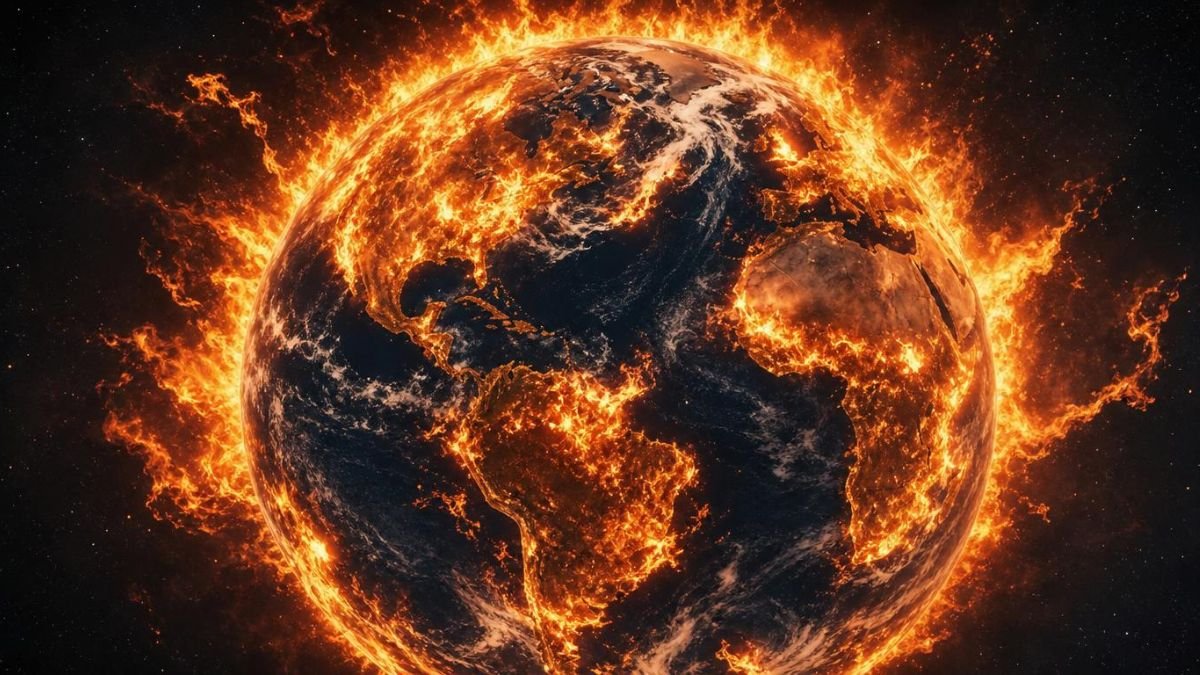
Have you noticed that we almost never use this phrase to say that someone will?
Think about it. When was the last time you heard someone say, without irony, "she's going to set the world on fire"? Now think about how often you've heard the other version. He's a good worker, he's not going to set the world on fire, but he shows up. She's fine. Nice enough. Won't set the world on fire. It's a phrase about blazing, planetary glory, and we've quietly repurposed it into one of the gentlest insults in the language — the polite way of saying: ordinary. Adequate. Not remarkable. We take the most extravagant image we have and we hand it to people as a measurement they've already failed.
The phrase seems to have come down from an older English joke. In Britain they used to say a person would never set the Thames on fire. The Thames — a river. Wet, wide, cold, moving. The whole point was the absurdity of it. Setting a river alight is precisely the thing that cannot be done, and so it became the standard for the extraordinary: not merely difficult, but impossible, and therefore the perfect stick to beat the merely competent with. Somewhere along the way the river became the world, and the joke lost its wink, and now we say it seriously — as if setting a world on fire were a normal item on the list of things a life might be expected to achieve.
But here's what I keep coming back to. Nobody has ever set a world on fire. That is not how fire works, and I think the phrase quietly lies to us about it.
Fire doesn't arrive at scale. A forest fire does not begin as a forest fire. It begins as one dry thing meeting one small heat, in one specific place, usually somewhere nobody was watching. A cigarette. A shard of glass angling the sun. One branch that catches, then the branch beside it, then the leaf litter, then the slope, then the ridge, then the sky the color of an old wound for a hundred miles. Nobody set the mountain on fire. Somebody set a twig on fire, and the mountain was ready.
And that's the second thing, the part the phrase hides completely. Fire is never the work of the match alone. A match dropped in a wet field is a small hiss and nothing else. The same match dropped in a dry field in August is a catastrophe. The difference isn't the match. The difference is the field. What we call setting the world on fire is really the meeting of a small ignition with a world that had already been drying out, waiting, aching for a reason to go up. Every person we describe this way was one part spark and nine parts timing. Which should make us humbler about the ones who blazed, and far, far kinder to ourselves about the ones who didn't. You may have struck beautifully in a season of rain.
So when we say someone won't set the world on fire, what we're really doing is measuring them against a picture that doesn't exist — a single person, alone, producing a blaze the size of the planet. Nobody has ever done that. Not one. The people we say it about did the same thing everyone does: they lit one small thing, close to hand, and the world happened to be dry.
But I want to press further, because there's a question underneath the whole phrase that we rarely stop to ask. Do you actually want to set the world on fire?
Fire consumes. That's what it is. A fire that spreads across a world is not a gift to that world; it's a loss. And I wonder how much of our ambition is secretly shaped like arson — a hunger to be seen from a great distance, to leave a mark visible from space, to be the event rather than the warmth. There's another way to hold fire, and it's older than ambition. A hearth. A lamp. A candle in a window on a road with no lights. Fire that stays put, and feeds people, and lets them see each other's faces, and asks nothing about scale. The blaze is seen by millions and warms no one. The hearth is seen by six people and keeps them alive through winter.
I'm not telling you which to want. I'm telling you they're different fires, and most of us have never once separated them. We say we want to set the world on fire when what we actually want, if we're honest, is to matter to someone — and those are not the same wish, and only one of them can be satisfied.
There's a line often attributed to Catherine of Siena, and whether or not she truly said it, it's stayed alive for centuries because of what it does to this idea. Be who you were meant to be, and you will set the world on fire. Notice the shape of that. It doesn't say: burn brighter. It doesn't say: aim at the world. It puts the whole task in the smallest possible place — become the thing you actually are, completely, without dilution — and treats the fire as an aftereffect. Something that happens behind you while you're busy being yourself. In that version, the world catching is never the goal. It's the weather report.
And that, I think, is how it actually goes. Nobody who ever changed anything woke up and decided to ignite a planet. They were consumed by one thing. They gave their whole attention to something small and specific and theirs — a question, a craft, a person, a wrong that wouldn't leave them alone — and they burned at it steadily for years while nobody watched. The spreading came later, and often after they were gone, and was mostly out of their hands.
So the next time someone tells you that you're not going to set the world on fire, I'd like you to hear what they've actually said. They've told you they can't see a blaze from where they're standing. That's all. They haven't checked what's burning. They haven't asked how dry the field is. They haven't noticed the six faces lit by your particular flame, or the fact that you've kept it going through weather that would have put out something showier.
Strike the match anyway. Light the thing nearest you. Let the wind decide the rest.
So here's what I'll leave you with. If no one has ever set a world on fire — if every great blaze was only ever one small thing catching in a season that was ready — then what have you refused to light, because you were waiting to be handed something the size of the world? And what if the twig in your hand is the only ignition you were ever going to get?






0 Comments