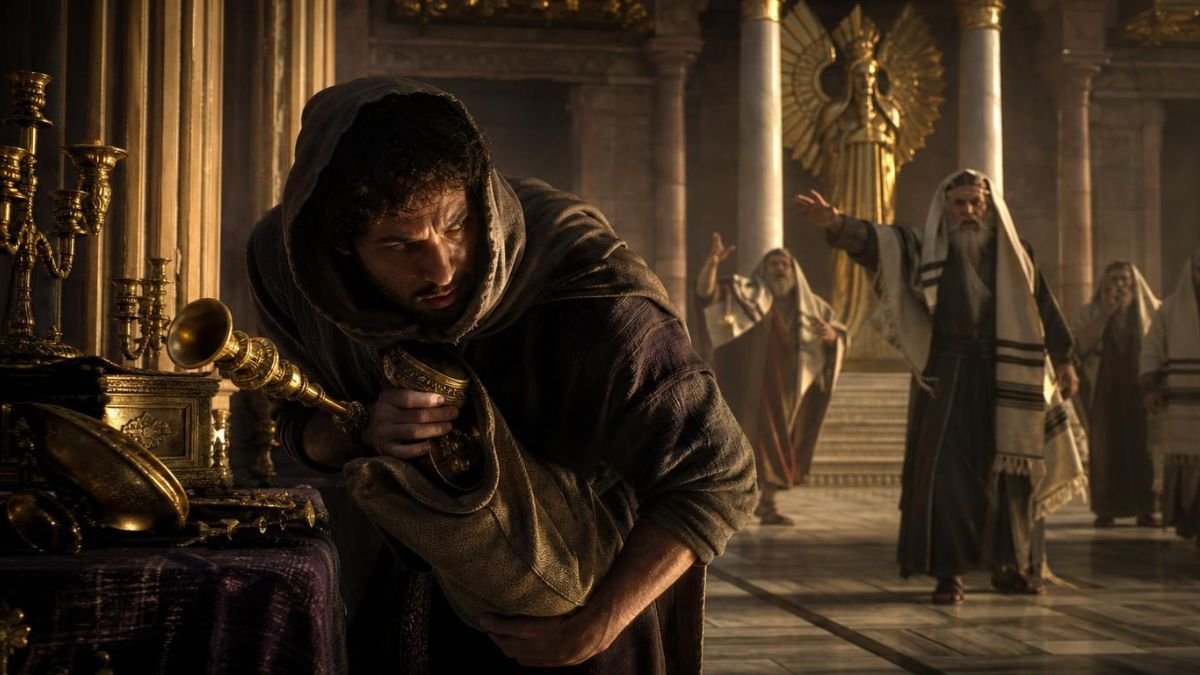
What in your life would you call untouchable?
Not merely important. Untouchable — the thing that would produce something more than annoyance if someone handled it carelessly. A reaction with heat in it, disproportionate to any practical damage.
Because that reaction has a name, and the name is older and more precise than we usually realize. Sacrilegious.
We use it loosely now, often jokingly: putting ketchup on that is sacrilegious, rewriting that ending would be sacrilege. And the joke works precisely because we all still recognize the category, even when we've stopped believing in any of the old temples.
The Latin is startlingly literal. Sacrilegus, from sacer: sacred, set apart, and legere, meaning to gather, to pick up, to collect. The same legere that gives us collect, select, and, through its offspring, legend and lecture, because reading was originally gathering letters up with the eye.
So sacrilege means, precisely: picking up sacred things and carrying them off. It was temple robbery. A crime of the hands, not the mind. Somebody went into the sanctuary, took the vessels, and left.
That's a crucial distinction, and it clarifies the whole word. Sacrilege was never about disbelief. A person who simply didn't believe in the god committed nothing. The offense was in the handling; in treating as ordinary, portable, and usable a thing that had been formally set apart from the ordinary world.
And that tells you what sacer really means, which is not what most people assume. Sacred doesn't mean lovely, or spiritual, or morally good. It means separated. Removed from general circulation. A sacred object is one that has been withdrawn from the economy of normal use; it can't be sold, borrowed, repurposed, or casually touched. That's the whole content of the category.
Which means every culture, including ours, including the most secular room you can imagine, runs on a system of sacred objects. We just don't call them that.
Think about it. A wedding ring is materially a small quantity of metal, and nobody would think twice about melting down an identical ring bought yesterday. But that one is withdrawn from circulation. A grave is a piece of ground with the same soil as the field beside it, and a completely different set of rules governs your feet. A flag is fabric. A photograph of a dead parent is paper and ink, and its replacement value is nothing, and you would be genuinely shaken to find someone had used it as a coaster.
None of that is superstition. It's how meaning is stored. We take an ordinary object and place it outside ordinary use, and it becomes a container for something that has no other physical location; a promise, a person, a grief. And the flare of anger you'd feel if someone handled it casually isn't irrationality. It's the alarm system on the container.
So sacrilege is not primarily an offense against a god. It's an offense against someone's stored meaning. Which is why it produces such disproportionate reactions in an age that supposedly has none.
And here's the part I actually find useful, and slightly humbling.
Because the sacred is created by setting apart, it's always local. It's always an agreement among a particular group of people. Which means that from outside, every sacred object looks exactly like an ordinary one, and the person handling it carelessly usually isn't a vandal at all; they simply weren't in the room when the thing was set apart.
That's the source of an enormous amount of avoidable hurt between people. Somebody moves an object in your house and can't understand why your face changed. Somebody makes a joke about a subject and doesn't know your family's history with it. Somebody treats a routine as negotiable and doesn't know it's the last thing your father did with you. They didn't commit sacrilege. They walked into a temple with no signage.
So there's a practical instruction hiding in this old word, and it runs both directions. If you want your sacred things respected, they have to be marked, because nobody can see a boundary that exists only in your head. And if you want to be a decent person, you should assume that every room you enter contains things that have been set apart, and that you can't see which ones.
That second assumption is, I think, the most useful form of ordinary courtesy there is. Move slowly with other people's objects, and with their subjects. There's always a shrine somewhere in the house.
But I'll add the counterweight, because this word has a shadow.
Declaring something sacred is also a way of putting it beyond question, and that has been used for a great deal of harm. If a practice is holy, it can't be examined. If a text is untouchable, it can't be argued with. If a family story is sacred, nobody can say what actually happened. And whoever gets to declare things sacred acquires enormous power without ever having to defend a position.
So the honest test is the same one that applies to any protected thing: who benefits from this being untouchable? If the answer is the memory of someone who was loved, that's a shrine. If the answer is the person who would look bad if we examined it, that's not sanctity. That's a fence with a good sign on it.
So here's what I'll leave you with. Everyone is carrying a small collection of things that have been withdrawn from ordinary use; objects, dates, subjects, rituals, and almost none of them are visible to anyone else. So think about your own set. What have you set apart, and does anyone know? And then the other half: whose shrine have you walked through carelessly, simply because nobody told you the ground you were standing on had been made holy?





0 Comments