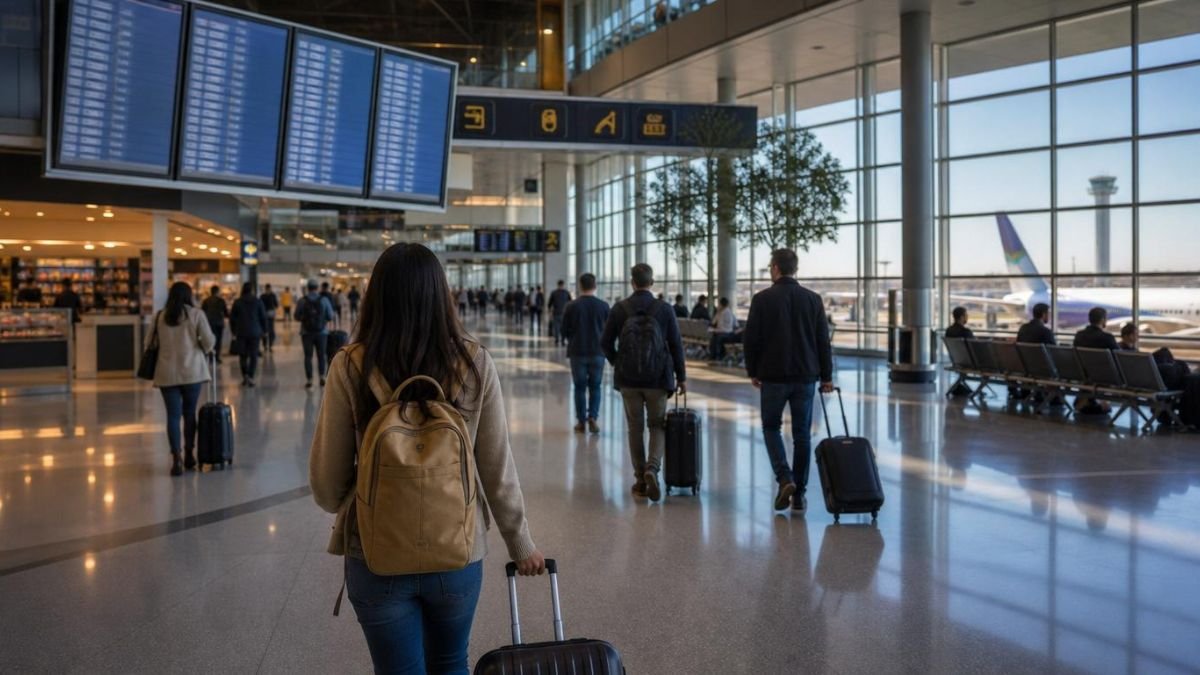
Have you ever stood in the middle of a massive airport, staring at a departures board, unsure which terminal you're supposed to be in, which queue you need to join, and what exactly the gate agent just announced over that crackling PA system? If the answer is yes — welcome to the club. Airports are equal-opportunity stressors. They don't care how experienced you are, how many flights you've taken, or how confident you feel before you leave home. The moment you walk through those doors, you're suddenly navigating a world with its own rules, its own language, and its own brand of anxiety-inducing chaos.
But here's the thing: airports also follow a very predictable pattern. Once you know the language — the words, the phrases, the signs, the announcements — the whole experience transforms. Suddenly, the chaos becomes a flow. The confusion becomes a sequence. And you move through it not with panic, but with purpose.
That's exactly what we're doing today. We're going to walk through the airport together — from the moment you arrive at the departure hall all the way to finding your seat on the plane — and we're going to do it progressively. That means we start simple, at the elementary level, and we build all the way up to the kind of sophisticated, nuanced language that even confident speakers can sharpen. Think of it as a journey within a journey.
Let's go.
Level 1: The Basics — Elementary (A1/A2)
Alright, let's start at the very beginning. You've arrived at the airport. Maybe it's your first time flying internationally. Maybe you've flown before but always relied on someone else to do the talking. Either way, the good news is that at this level, you really only need a handful of words to get by, and they are very, very useful.
The first word you need to know is 'check-in.' This is the process where you go to the airline counter, show your passport and your booking confirmation, and get your boarding pass. The boarding pass is your permission slip to get on the plane — it has your name, your flight number, your departure gate, and your seat number. You absolutely cannot board without it.
At the check-in counter, the agent might ask you a few questions. One of the most common is, 'How many bags are you checking in?' This means: how many suitcases are you putting in the hold — the big storage area underneath the plane? Your carry-on bag, by contrast, is the small bag you take with you onto the plane and put in the overhead compartment above your seat.
Here's a phrase that will save you: 'I have one bag to check in.' Simple. Direct. Understood anywhere in the world. You can also say, 'I only have carry-on luggage,' if you're traveling light and not checking anything. The word 'luggage' and the word 'baggage' mean exactly the same thing, by the way. Both are perfectly fine to use, though 'baggage' tends to be more common in official signage and announcements.
A grammar note here: in English, 'luggage' and 'baggage' are uncountable nouns. This trips up a lot of learners. You don't say 'I have two luggages.' You say 'I have two pieces of luggage' or 'I have two bags.' Think of it like the word 'water' — you don't say 'two waters' unless you're ordering at a restaurant. Same principle.
After check-in, you move to security. This is where you go through a scanner and put your bags through an X-ray machine. The staff here might ask you to 'remove your shoes' or 'take your laptop out of your bag.' These are instructions, and the best response is to simply follow them and say 'Of course' or 'Sure' if you want to be polite. You don't need to explain yourself or make conversation. Smile and comply — that's the golden rule at security.
Once you're through security, you're in the departure area, sometimes called the departure lounge. This is where you wait for your flight. You'll see the departures board — a big screen showing all the flights leaving that day. You need to find your flight number (like BA203 or EK455) and check your gate. The gate is the specific door you'll board from. Gates are labeled with letters and numbers, like Gate B14 or Gate C3.
Some airports are enormous, and the gates can be very far apart. Pay attention to the signs and give yourself plenty of time. One of the most important phrases at this stage is, 'Excuse me, where is Gate B14?' People are generally very helpful in airports. You can also ask, 'Is this the right gate for flight EK455?' and the staff will confirm.
Finally, when your flight is called — and you'll hear an announcement over the PA system, something like 'Flight BA203 to London is now boarding at Gate B14' — you go to the gate, show your boarding pass, and get on the plane. The verb 'to board' means to get on. You board a plane. You board a ship. You board a bus, sometimes. It just means entering a vehicle, typically a large one.
A few more words to keep in your toolkit: 'departure' means leaving. 'Arrival' means coming in. 'Terminal' is the building where you check in and board — large airports often have multiple terminals. 'Passport control' or 'immigration' is where your documents are checked when you arrive in a new country. 'Customs' is where they check that you're not bringing prohibited items into the country. And 'baggage claim' or 'baggage reclaim' is where you pick up your checked bags after landing.
That's your elementary survival kit. These words and phrases will get you through the essential checkpoints. Now let's add some depth.
Level 2: Adding Color and Depth — Intermediate (B1/B2)
Here's where things get interesting. You've got the vocabulary for what happens, but now we need to talk about how things happen, how to express yourself when things don't go according to plan, and how to understand more complex language around you.
Let's start with check-in again, but this time let's go deeper. You might encounter phrases like 'your flight is overbooked' or 'we need to check your visa.' 'Overbooked' means the airline sold more tickets than there are seats on the plane — yes, this actually happens, and it's not illegal. Airlines gamble on the fact that some passengers won't show up. When everyone does show up, there's a problem. In this situation, the gate agent might ask for volunteers to take a later flight in exchange for compensation. The word 'compensation' here means something you receive in exchange — usually a travel voucher, a refund, or a free ticket for a future flight.
At this level, it's also worth knowing the difference between a 'direct flight' and a 'non-stop flight.' A non-stop flight goes from A to B without stopping. A direct flight — and this confuses a lot of people — can actually include a stop. It's the same flight number throughout, but the plane might land, let some passengers off, take new ones on, and continue. If you care about not stopping, ask specifically for a non-stop flight.
Now let's talk about something almost every traveler encounters at some point: a delay or a cancellation. If your flight is delayed, that means it's leaving later than planned. If it's cancelled, it's not going at all. Here's how these conversations tend to go. You approach the desk and say something like, 'I was wondering if you could help me — my flight has been cancelled and I need to be rebooked on the next available flight.' Notice the structure: 'I was wondering if you could...' This is a very polite, indirect way of making a request. It's not demanding. It opens a door.
Alternatively, if you're frustrated — and you have every right to be — you might say, 'I've been waiting for three hours and I haven't been given any information about my flight. Could you please tell me what's happening?' The key here is that even in frustration, keeping the language civil and asking a question rather than making an accusation will almost always get you further. This is not just an English lesson — it's a diplomacy lesson.
Let's talk about announcements for a moment, because they can be tricky. Airport announcements are often fast, distorted by the PA system, and full of jargon. Some phrases you'll hear repeatedly: 'Please proceed to Gate C5 for boarding.' The word 'proceed' simply means 'go' or 'make your way.' 'Your flight is now boarding' — that means the doors are open and passengers are getting on. 'Final call for passengers on flight TK789 to Istanbul.' 'Final call' means this is the last announcement before the doors close — you need to be there right now. 'Please have your boarding pass and passport ready for inspection.' 'For inspection' means to show them — they're going to look at your documents.
At the intermediate level, we also need to talk about phrasal verbs because they are everywhere in travel English and they come in heavy rotation. 'Check in' — to register for your flight. 'Check out' — to leave a hotel. 'Take off' — when the plane leaves the ground. 'Touch down' or 'land' — when the plane arrives on the ground. 'Pick up' — to collect, as in 'pick up your bags at baggage claim.' 'Drop off' — to leave someone at a place, like 'my friend dropped me off at the terminal.' 'Hold up' — a delay or an obstacle, as in 'there was a hold-up at security.' And 'turn around' in aviation can mean a technical delay where the plane is sent back for maintenance.
Here's a grammar insight worth noting: we often use the present continuous tense to talk about scheduled future events in travel. 'The flight is leaving at 9 PM.' 'We're landing in about two hours.' 'The gate is closing at 3:40.' This isn't a mistake — it's a grammatically valid and very natural way to talk about planned future actions. The present continuous here signals that it's part of an arrangement or schedule, not just a general prediction.
One more thing at this level: connecting flights. If you have a layover, that's a period of time between flights when you're at a connecting airport. A short layover — say, one hour — is a tight connection. A long layover — six, eight hours — might give you time to leave the airport and explore. When you have a connecting flight, you often hear phrases like 'transit passengers' (people passing through but not staying in the country) or 'you will need to re-clear security in the connecting airport.' That means you have to go through the security process again.
Knowing this vocabulary lets you ask better questions, understand more of what's happening around you, and respond more naturally when the unexpected happens — because in airports, the unexpected is practically guaranteed.
Level 3: Fluency and Nuance — Advanced and Proficiency (C1/C2)
Now we arrive at the level where language becomes truly expressive. At this stage, it's not just about communicating accurately — it's about communicating with precision, elegance, and awareness of register. 'Register' is a linguistic term for the level of formality and the specific style of language appropriate for a given situation.
In an airport, you'll navigate multiple registers simultaneously. With a gate agent, you might be formal and professional. With a fellow traveler stranded next to you for six hours, you'll probably shift to casual, even humorous language. With a customs officer, you'll be precise and measured. Fluency isn't just vocabulary — it's the ability to read the room and adjust.
Let's start with the kind of language you might use when something goes seriously wrong. Imagine your bag hasn't arrived at baggage claim. At the elementary level, you'd say, 'My bag is not here.' At the intermediate level, 'I think my bag might have been put on the wrong flight.' At the advanced level, you'd walk to the baggage services desk and say something like, 'I'd like to file a delayed baggage report. My bag was on flight LH448 from Frankfurt, and it doesn't appear to have arrived with the rest of the luggage. I have my boarding pass stub and my baggage claim ticket here — could you open a case for me?' This is a complete, professional communication that includes the key details the agent needs, makes a clear request, and demonstrates that you know the process.
The phrase 'it doesn't appear to have...' is worth noting. Instead of saying 'it isn't here' or 'I can't find it,' this construction sounds more measured and less accusatory. 'It appears' and 'it doesn't appear' are hedging phrases — they soften a statement and show you're allowing for the possibility that you might have missed something. This is the kind of diplomatic phrasing that makes difficult conversations go more smoothly.
Let's talk about something more nuanced: the language of uncertainty and inference at the airport. If you're not sure when your gate will open, you might say, 'I imagine the gate won't be open for at least another half hour, given the departure time.' If you're trying to figure out which queue is faster, 'Looking at the lines, I'd hazard a guess that the one on the left might move more quickly — those automated gates tend to clear faster.' 'To hazard a guess' means to make an estimate despite uncertainty. 'Tend to' signals a general pattern rather than an absolute rule.
At this level, you should also be comfortable with the passive voice in its natural context. Aviation is absolutely full of passive constructions. 'Passengers are asked to...' 'The flight has been delayed.' 'Your bag will be screened.' 'Priority boarding is given to...' 'Passengers traveling with infants are invited to board at this time.' Why is this? Because in formal, institutional contexts, the action matters more than who is doing it. The passive voice de-emphasizes the agent and focuses on the event or instruction. Learning to hear and use passives naturally is a significant marker of proficiency.
There's also a rich vocabulary of air travel that goes beyond the operational. 'Turbulence' is not just bumpy flight — it has a metaphorical life in English. 'We hit some turbulence in the negotiation' is perfectly natural in a business context. 'The project is in a holding pattern' — borrowed from aviation, meaning it's waiting for a decision before it can move forward. 'She really came in for a landing on that presentation' — meaning she wrapped it up skillfully. Aviation has gifted the English language a remarkable number of idioms, and knowing them elevates your comprehension and your expressiveness.
A word about cultural competence and language. In international airports, you're often code-switching — moving between languages if you know more than one, or at least adjusting your English depending on who you're talking to. If the person you're speaking to has limited English, you instinctively simplify your vocabulary, slow your speech, and use clearer gestures. This isn't condescension — it's communicative intelligence. The best communicators are those who can go up or down the register ladder based on the needs of the moment.
And speaking of cultural nuance: in many airports — particularly in the UK, parts of Europe, and East Asia — excessive complaint, loud frustration, or assertive demands can work against you. The culturally calibrated approach is to be polite, persistent, and specific. Saying, 'I understand you're busy, and I appreciate your help. I just want to make sure I understand my options in this situation,' will almost always get you further than raising your voice. Not because your frustration isn't valid — it very often is — but because airline staff have the authority to solve your problem and are much more likely to use that authority creatively for someone who treats them with respect.
One final linguistic note: the subjunctive mood appears in some airport communications and is worth knowing. 'Should your flight be delayed...' 'Were you to miss your connection...' 'Should you require any assistance...' These are formal conditional structures using the subjunctive, and you'll find them in travel documents, insurance paperwork, and official communications. They signal a formal register and a degree of preparedness for contingencies. Being able to read and produce these structures marks you as genuinely proficient.
Bringing It All Together
So we've walked through the airport together — from checking in your bags to understanding the difference between linguistic registers at passport control. The airport is a perfect English learning laboratory because it compresses so many different types of communication into one place: instructions, requests, complaints, negotiations, announcements, and casual conversation.
What makes airport English so worth studying isn't just the vocabulary — it's the patterns of communication under pressure. When you're tired, when your flight is delayed, when you can't find your gate, your language simplifies naturally. Building a strong foundation at the elementary and intermediate levels gives you something to fall back on. And the advanced vocabulary and patterns give you the tools to handle the complicated situations with composure.
Think about it this way: the airport is a microcosm of international communication. The same skills that help you navigate Heathrow or JFK will serve you in a boardroom, a hospital, a negotiation, a dinner party. Clear, adaptive, confident communication — that's the goal. And every gate you walk through, every announcement you understand, every question you answer with ease is a small victory on that journey.
Your Challenge
Here's your optional challenge for this episode, and I'd love for you to actually try this one because it's genuinely useful.
Think of a real or imagined trip you're planning — or one you've taken in the past. Write a short account — around 200 to 300 words — describing your journey through the airport. Use at least five words or phrases from the elementary section, three from the intermediate section, and two from the advanced section. This might feel a bit like a recipe, but it's actually a great way to force yourself to use language at all levels rather than just staying comfortable in your favorite range.
If you want to make it a speaking challenge instead, record yourself narrating the journey out loud. Pay particular attention to how you shift your language when something goes wrong in your story — a delay, a missing bag, a tight connection. That's where your true communicative resourcefulness shows up.
Safe travels, and I'll see you at the next gate.









0 Comments