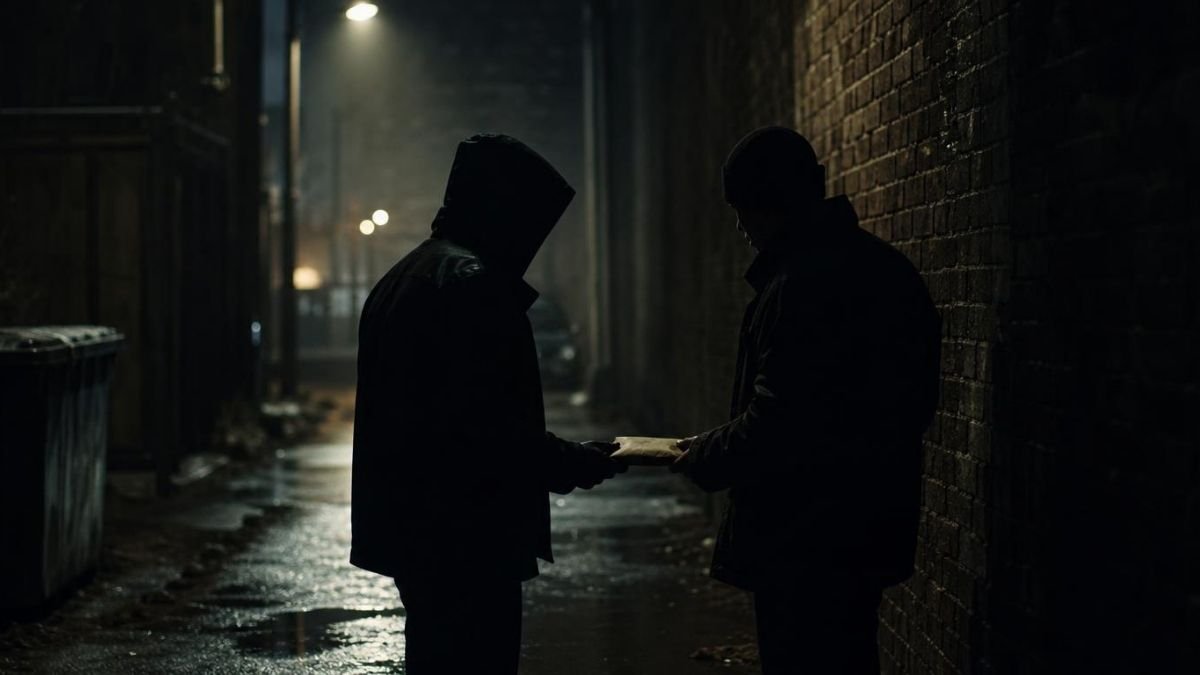
What's the difference between something private and something clandestine?
Because we feel that difference instantly, even if we've never explained it. There's a whole family of words for things not on display — private, personal, confidential, discreet, secret, covert, clandestine — and they are not interchangeable. Each carries a different weight, and clandestine is the heaviest of them.
The root is Latin clandestinus, from clam, meaning secretly or in concealment. And clam is thought to be related to celare — to hide, to conceal — which also gives us conceal and, further back, cell, a hidden room, and even hell in the old Germanic sense of the covered place. So this is a word made from hiding itself.
But here's the important part, and it's what separates clandestine from the softer words. Private describes something that simply isn't your business — it's not being hidden, it's just not being shown, and there's an enormous moral difference between those. Confidential means shared under an agreement. Discreet means handled quietly out of consideration.
Clandestine means concealed on purpose, by people who understand the consequences of being found out.
That's the entire distinction, and once you have it, you can use it as an instrument on your own life. Because there's a very clean test hiding in this word, and it's one of the most useful I know.
Ask: is this hidden because it's nobody's business, or is it hidden because it couldn't survive being seen?
Those are completely different conditions. Your medical history, your finances, your private grief, what happens in your marriage — genuinely private, hidden from no one in particular, and nothing about them changes if they come out except your comfort. But a clandestine arrangement has a structural dependency on darkness. The concealment isn't a preference. It's load-bearing. Remove it and the thing collapses, because the thing was only ever viable unseen.
And that's why the word carries such a chill. It implies a judgment already made — by the people doing it. Nobody conceals something clandestinely without having internally assessed how it would be received. The secrecy is a confession that arrived before the discovery.
Now I want to be fair to the word, because it isn't purely dark, and I'd be dishonest to pretend it is.
Some of the most necessary things in human history have been clandestine. People hidden in attics. Manuscripts copied and passed by hand under regimes that burned them. Escape routes. Underground schools for girls forbidden to learn. Meetings in basements that eventually became movements. All of these were clandestine in the strictest sense — deliberately concealed by people fully aware of the penalty.
So the word doesn't tell you whether something is wrong. It tells you that someone believed there would be a cost to it being seen. And the cost can come from a tyrant just as easily as from a conscience.
Which means the moral question isn't are you hiding something. It's who are you hiding from, and what would they do? Concealment from an unjust power is one of the oldest forms of courage. Concealment from the people who trust you is something else entirely, wearing the same clothes.
But I want to spend the last part on what secrecy costs, because I don't think we account for it honestly.
A clandestine thing requires continuous maintenance. That's its defining feature and its hidden expense. A visible life requires nothing to sustain — it simply is what it is. A concealed one requires an ongoing operation: tracking who knows what, remembering which version you told to whom, managing your face, monitoring proximity, being alert in rooms where other people are relaxed. And it never stops running. It runs while you sleep.
That's why people who come out of long concealment — of any kind, not just the guilty kind — describe the same thing afterward, and it's almost always about tiredness rather than relief. They didn't know how much processing power it was consuming until it stopped.
And there's a second cost, which is subtler and worse: concealment isolates you at exactly the point where you're most in need of another perspective. A hidden thing cannot be examined by anyone else. It cannot be argued with, corrected, or gently questioned, because nobody knows it exists. So it develops in a sealed chamber, with only your own reasoning for company — and your own reasoning, in a sealed chamber, becomes extraordinarily persuasive. Almost every catastrophic decision I've watched somebody make was made in a room where nobody else was allowed.
That's the deepest danger in the clandestine. Not the discovery. The lack of correction.
So the practical wisdom I'd take from this word isn't never hide anything — that's neither possible nor desirable, and everyone is entitled to a private interior. It's narrower: whatever you're carrying in the dark, at minimum, let one person see it. Not the world. One. Because a thing witnessed by one trustworthy person is no longer developing in a sealed chamber, and that single change alters everything about where it can go.
So here's what I'll leave you with. Think of something you're keeping out of sight, and then run the test honestly. Is it hidden because it's genuinely nobody's business — or is it hidden because it couldn't survive being seen? And if it's the second, ask the harder half: how much of your energy is going into the maintenance, and how long has it been since anyone was allowed in the room to tell you what they think?







0 Comments