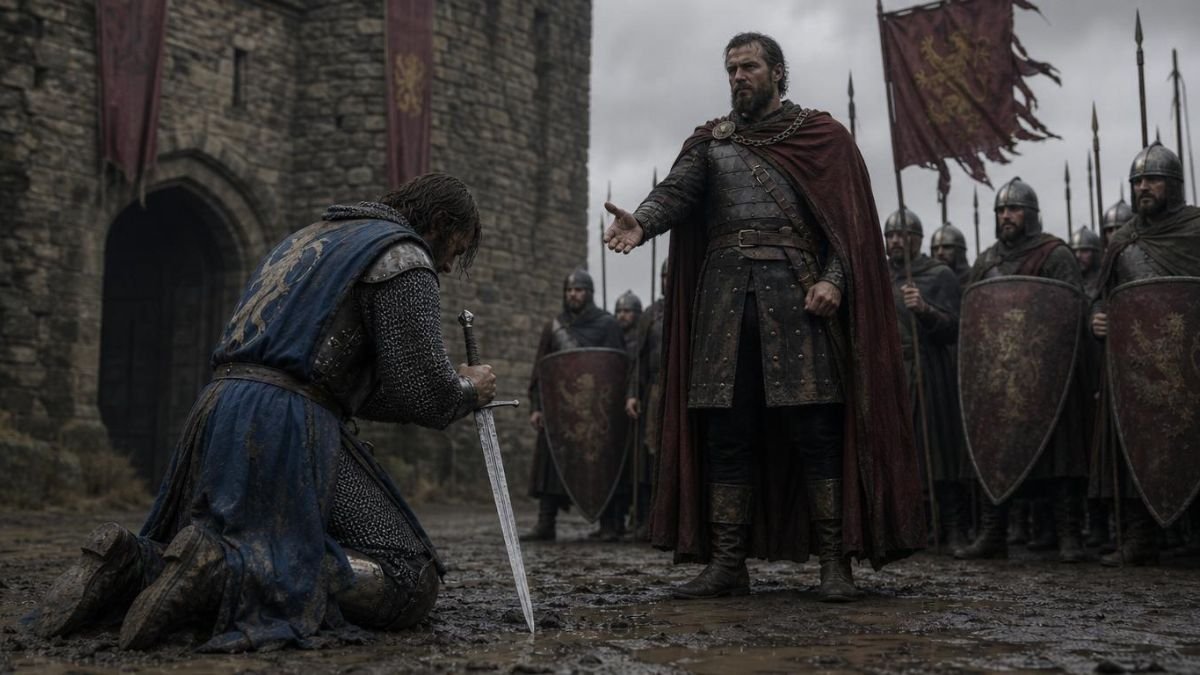
Is there a difference between losing well and losing badly, and would you know which one you were doing?
I want to look at a word we only ever use as an accusation. Capitulate. He capitulated. They capitulated to pressure. It carries a faint sneer, doesn’t it — the sense of someone who folded, who hadn’t the spine for it.
But the origin has nothing to do with weakness. It’s from the Latin capitulare, and it means: to draw up under headings.
Capitulum is a little head — a diminutive of caput, head. And a capitulum is what we still call a chapter: a section of a document under its own heading. The word survives all over the language once you look. Capital, the head city. Captain, the head of a company. Chief. Per capita, by heads. A cape is a headland sticking out into the sea.
So to capitulate, originally, was to set out an agreement in chapters. Heading by heading. Clause by clause. A capitulation was a document.
And it came to mean surrender only because that’s what the terms of a surrender were: an articulated agreement, negotiated, written down under headings, signed by both sides.
Which means the word remembers something we’ve completely lost. It remembers that ending a fight used to be an act of composition.
Sit with that for a second, because I think it changes what the word is asking of us. Capitulation, properly understood, is not collapse. Collapse has no chapters. A rout has no headings. When an army truly breaks, there is no document — there’s just people running in every direction and everything abandoned in the field.
Capitulation is the opposite of that. It’s the orderly, dignified, deeply unpleasant business of sitting down with the person you were fighting and working out, point by point, what happens now.
And that requires a head. Literally, in the etymology — caput. It requires someone still thinking clearly enough to organize the ending.
Which is, I’d argue, one of the rarest and most underrated skills a human being can have.
Because look at how most of us end things. We have basically two modes.
The first is fighting past the point of sense. Long past it. We keep going not because we think we’ll win but because stopping would mean admitting it’s over, and there’s a stretch of every losing struggle where the fight itself has become the only thing preserving our story about ourselves. Businesses do this. Marriages do this. Arguments at ten at night absolutely do this.
The second mode is collapse. One day the whole thing just goes. No terms, no discussion, no headings — somebody walks out, or the money runs out, or a sentence gets said that can’t be taken back, and afterwards there’s nothing agreed and nobody knows what happens to any of it.
And in between those two — rarely used, quietly available the whole time — is capitulation. Which is to say: deciding that this is lost, and then ending it on purpose, in an organized way, with terms.
That’s what the word offers back to us. Not defeat, which happens to you. A composed conclusion, which you write.
Think about what the headings would be in an ordinary human version of this. If you were ending something — a partnership, a project you’ve poured four years into, a version of your life — the chapters would be things like: what happens to the money. What we tell people. What each of us keeps. What we’ll say about each other in ten years. Who tells your mother.
Almost nobody does this. Almost everybody just lets it happen and then spends years dealing with the parts nobody wrote down.
So there’s a real, practical dignity in this old meaning. To capitulate well is to refuse both the endless doomed fight and the formless collapse, and to insist that even a loss deserves a structure.
Now, the shadow — because there’s obviously a wrong version, and it’s the one the word’s modern reputation is built on.
There’s capitulating too early. Sitting down to write the terms of surrender while the thing is still genuinely winnable, because the fighting is uncomfortable and a document feels like relief. That happens constantly, in negotiations and in relationships and in arguments about what’s right.
And there’s the worse version: capitulating with the pen in someone else’s hand. Because the whole dignity of the original meaning depends on the losing side actually drafting. If the terms are written entirely by the other party and you merely sign, that’s not capitulation. That’s dictation.
So the questions the word puts to you are quite sharp. Is this actually lost, or am I just tired? And if it is lost — am I holding a pen?
Because here’s the thing about the moment of capitulation: it is, oddly, the last moment of leverage you will ever have. Before it, everything is contested. After it, it’s over. The window in which terms can still be negotiated is short, and most people spend it either fighting or fleeing, and by the time they’d like to discuss terms there’s nobody at the table.
Which means knowing when is nearly the whole skill. Too early and you gave away something you could have kept. Too late and there’s nothing to draw up, because collapse has already answered every question for you, badly.
So here’s what I’ll leave you with tonight. There’s something in your life you’ve been fighting for longer than you privately believe in — you knew what it was before I finished the sentence, because that knowledge usually arrives well before we let it.
So the question isn’t whether to give up. That’s the wrong frame and it always was. The question is this: if you sat down tonight and wrote the terms — the actual headings, in order, of how this ends and what each person walks away with — what would the first chapter be called?
And who, right now, is holding the pen?






0 Comments