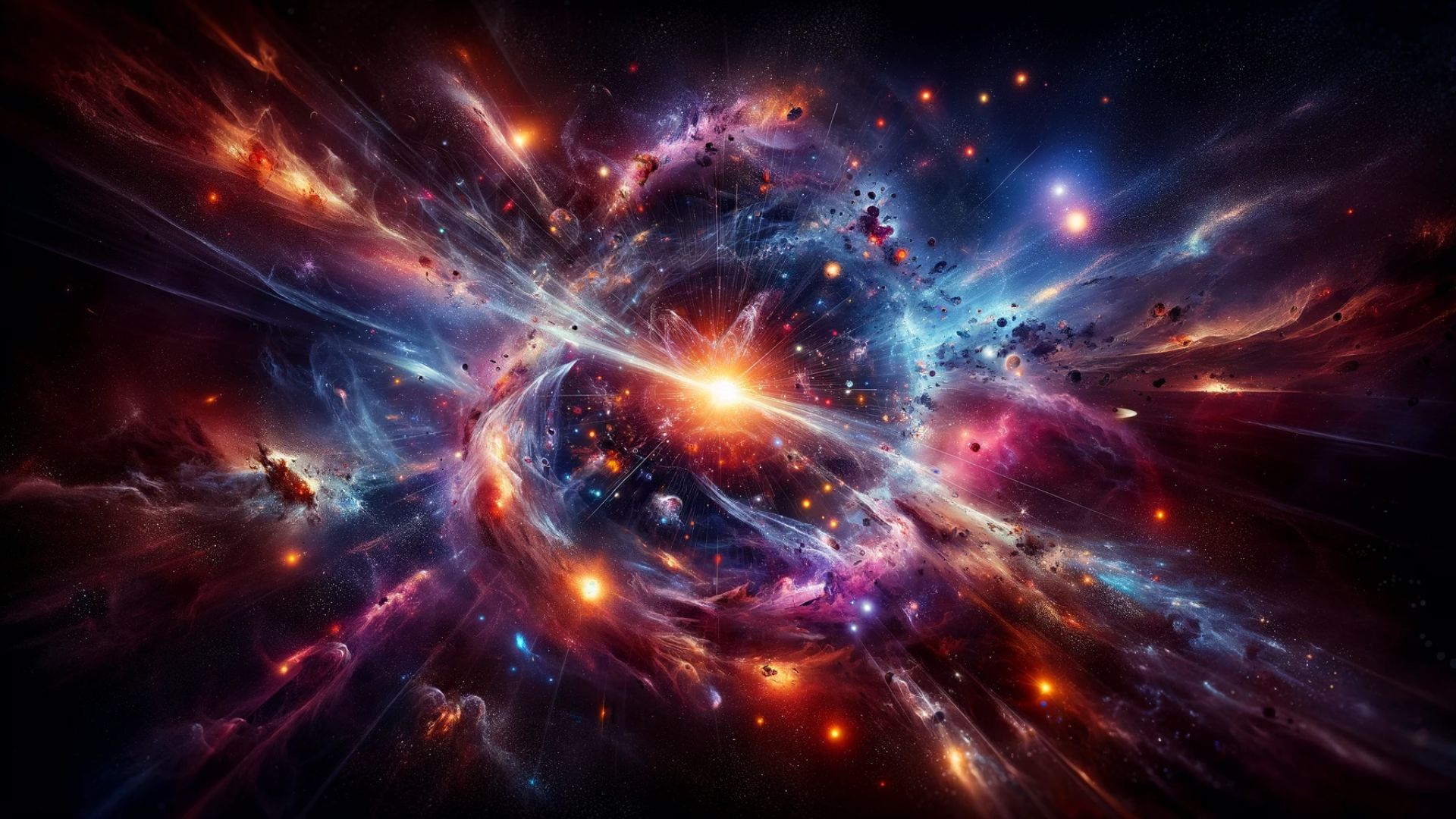
Dive deep into the Big Bang Theory, the scientific explanation for the origin and evolution of the universe. Learn how this monumental theory helps us understand our cosmos, from the very first moments to the complex structures we see today. Discover the significance of the Big Bang Theory in modern astronomy and how it shapes our understanding of the universe's past, present, and future.
In the vast expanse of the cosmos, the question of how the universe came into being and evolved over billions of years has fascinated humanity for centuries. The Big Bang Theory stands as the most compelling scientific explanation, offering insights into the universe's birth and its continuous expansion. This foundational theory not only revolutionizes our understanding of the cosmos but also connects directly to our quest for knowledge about our origins and our place in the universe.
The Genesis of the Universe: The Big Bang
The Big Bang Theory describes the universe's origin from a singular, incredibly hot, and dense point approximately 13.8 billion years ago. This event was not an explosion in space, as the name might suggest, but rather the expansion of space itself. From this initial singularity, the universe has been expanding and cooling, leading to the formation of subatomic particles, atoms, stars, galaxies, and all other celestial structures we observe today.
Evidence Supporting the Big Bang
- Cosmic Microwave Background Radiation (CMBR): Discovered in 1965 by Arno Penzias and Robert Wilson, the CMBR is the afterglow of the Big Bang, pervasive throughout the universe and providing compelling evidence of its hot, dense origin.
- Galactic Redshift: Observations by Edwin Hubble in 1929 of distant galaxies revealed that they are moving away from us, with their light shifted towards the red end of the spectrum. This redshift is a direct consequence of the universe's expansion from the Big Bang.
- Abundance of Light Elements: The proportions of hydrogen, helium, and other light elements in the universe match predictions made by the Big Bang nucleosynthesis model, further substantiating the theory.
The Evolution of the Universe
Following the Big Bang, the universe underwent several epochs, from the Planck era to the current era of acceleration, marked by significant events such as the formation of the first atoms, stars, and galaxies. The large-scale structure of the universe, including galaxy clusters and superclusters, evolved from tiny fluctuations in the universe's density in its early moments.
Implications for Modern Astronomy and Cosmology
The Big Bang Theory has profound implications for our understanding of the universe. It sets the stage for studying cosmic phenomena, such as black holes, dark matter, and dark energy, and for exploring fundamental questions about the universe's fate. Moreover, it highlights the interconnectedness of all cosmic entities, from the smallest particles to the vastest galaxies, underscoring the unity of the cosmos.
Action Point:
Reflect on the significance of the Big Bang Theory in shaping our understanding of the universe. Consider the awe-inspiring journey from the universe's fiery birth to the rich tapestry of celestial bodies we observe today. Let this knowledge inspire you to learn more about astronomy and cosmology, perhaps by observing the night sky, visiting a planetarium, or engaging with the scientific community. By exploring the universe's mysteries, we not only deepen our knowledge but also connect with the profound story of our cosmic origins.
The Big Bang Theory not only illuminates the past but also guides us in exploring the universe's future. It encourages us to contemplate our place in the cosmos and to pursue the unending quest for knowledge that defines our species. As we stand on the shoulders of giants who have unraveled the secrets of the universe, let us continue to wonder, explore, and discover, pushing the boundaries of our understanding ever further.
Why Should You Care?
Understanding the Big Bang Theory is fundamental to grasping our universe's origins and its evolution. This knowledge not only satisfies human curiosity about where we come from but also enhances our comprehension of the cosmos, informing our exploration of space and the search for life beyond Earth. It underscores the interconnectedness of all matter in the universe and our shared cosmic heritage, fostering a deeper appreciation for the mysteries of existence.
Key Takeaways:
- The Big Bang Theory is the leading explanation for the universe's origin, describing its expansion from a hot, dense state 13.8 billion years ago.
- Cosmic Microwave Background Radiation, Galactic Redshift, and the Abundance of Light Elements serve as strong evidence supporting the theory.
- The universe has evolved through several epochs, leading to the formation of atoms, stars, galaxies, and the large-scale structure observed today.
- This theory has profound implications for understanding cosmic phenomena, including dark matter and dark energy.
- It emphasizes the importance of continual exploration and learning in cosmology and astronomy.
Keywords and Definitions:
- Big Bang Theory: The scientific explanation for the early development and shape of the universe, proposing that it began from a singular state.
- Cosmic Microwave Background Radiation (CMBR): Electromagnetic radiation left over from an early stage of the universe, considered critical evidence for the Big Bang Theory.
- Galactic Redshift: The displacement of spectral lines of galaxies towards longer wavelengths, indicative of their movement away from us and the universe's expansion.
- Nucleosynthesis: The process of creating new atomic nuclei from pre-existing matter, occurring during the early phases of the universe.
- Epochs of the Universe: Distinct phases in the history of the universe, each characterized by significant physical processes and conditions.
- Dark Matter: A form of matter thought to account for approximately 85% of the matter in the universe, invisible through telescopes but detectable by its gravitational effects.
- Dark Energy: A mysterious force that is causing the acceleration of the universe's expansion.
- Planck Era: The earliest known period of the universe, immediately following the Big Bang, when quantum effects of gravity were significant.
- Cosmology: The scientific study of the universe's origin, evolution, and eventual fate.
- Astronomy: The study of celestial objects, space, and the physical universe as a whole.
Frequently Asked Questions:
What happened before the Big Bang?
The question of what existed before the Big Bang challenges the boundaries of current scientific understanding and theories. Time and space as we know them were created at the moment of the Big Bang, making the concept of "before" somewhat irrelevant in this context.
Is the universe still expanding?
Yes, the universe continues to expand at an accelerating rate, a phenomenon attributed to dark energy.
Myth Buster:
Myth: The Big Bang was an explosion in space.
Reality: The Big Bang was not an explosion in the conventional sense but rather an expansion of space itself from a singular point.
Let's Talk:
- How does the concept of the universe's expansion from a singular point change your perspective on the nature of space and time?
- What implications do you think the continued study of the Big Bang Theory has for our understanding of the universe?
- In what ways do discoveries about the early universe influence our search for life beyond Earth?
I encourage you to share your thoughts and insights in the comments section. Let's delve deeper into the mysteries of the cosmos together, exploring how the Big Bang Theory continues to illuminate our understanding of the universe's grandeur and complexity.







0 Comments