English Plus Magazine
Dive into a world of ideas, stories, English and discovery.
Coming Soon!
Some of these articles are already published, and some will be published very soon. Check out the new articles below…
Danny's Column
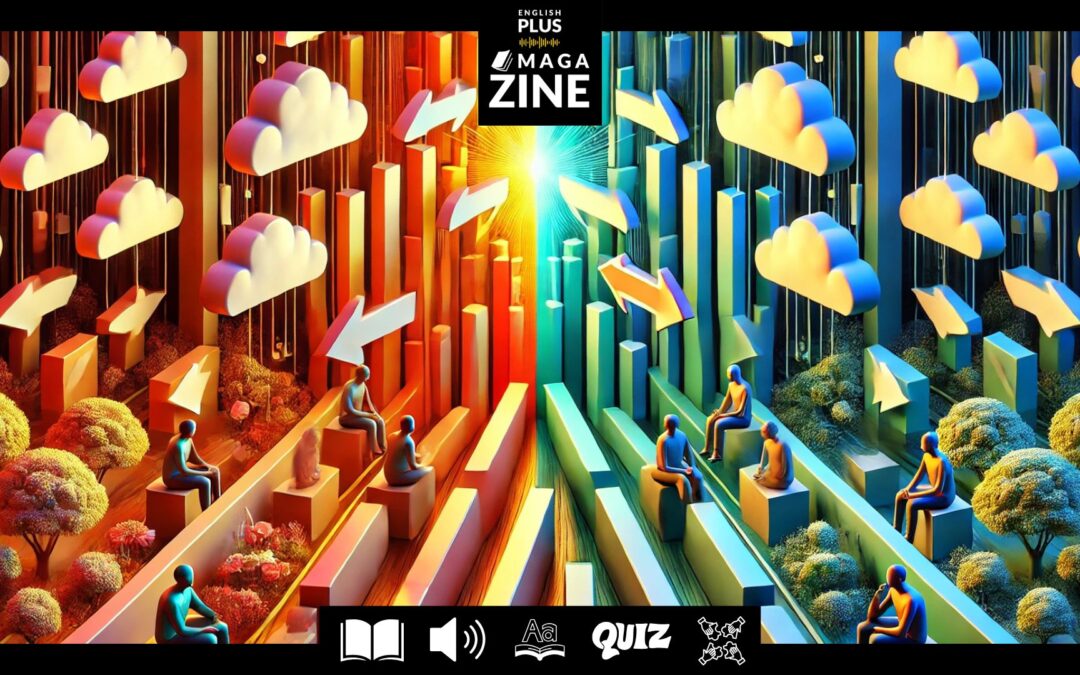
The Narrative Thread: Are You the Author or the Character?
Have you ever tried to explain a part of your life to someone—a past relationship, a career change, a moment that changed everything—and found yourself instinctively shaping it into a story? You set the scene, you introduce the characters, you build the tension, you reveal the climax. We are, at our core, narrative creatures. We don’t just live; we interpret. But this raises a dizzying set of questions. If life is a story, who’s writing it? Are we free agents creating our own plot, or are we characters living out a pre-written script? The quest for finding meaning in life often feels like trying to read a book while you’re still in the middle of it, desperately trying to figure out the theme before the author has revealed the ending.
Free Will vs. Destiny: The Ultimate Writer’s Room Debate
Let’s start with the big one, the question that has kept philosophers up at night for centuries. Are you the author, or are you the character? One school of thought, the free will camp, hands you the pen. Every choice you make—from hitting the snooze button to changing your entire life’s trajectory—is you, writing your own story, sentence by agonizing sentence. You are the protagonist, the narrator, and the all-powerful author. It’s empowering, right? But it’s also terrifying. It means every bad decision, every cringey plot point, every narrative dead-end… that’s on you. There’s no one else to blame. Then you have the destiny argument, the idea that the book is already written. We are simply characters turning the pages, acting out our roles. There’s a strange comfort in this, isn’t there? It absolves you of so much pressure. That terrible breakup? That job you hated? It was all just a necessary part of your character arc, moving the plot forward. It’s so much easier to blame a celestial screenwriter for that time you decided bangs were a good idea in the middle of a humid summer. But the comfort comes at a cost: a loss of agency. Maybe the truth isn’t a choice between the two. Maybe life is more like a “Choose Your Own Adventure” book, where the structure is set, but your choices genuinely create different paths within the grander story. What does it feel like for you? When you look back, do you see a chain of deliberate choices, or a series of events that couldn’t have gone any other way?
The Editing Room of Memory: You and Your Biased Director’s Cut
No story is ever the raw, unedited footage of what happened. It’s a curated selection of scenes, arranged to create a specific effect. And your memory is the most biased editor in the business. Think about it. When you recall your past, you’re not accessing a perfect video file. You are reconstructing it. You choose the starting point. You choose which details to zoom in on—the triumphant moment you proved someone wrong—and which to let fade into the background—the ten years of hard, unglamorous work that led to it. We cast people in roles: the villain, the mentor, the comic relief. And funnily enough, in our own internal director’s cut, we are almost always the sympathetic hero. That argument you had last week? In your version, your points were eloquent and devastatingly logical; the other person was clearly being unreasonable. The “objective” truth is likely somewhere in the messy middle. This isn’t a moral failing; it’s a human survival mechanism. We craft narratives to make sense of the chaos, to justify our actions, to create a version of ourselves we can live with. The real philosophical workout is to ask: What am I choosing to leave on the cutting room floor? Who have I cast as a villain in my story that might be the hero of their own? Acknowledging your role as the editor of your own history doesn’t invalidate your story; it deepens it. It adds a layer of self-awareness that is, in itself, a mark of a great protagonist.
What’s the Theme Here Anyway? Uncovering Your Life’s Central Message
Every great book has a theme, a central idea it’s wrestling with. It might be the corrupting nature of power, the endurance of love, or the search for identity. So, what’s the theme of your book? This can feel like an impossible question. We’re too close to it, still stuck in the middle of Act Two, to see the big picture. Some people seem to be living a clear theme from the start—a life dedicated to service, or art, or family. For many of us, though, the theme is a moving target. Maybe your twenties were a chaotic adventure novel about freedom and self-discovery. Then a “plot twist”—a loss, a new love, a sudden responsibility—hits, and suddenly the book you thought you were in becomes a different genre entirely. The theme shifts from “freedom” to “resilience” or “connection.” Perhaps the most profound realization is that the theme isn’t something we find, as if it were a hidden clue. It’s something we create through the act of interpretation. By looking back at the seemingly random chapters of your life and asking, “What does this all mean?” you are actively weaving the narrative thread. You are assigning meaning. The search for the theme is the theme. It’s a lifelong story about the very human, very beautiful struggle of finding meaning in life.
The Supporting Cast and the Interwoven Narratives
No protagonist is an island. Your story is inextricably linked with countless others. The people in your life aren’t just minor characters who exist to move your plot forward; they are the protagonists of their own sprawling, complex epics, and you are a character in theirs. Sometimes you’re a main character in someone’s chapter, and sometimes you’re just a background extra who appeared in a single scene. This is where life becomes a vast, interconnected library of stories. Your narrative thread weaves around your family’s, your friends’, your community’s. Their triumphs become subplots in your story; their tragedies become turning points that shape your own arc. There is something both humbling and deeply comforting in this. It reminds us that our personal struggles are part of a larger human tapestry. And it means that when a major character exits our story—through distance, disagreement, or death—the hole they leave is profound. Their thread is gone, and the pattern is forever changed. The story must go on, but it will never be the same. Recognizing this interconnectedness forces us to ask: What role am I playing in other people’s stories? Am I contributing to a narrative of kindness, of conflict, of support? Our lives are not monologues; they are a constant, improvisational dialogue with the stories all around us.
Your life is not a tidy, linear novel with a clear beginning, middle, and end. It’s probably more like a messy first draft, full of crossed-out sentences, notes in the margins, and entire chapters you wish you could rewrite. But it is a story. And it is yours. The beauty isn’t in having it all figured out, but in the brave, ongoing act of trying to make sense of the pages, of finding the poetry in the chaos, and of continuing to write, even when you have no idea what happens next.
So, let me ask you this: If you had to give a title to the current chapter of your life, what would it be? Not your whole life, just right now, this very phase. Let us know in the comments below. Let’s see what kind of stories we’re all living.
English Plus Magazine
Exploring the Word Phantasmagoria: Meaning, Origins, and Usage
Dive into the fascinating world of phantasmagoria. Learn its meaning, origins, and how to use this vivid word in writing and speech effectively.
Tsunamis: The Killer Waves That Shape Our World
Discover the science behind tsunamis, their devastating impacts, and how communities prepare for these killer waves. Learn what causes them and how they shape our planet.
Is Glass a Slow-Moving Liquid or Solid? Fact vs. Fiction
Uncover the truth about glass. Is it a slow-moving liquid or a solid? Explore the science behind this fascinating debate and find out the real nature of glass.
The Hidden Sacrifices Behind Success: Lessons from Vaibhav Shah’s Quote
Explore the deeper meaning of Vaibhav Shah’s quote about success. Learn why private sacrifices are often overlooked in the pursuit of public glories and how to embrace the journey.
Understanding “The Best Laid Plans of Mice and Men Often Go Awry”
Explore the meaning and origin of the proverb “The best laid plans of mice and men often go awry.” Learn how it applies to life’s uncertainties and how to embrace unexpected changes.
Crop Circles: Unraveling the Mystery of These Intriguing Patterns
Explore the enigmatic world of crop circles. Learn about their history, potential origins, and the theories behind these captivating agricultural patterns.
The Nature of Consciousness: Exploring the Mind’s Greatest Mystery
Dive into the fascinating world of consciousness. Discover what it is, how it works, and why understanding consciousness remains one of science’s greatest challenges.
Venus: Earth’s Twin or Mysterious Opposite?
Explore the similarities and striking differences between Venus and Earth. Discover why Venus is called Earth’s twin and what makes it a fascinating study for scientists.
Bridging the Gender Gap in Education: Challenges and Solutions
Explore effective strategies to bridge the gender gap in education worldwide. Learn about the barriers, success stories, and the importance of inclusive policies for equal opportunities.
Green Business: Balancing Sustainability with Profitability
Learn how green business practices can boost profitability while promoting sustainability. Explore strategies to create an eco-friendly brand and attract eco-conscious customers.
The Role of Literary Criticism in Understanding Texts: A Comprehensive Guide
Explore the role of literary criticism in understanding texts. Learn how critical analysis deepens appreciation, reveals hidden meanings, and connects literature to broader contexts.
Nepal’s Kumari Tradition: The Living Goddess of Kathmandu
Discover Nepal’s Kumari Living Goddess tradition, a fascinating cultural practice where young girls are revered as divine beings. Explore its history, rituals, and significance.
Also in English Plus Magazine
Mini Podcasts Network
No Results Found
The page you requested could not be found. Try refining your search, or use the navigation above to locate the post.
Stories
Poetry | To A Stranger
To all strangers who are reading or listening to this poem, I salute you. Without you, I could have never called myself a writer. I dedicate this poem to you.
Poetry | Life in a Cubicle
What does life in a cubicle feel like? Have you ever worked in a cubicle? Do you know what it feels like? A lot of people know what I am talking about, and this poem is dedicated to them.
Poetry | To Err Is Man
Unless you want to love a saint, you know that I am a man. My mistakes are the ones that built me. My mistakes are who I am. I am not proud of any, but neither am I ashamed. I owe it to myself to love who I am and strive to be the best, but accept that I may never be. Take me for I am for I cannot be another man.
Poetry | Unfinished Love
When you seek satisfaction, remember you are not the only one. Everyone else wants that, too. Men are like women, they both need love and affection, but when one is satisfied, the other may be not.
Poetry | Mighty Ulysses
Our times are calling out for a hero like in the olden times when heroes made a difference. Yet who should we call upon?
Poetry | The Snail
Sometimes, the problem may not be that you are small. This is the way of the world. There has always been big and small. Weak and strong. Rich and poor, and most of the time you have no say in which pool you are tossed.
Spectrum Radio Mixes
No Results Found
The page you requested could not be found. Try refining your search, or use the navigation above to locate the post.