
English Plus Magazine
Dive into a world of ideas, stories, English and discovery.
Letter from the Editor
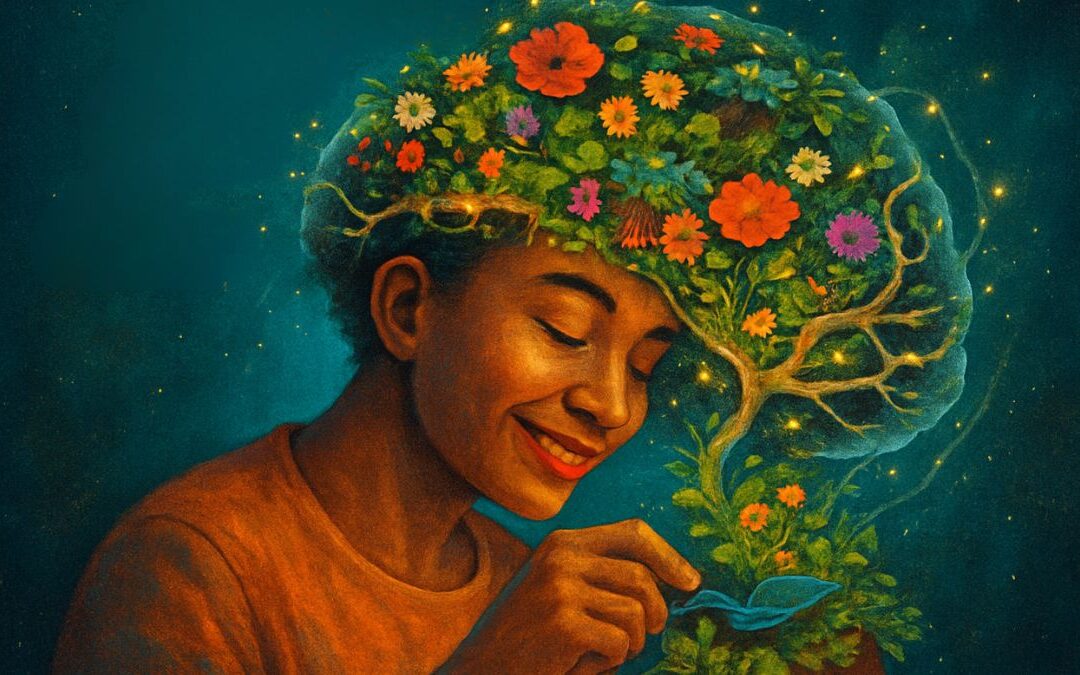
Your Brain is a Garden: How to Weed Out the Negative and Grow a Life You Love
Have you ever wondered if the story you tell yourself about your life is the only one you can live? We often think our circumstances dictate our happiness, but what if the opposite were true? What if the lens through which you view the world is actually the most powerful tool you have to shape it? It’s a question that leads us down a rabbit hole of self-discovery, right to the heart of what it means to cultivate a positive mindset—not as a fleeting mood, but as a deliberate, life-altering practice.
Your Brain’s Sneaky Default Setting
Let’s get one thing straight: if you tend to fixate on the one thing that went wrong in a day full of things that went right, you’re not broken. You’re human. Our brains are hardwired with something called a “negativity bias.” Think of it as a leftover software update from our cave-dwelling ancestors. For them, constantly scanning for threats—a rustle in the bushes, a shadow on the cave wall—was a matter of survival. Missing a pretty flower wasn’t a big deal, but missing a saber-toothed tiger was a very big deal. That ancient, life-saving programming still runs in the background of our modern lives, making us experts at spotting problems and remembering insults, while often letting compliments and moments of joy slide right by. It’s why a single piece of criticism can overshadow a dozen praises. But here’s the beautiful, liberating truth: your brain isn’t fixed hardware. It’s more like clay. This incredible ability to reshape itself is called neuroplasticity, and it means you can consciously choose to carve new pathways—pathways of optimism, gratitude, and resilience.
This Isn’t About Toxic Positivity
Now, when I talk about a positive mindset, I’m not talking about slapping a smiley-face sticker on a dumpster fire. I’m not advocating for “good vibes only” culture, where we pretend pain, grief, and frustration don’t exist. That’s not positivity; that’s denial. A genuine positive mindset isn’t about ignoring the darkness. It’s about acknowledging the darkness, sitting with it, respecting its lessons, and then deliberately choosing to turn your face toward the light. It’s the quiet courage to say, “This is incredibly difficult, and I will look for the lesson in it. This hurts, and I believe I have the strength to get through it.” It’s the difference between standing in a storm and pretending it isn’t raining, versus finding the strength to dance in it anyway, knowing the sun will eventually return.
The Universe Inside Your Head
Think of your mind as a garden. For years, you might have let the weeds of worry, self-doubt, and fear grow unchecked. They’re invasive, they’re stubborn, and they can easily choke out everything else. Cultivating a positive mindset is the act of becoming a conscious gardener. It’s about getting your hands dirty. It’s about identifying the weeds—those automatic negative thoughts—and gently, persistently pulling them out, one by one. And then, in the space you’ve cleared, you start planting seeds. Seeds of gratitude. Seeds of self-compassion. Seeds of possibility. At first, it feels like a lot of work for a few tiny sprouts. But you water them every day with your attention and your intention. You give them the sunlight of your focus. And over time, without you even realizing it, your inner landscape transforms from a patch of weeds into a flourishing garden that sustains you.
The Small Hinges That Swing Big Doors
So how do we start gardening? It’s not about grand, sweeping gestures. It’s about the small, consistent practices that, over time, create monumental shifts. It’s the small hinges that swing the biggest doors. Start with gratitude. Before you even get out of bed, or as you’re brushing your teeth, think of three specific things you’re grateful for. Not just “my family,” but why. “I’m grateful for the way my partner made me laugh yesterday.” “I’m grateful for the feeling of the warm sun on my skin through the window.” This practice literally trains your brain to scan the world for good things, counteracting that old negativity bias. Another powerful tool is the reframe. When you catch yourself thinking, “I can’t handle this,” try adding one simple, three-letter word: “yet.” “I can’t handle this yet.” That single word transforms a dead-end statement into a bridge. It acknowledges the struggle while affirming your capacity for growth. It’s a declaration that your story isn’t over.
Finding the Stars in a Pitch-Black Sky
But what about when life truly falls apart? When you’re facing loss, heartbreak, or a diagnosis that knocks the wind out of you? That’s when the practice of a positive mindset is tested not as a feel-good accessory, but as a survival tool. During these times, positivity isn’t about feeling happy. It’s about finding meaning. It’s about asking, “What can this teach me? How can this make me stronger? How can I use this experience to become a more compassionate human being?” It’s the profound wisdom of Viktor Frankl, a psychiatrist and Holocaust survivor, who found that the one thing that could never be taken from a person was the freedom to choose their attitude in any given set of circumstances. In the deepest darkness, he discovered that our perspective is our last and greatest freedom. It’s the ability to find a pinprick of starlight in a pitch-black sky and to navigate by its faint glow until the dawn finally breaks.
Your Perspective is Your Superpower
Ultimately, this all boils down to a fundamental question about your life: Are you a passive passenger, or are you the pilot? Circumstances will happen. Storms will come. People will disappoint you. The world will be messy and unpredictable. Those are the external weather patterns. But your internal climate? That’s yours to create. Your perspective is the thermostat for your soul. It doesn’t change the weather outside, but it determines whether you feel warmth and safety inside. This isn’t just about feeling better; it’s about becoming the creative force in your own life. When you shift your mindset, you begin to see opportunities where you once saw obstacles. You attract different people and experiences because you’re vibrating at a different frequency. You don’t just change how you see the world; you change the world you see.
So, let’s become the gardeners of our own minds. Let’s get our hands dirty, pull some weeds, and plant something beautiful. Let’s honor the storms when they come, but never forget that we have the power to choose where we focus our gaze—on the mud, or on the stars.
I’m curious, what’s one small weed you can pull from your mental garden this week? And what’s one beautiful seed you’d like to plant in its place? Share your thoughts in the comments below; I’d love to see what you’re growing.
More Editorials
No Results Found
The page you requested could not be found. Try refining your search, or use the navigation above to locate the post.
Featured Articles

How to Create Your Own Home Gym on a Budget
Learn how to create your own home gym on a budget with affordable equipment ideas and practical tips to help you stay fit without breaking the bank.

Dante Alighieri: The Poet Who Journeyed Through Heaven and Hell
Discover the life and legacy of Dante Alighieri, the iconic poet whose Divine Comedy shaped literature and continues to influence the world with its exploration of love, morality, and the afterlife.

The Battle of Gettysburg: Turning Point of the American Civil War
Discover the story of the Battle of Gettysburg, a crucial turning point in the American Civil War. Learn how this fierce battle shaped history and the events that led to its outcome.
Food Insecurity and Hunger: Understanding the Global Challenge
Explore the causes and impacts of food insecurity and hunger, and learn how communities and global initiatives are working to address this critical social issue.
The Death of Balder: A Tragic Tale from Norse Mythology
Explore the Norse myth of the death of Balder, the beloved god whose tragic fate set the stage for Ragnarok. Learn about betrayal, prophecy, and how his death marked the beginning of the end for the gods.

Understanding the Peak-End Rule: How We Judge Our Experiences
Discover the psychology behind the peak-end rule, which explains how we judge experiences based on their most intense moments and their conclusion. Learn how this impacts decision-making and memory.

The Shortest War in History: Britain vs Zanzibar, 1896
Discover the fascinating story of the shortest war in history between Britain and Zanzibar in 1896, lasting only 38 minutes. Learn what triggered it and how it ended so quickly.

The Concept of Entropy: The Universe’s Unstoppable Trend Toward Disorder
Discover the concept of entropy, how it drives the universe toward disorder, and what this fundamental law of thermodynamics reveals about life, time, and energy.

Frequently Asked Questions About Artificial Intelligence: Your Guide to Understanding AI
Explore answers to the most frequently asked questions about artificial intelligence, covering everything from how AI works to its impact on society and future trends.
More Articles
The Immortal Jellyfish: Nature’s Secret to Eternal Life in the Ocean
Discover the fascinating world of the immortal jellyfish, a creature that can reverse aging and revert to its juvenile form after maturity, challenging our understanding of life and death.
Bioinformatics: Bridging Biology and Computer Science for Breakthrough Discoveries
Explore how bioinformatics connects biology and computer science, revolutionizing fields like genetics, drug discovery, and personalized medicine through data analysis and computational tools.
Frequently Asked Questions About Classical Music: Everything You Need to Know
Discover answers to the most common questions about classical music, including its history, genres, famous composers, and why it’s still relevant today.
Unlocking the Power of the Word Dauntless
Discover the meaning of the word dauntless, its origins, and how you can use it in everyday language to describe someone who shows fearless determination.
Exploring Salt Flats: Nature’s Perfect Mirror
Discover the breathtaking beauty of salt flats, nature’s perfect mirror. Learn how these vast landscapes are formed and why they create such stunning reflections on Earth.
Is a Dog’s Mouth Really Cleaner Than a Human’s?
Explore the claim that a dog’s mouth is cleaner than a human’s. Learn the truth about bacteria in both and whether your dog’s slobber is as safe as you think.
Why Trust Is About Taking Risks, Not Certainty
Discover the meaning behind the quote “Trust because you are willing to accept the risk, not because it’s safe or certain” and explore how real trust involves embracing uncertainty and vulnerability.
Why It’s Important to Practice What You Preach
Discover the meaning behind the proverb “practice what you preach” and why aligning your actions with your words is key to building trust and integrity in both personal and professional life.
Unveiling the Mystery of the Lost City of Atlantis
Dive into the mystery of the Lost City of Atlantis. Discover its origins, the theories behind its existence, and why this legendary civilization continues to capture our imagination.
How Does Anesthesia Work at a Molecular Level?
Discover how anesthesia works at the molecular level. Learn how this remarkable medical technology interrupts pain signals and consciousness through fascinating chemical interactions.
Learn English Magazine

The Life and Achievements of Leonardo Da Vinci: A Renaissance Man
Explore the life and achievements of Leonardo da Vinci, the great Renaissance artist, engineer, and inventor. Discover his legacy and impact on art, science, and technology.

Exploring Love and Loss
Dive into the complexities of love and loss with D.H. Phoenix’s evocative poems. From heartbreak to new beginnings, these poems explore the universal experiences of navigating relationships and finding meaning in life.
The Timeless Appeal of Pride and Prejudice: A Closer Look at Jane Austen’s Masterpiece
Discover the enduring appeal of Jane Austen’s classic novel, Pride and Prejudice. From its timeless themes to its masterful prose, this beloved masterpiece continues to captivate readers today.
The Oracle of Delphi: A Powerful and Influential Figure in Ancient Greece
Discover the fascinating history of the Oracle of Delphi and her influence on Ancient Greece. Explore her role in the Pythian Games, the founding of Cyrene, and more.

The Struggle of Being a Poet: My Journey as an Unknown Writer
Follow my journey as a struggling poet, writing for years and facing rejection after rejection. Despite the lack of recognition, I share my words, pouring my heart onto paper and persevering in my passion.
Mastering the Elements of Short Story Writing: Tips from Edgar Allan Poe
Discover the key elements that contribute to the power of a well-written short story, as we take a deep dive into the craft of short story writing, providing tips from Edgar Allan Poe on character development, plot structure, setting, dialogue, theme, and point of view.
Exploring the Rich History and Enduring Beauty of the Sonnet Form
From Petrarch to Shakespeare to Spenser, the sonnet has been a beloved poetic form for centuries. Learn about its origins, forms, and examples in this in-depth exploration.

Explore the Fascinating World of Greek Mythology: A Comprehensive Guide to the Gods and Goddesses
Discover the captivating world of Greek mythology and its most prominent deities. Learn about the Twelve Olympians and their powers, relationships, and roles in ancient Greek culture.

Crafting a Memorable Setting in Fiction Writing: Tips and Techniques for Immersive Environments
Discover how to create evocative and memorable settings that captivate readers and elevate your fiction writing. Learn tips and techniques for crafting immersive environments that enhance character development, advance plotlines, and resonate with readers.
Exploring War Poetry by Danny Ballan: Analysis and Paraphrasing
Dive into the world of war poetry with D. H. Phoenix’s evocative works, expertly analyzed and paraphrased in this insightful post.
Literary Magazine
No Results Found
The page you requested could not be found. Try refining your search, or use the navigation above to locate the post.