
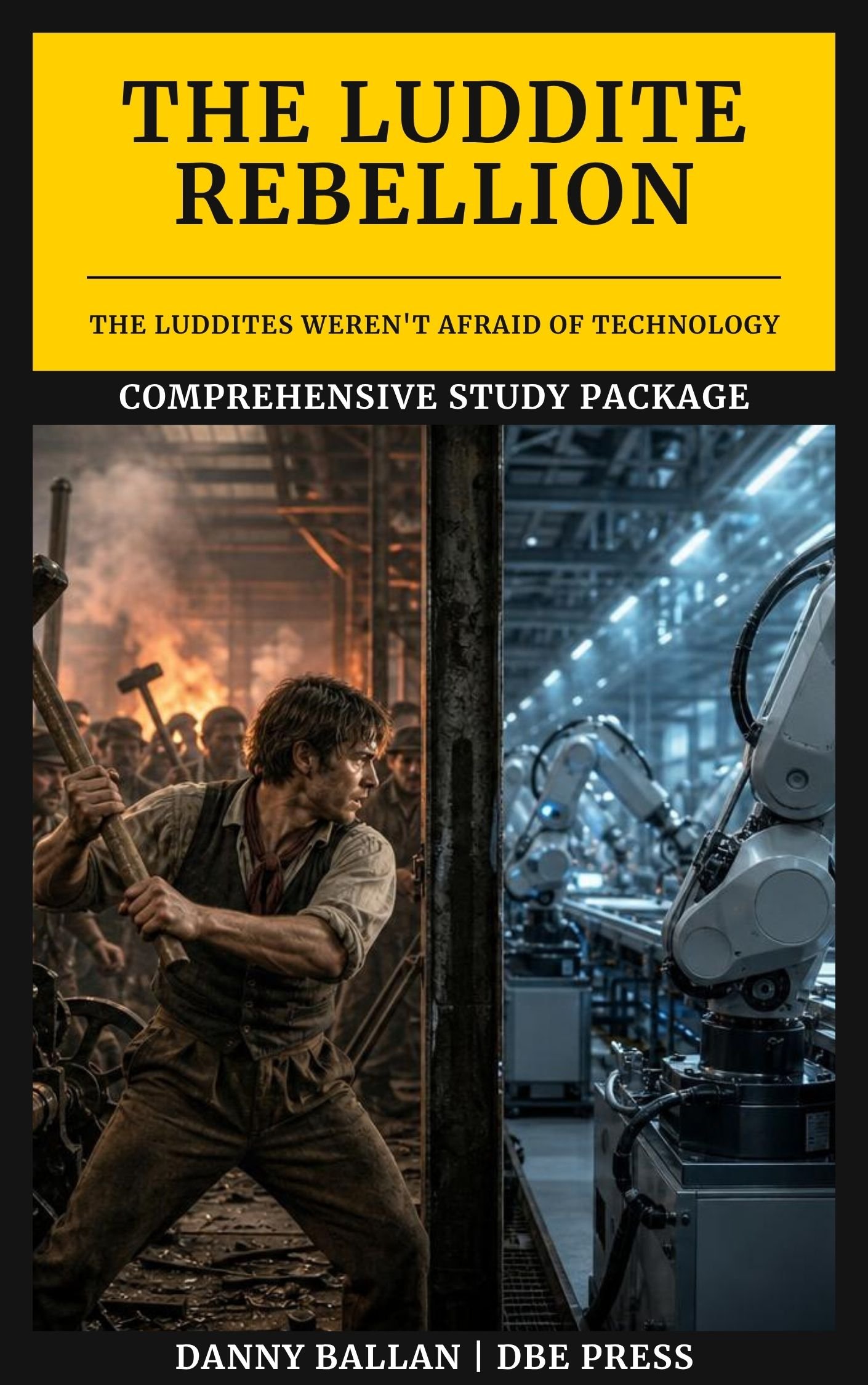
Luddites and AI | CSP
Almost every student has used the word “Luddite” as an insult. Almost none of them know it named a group of highly skilled workers who were not afraid of technology at all. This unit uses that gap as its hook, and then spends 109 pages and a full audio lecture turning it into serious reading, listening, vocabulary, writing, and debate practice.
The core argument is simple and students find it electrifying: the Luddites of 1811 to 1816 were not smashing machines because machines frightened them. They were fighting over who controlled the machines and who kept the gains. That question has not aged. It is the same question sitting under every conversation your students are having about AI right now.
What’s included
A 3,000-word main article, “The Luddites Weren’t Afraid of Technology,” covering the stockingers of Nottinghamshire, the croppers of Yorkshire, the myth of Ned Ludd, the phrase “machinery hurtful to commonality,” the Frame Breaking Act of 1812, Byron’s maiden speech in the House of Lords, and the York Special Commission.
A full rebuttal section, “Let’s Get Critical,” that argues against the main article on purpose, so students have two credible texts to work between instead of one they are expected to agree with.
A “Fantastic Guest” interview with Lord Byron, written as a dramatized conversation, usable as a paired reading, a read-aloud, or a study of how voice and persuasion are constructed.
An original short story, “The Quiet Take,” with an Author’s Commentary that follows it, so students can read for theme and symbolism first and compare their reading to the writer’s afterward.
Twelve discussion questions and a “What Now?” section built around three questions and two habits, plus a seven-day action plan students can actually finish.
A vocabulary lesson covering ten high-value keywords, with definitions, usage guidance, and French, Spanish, Italian, and Arabic translations, followed by a guided vocabulary builder with stop-and-think prompts and a speaking challenge.
A separate 10-page vocabulary activity workbook covering thirty keywords: a themed crossword, a word search, a thirty-item spelling discrimination exercise, thirty contextual gap-fill sentences, and a study sheet with all thirty definitions. A complete 10-page answer key comes with it, including the solved crossword grid and the marked word search.
A grammar and writing lesson on concession, hedging, and the counterfactual conditional, which is exactly the language students need to write a nuanced argument instead of a shouting one.
Three capstone projects, each written at three levels, so a mixed-ability class can work on the same project at the right stretch. Below Level is roughly B1 to B2, At Level is C1, Above Level is C1 to C2. A four-criterion rubric is included for self-assessment and grading.
A glossary of key terms with usage notes.
A 30-question quiz in two parts, comprehension and vocabulary, with a “Your Reasoning” line under every item so students have to defend the answer, not just pick it.
A complete answer key with full feedback that explains why the correct answer is correct and why each distractor is wrong. This is the part teachers tell us saves the most time.
A listening comprehension lecture, “The Machines We Chose to Break,” on the red-flag road laws, the canuts of Lyon, the Swing Riots, and William Lee’s stocking frame, delivered as a ready-to-play audio recording with the full script included, plus a 10-question listening quiz and its own full-feedback answer key. Play it in class, assign it for homework, or run it as timed exam practice.
A self-study guide mapping the package to exam skills, for independent learners or for students you want to hand extra work.
A teacher’s guide with two complete pathways, a First Language path and an ESL path, each with day-by-day scheduling, focus areas, differentiation notes, and separate guidance for in-person and online delivery.
Who this is for
High school and upper-level ELA, AP Language and Composition, IB English, world and European history, and any classroom running a unit on technology, work, or the Industrial Revolution. It also works as written for advanced ESL and EFL, CEFR B2 to C2, including IELTS, TOEFL, and Cambridge preparation, because the listening, speaking, reading, and writing components are balanced by design and the listening section comes with real audio rather than a script you have to perform yourself.
How to use it
The teacher’s guide lays out one to three weeks depending on your contact hours. The First Language path runs two weeks: week one on argument, ending in a Socratic seminar and a synthesis essay; week two on craft and voice, ending in a timed essay and the capstone launch. The ESL path runs two to three weeks: vocabulary and reading, then listening and speaking, then writing and capstone. Take what serves your students and leave the rest.
Format
109 pages across three print-ready PDFs, plus one audio file for the listening lecture. No prep required. Answer keys included for the quiz, the listening quiz, and the vocabulary workbook.
One thing worth saying plainly. This unit does not tell students that AI will ruin everything, and it does not tell them progress always works out. It refuses both cartoons and teaches them to ask three better questions instead: who benefits, who decides, and what is the alternative. If a student in your room is anxious about their own future, that framing turns dread into analysis, which is the whole point.
Standards
Reading Informational Text
RI.9-10.1 and RI.11-12.1, textual evidence and inference. The quiz’s “Your Reasoning” line is built for this.
RI.9-10.2 and RI.11-12.2, central idea and its development.
RI.9-10.3, analyze how ideas and events are introduced and connected.
RI.9-10.4 and RI.11-12.4, word meaning including figurative, connotative, and technical language. The word “Luddite” itself is the case study.
RI.9-10.5, analyze how an author’s ideas are developed by structure.
RI.9-10.6 and RI.11-12.6, author’s point of view and rhetoric.
RI.9-10.8 and RI.11-12.8, evaluate argument, reasoning, and evidence. The rebuttal section makes this unusually easy to assess.
RI.9-10.9 and RI.11-12.7, analyze seminal or multiple sources on the same topic.
Literacy in History and Social Studies
RH.9-10.1 through RH.9-10.6, and RH.11-12.1 through RH.11-12.6, covering evidence, central ideas, sequence of events, vocabulary specific to history, text structure, and point of view.
RH.9-10.8 and RH.11-12.8, assess the extent to which reasoning and evidence support the author’s claims.
Reading Literature (for the short story and commentary)
RL.9-10.1, RL.9-10.2, RL.9-10.3, RL.9-10.4, and RL.9-10.5.
Writing
W.9-10.1 and W.11-12.1, argument with valid reasoning, including the counterclaim requirement that the capstone rubric explicitly grades.
W.9-10.2, informative and explanatory writing.
W.9-10.4, W.9-10.5, and W.9-10.6, production, revision, and publishing.
W.9-10.9, draw evidence from texts to support analysis.
Speaking and Listening
SL.9-10.1 and SL.11-12.1, collaborative discussion. The discussion questions are written as a seminar spine.
SL.9-10.2 and SL.11-12.2, integrate and evaluate information presented in diverse media and formats. The audio lecture makes this one legitimate, and it is the standard most nonfiction units cannot claim.
SL.9-10.3 and SL.11-12.3, evaluate a speaker’s point of view, reasoning, and use of evidence. The listening lecture and its quiz assess exactly this.
SL.9-10.4 and SL.11-12.4, present information clearly. The speaking challenge covers it.
Language
L.9-10.2 and L.11-12.2, command of spelling. The workbook’s spelling discrimination exercise is a direct hit.
L.9-10.4 and L.11-12.4, determine word meaning using context and etymology. The workbook’s thirty gap-fill sentences and the “sabotage” folk-etymology discussion both serve this.
L.9-10.5, figurative language and nuances in word meaning.
L.9-10.6 and L.11-12.6, acquire and use academic and domain-specific vocabulary. With thirty tier-two and tier-three words taught and assessed, this is the strongest single alignment in the unit.
 The Polymath Advantage | Comprehensive Study Package (CSP)
  The Gamification of Language Learning CSP
  Video Games as Modern Literature CSP
  Succession Planning CSP
  The Standard Model CSP
  Plate Tectonics CSP
  The Loneliness Epidemic CSP
  Ethical Leadership CSP
  The Futility of War CSP
  Digital Legacy and the Afterlife of Data CSP
 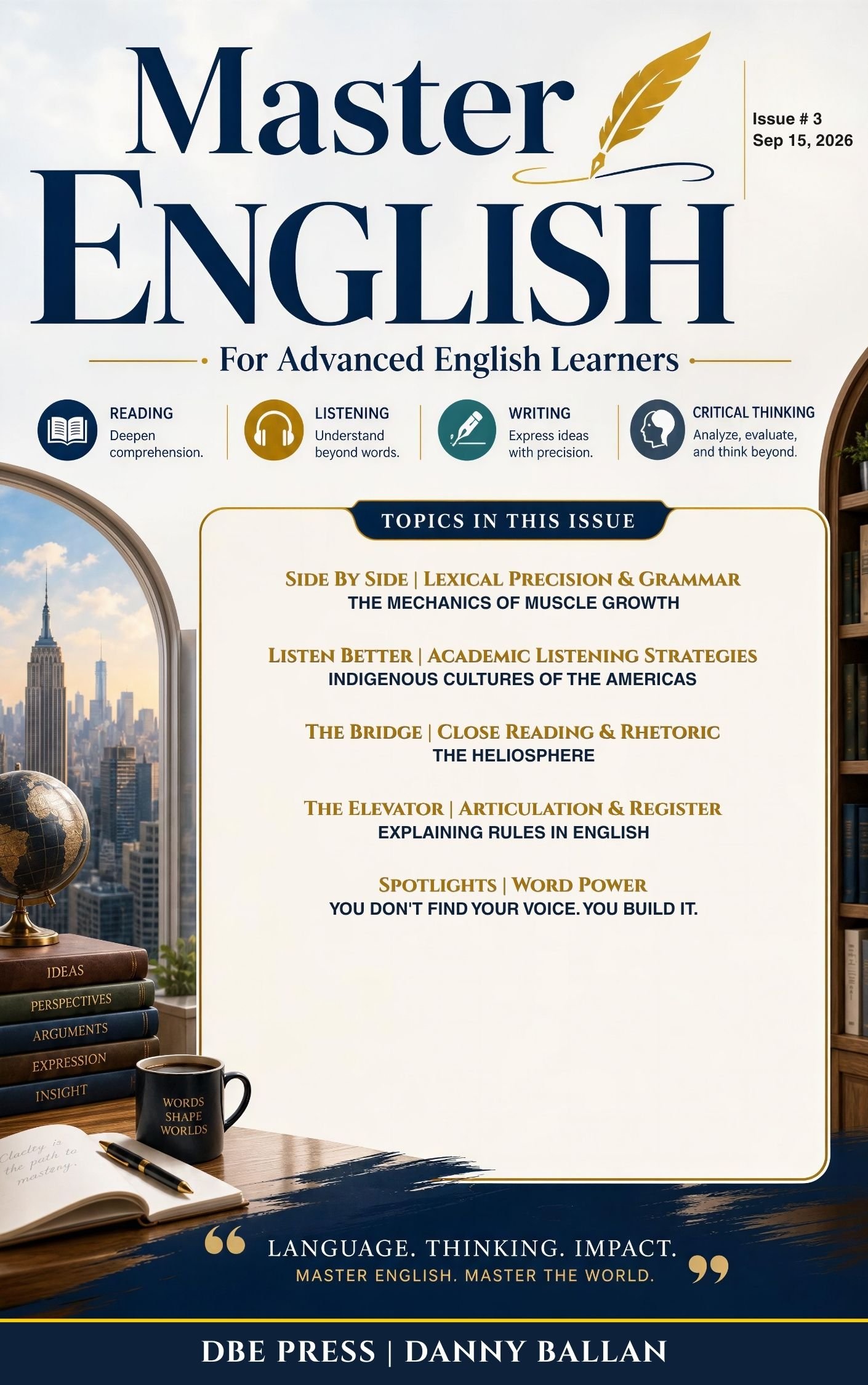 Master English Magazine | Issue #3
 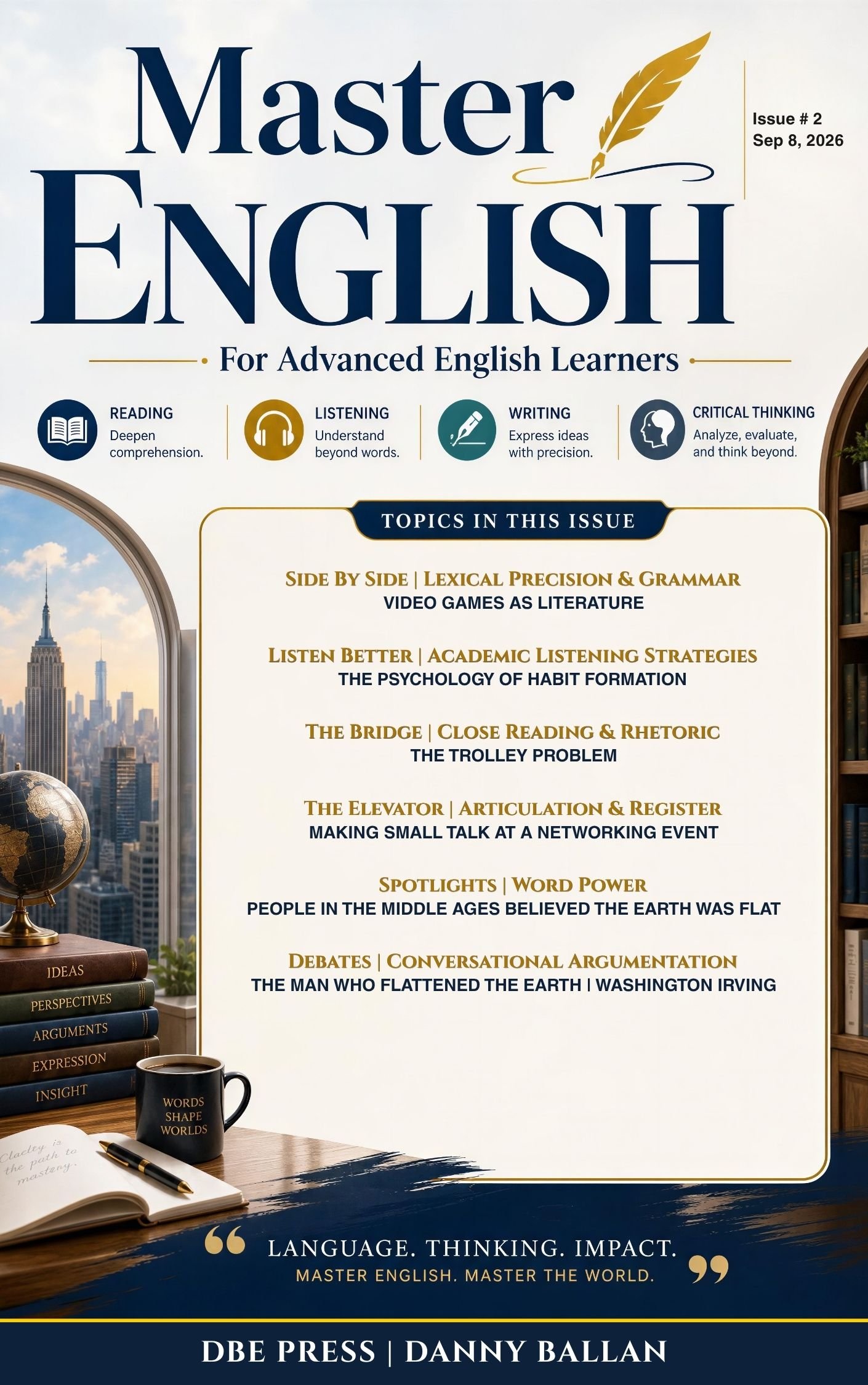 Master English Magazine | Issue #2
 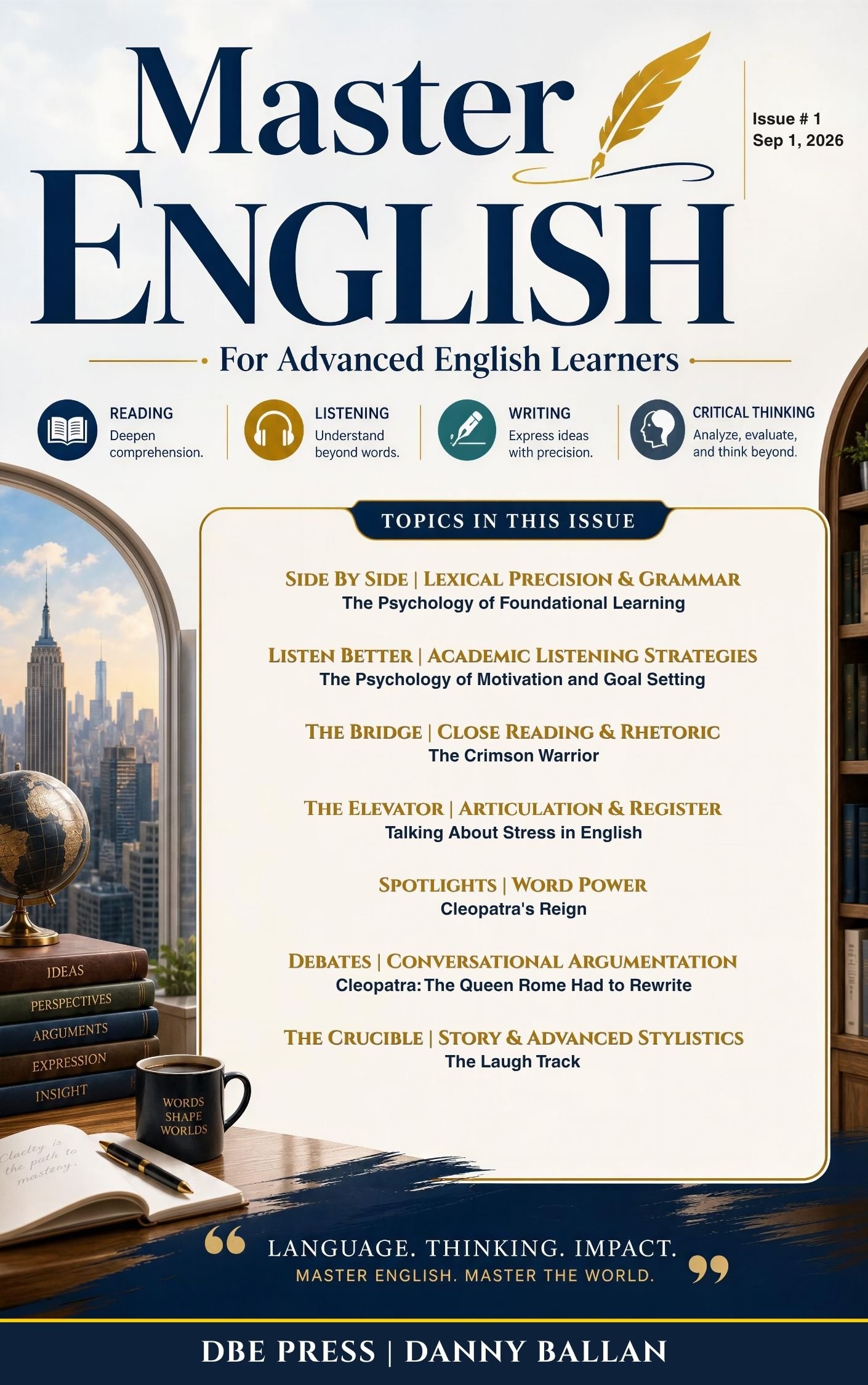 Master English Magazine Issue #1
  Living in Lebanon
  When the Bells Stop Ringing
  Identity | Poetry
  The War Edition | Poetry
  The Scream | Poetry
  Long Way from Home | Novel