
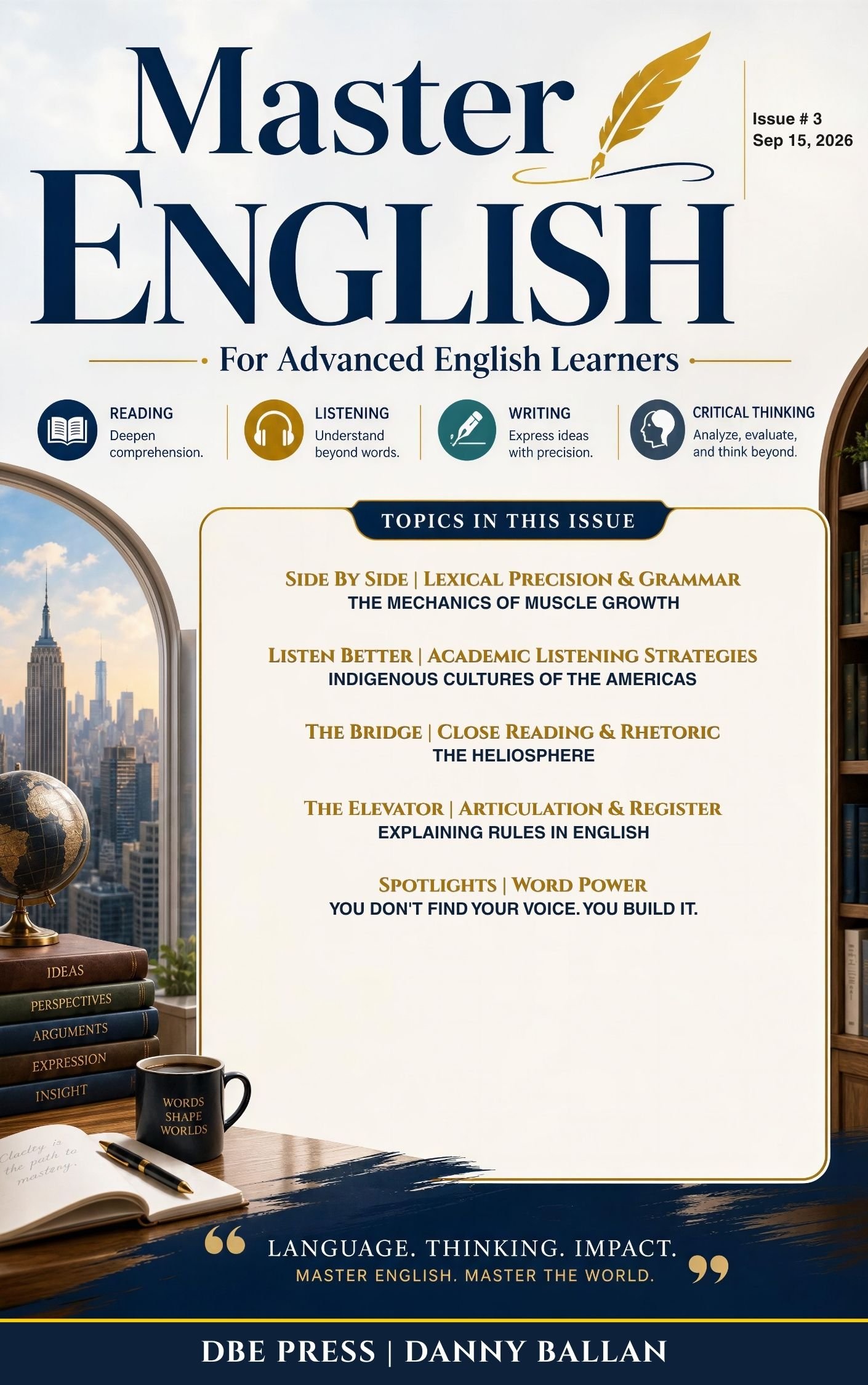
Master English Magazine | Issue #3
In this issue of Master English Magazine, you will find the following topics:
Side By Side | You Don’t Grow at the Gym: The Mechanics of Muscle Growth
Two people do the identical workout. One can barely walk for three days. The other feels fine by dinner. Which one grew more muscle?
You can’t tell. And the fact that almost everyone thinks you can is a good sign of how much folk wisdom is still standing in this field.
This episode goes into the actual mechanics: mechanical tension and how a physical force gets converted into a chemical instruction, the constant demolition and rebuilding that means you replace a meaningful fraction of yourself every week, Henneman’s size principle and why a light weight taken far enough does much of what a heavy one does, satellite cells donating their nuclei to a cell that already has hundreds, and the genuinely unresolved question of whether muscle remembers. Plus a good story about a soil sample from Easter Island and a molecule named after the drug that shuts it off.
The English is built alongside, as always. Latin plurals that keep tripping up advanced writers. Present perfect versus past simple, which is the exact grammar of ongoing effort. Reporting verbs arranged by strength, so you can attribute a finding without overstating it. The like versus as distinction. And the countable and uncountable nouns that make this topic a minefield.
There are pauses. They’re working pauses. Build your version first.
For C1–C2 learners, teachers, the curious, and anyone who has ever wondered where exactly the progress goes between sessions.
Listen Better | Indigenous Cultures of the Americas
Advanced English listening practice for IELTS, TOEFL, and SAT. Listen to an academic lecture on Indigenous American civilizations and answer 10 exam-style questions.
You are about to hear part of a university lecture in an anthropology course. The speaker examines what archaeological evidence reveals about the Indigenous societies of the Americas before European contact, and why the picture presented in older textbooks was so badly mistaken. Before you listen, consider this question: if a landscape looks wild and untouched, how would you know whether it had been shaped by people? The speaker’s answer to that question runs through the entire lecture.
The Bridge | The Heliosphere: The Giant Bubble the Sun Blows Around Us
A C1-level close reading experience built around one of the strangest structures in our neighborhood: the vast magnetic bubble the Sun inflates around itself, and inside which every human being who has ever lived has spent their entire life. You’ll read a full-length article on solar wind, termination shocks, the two Voyager spacecraft that crossed the boundary decades apart, and the genuine scientific argument over what shape the thing even is. Close reading and critical thinking questions follow every paragraph, and a detailed analysis unpacks the vocabulary, grammar, metaphors, and reasoning behind them. You’ll finish with a writing challenge and a speaking challenge designed to move your English from competent into genuinely advanced.
The Elevator | Explaining Rules in English: How to Teach a Board Game Without Losing the Room
Have you ever explained a game for twenty solid minutes, finished, felt rather pleased with yourself, and then had someone ask, “Sorry, so what are we actually trying to do?” That question is the sound of an explanation that started in the wrong place, and it is the most common mistake in instruction of any kind. In this episode we build the English of explaining rules, which turns out to be the English of explaining anything: imperatives and sequencing at the elementary level, the modal verbs of obligation and permission at intermediate; including the difference between “you mustn’t” and “you don’t have to,” which are opposites that learners routinely swap, and at the advanced level the exact, slightly legalistic register of written rulebooks. Along the way: the curse of knowledge, why experts are so often the worst teachers, and why a demonstrated turn beats five minutes of accurate description every single time.
Spotlights WP | You Don’t Find Your Voice. You Build It.
“Find your authentic voice” might be the most repeated and least examined piece of creative advice in circulation. It sounds like archaeology: dig deep enough, clear away the influences, and the real you is down there. In this episode we take that metaphor apart and replace it with something far more useful and considerably more encouraging. We’ll look at Hunter S. Thompson retyping The Great Gatsby word for word, Benjamin Franklin teaching himself prose by rewriting essays he’d deliberately half-forgotten, and the psychological research showing that our idea of a “true self” is quietly, stubbornly moralized. We’ll talk about why your personality feels flatter in a second language and what to actually do about it, and why in an era of frictionless machine-generated competence, the specific weirdness of one human being is becoming the scarce commodity. Includes our “Let’s Get Critical” segment, where we argue that being told to be yourself is not equally safe for everyone, plus a full Language Focus section for advanced English learners.
Grab your copy of Issue 3 today, dive into the deep end, and let’s get to work!
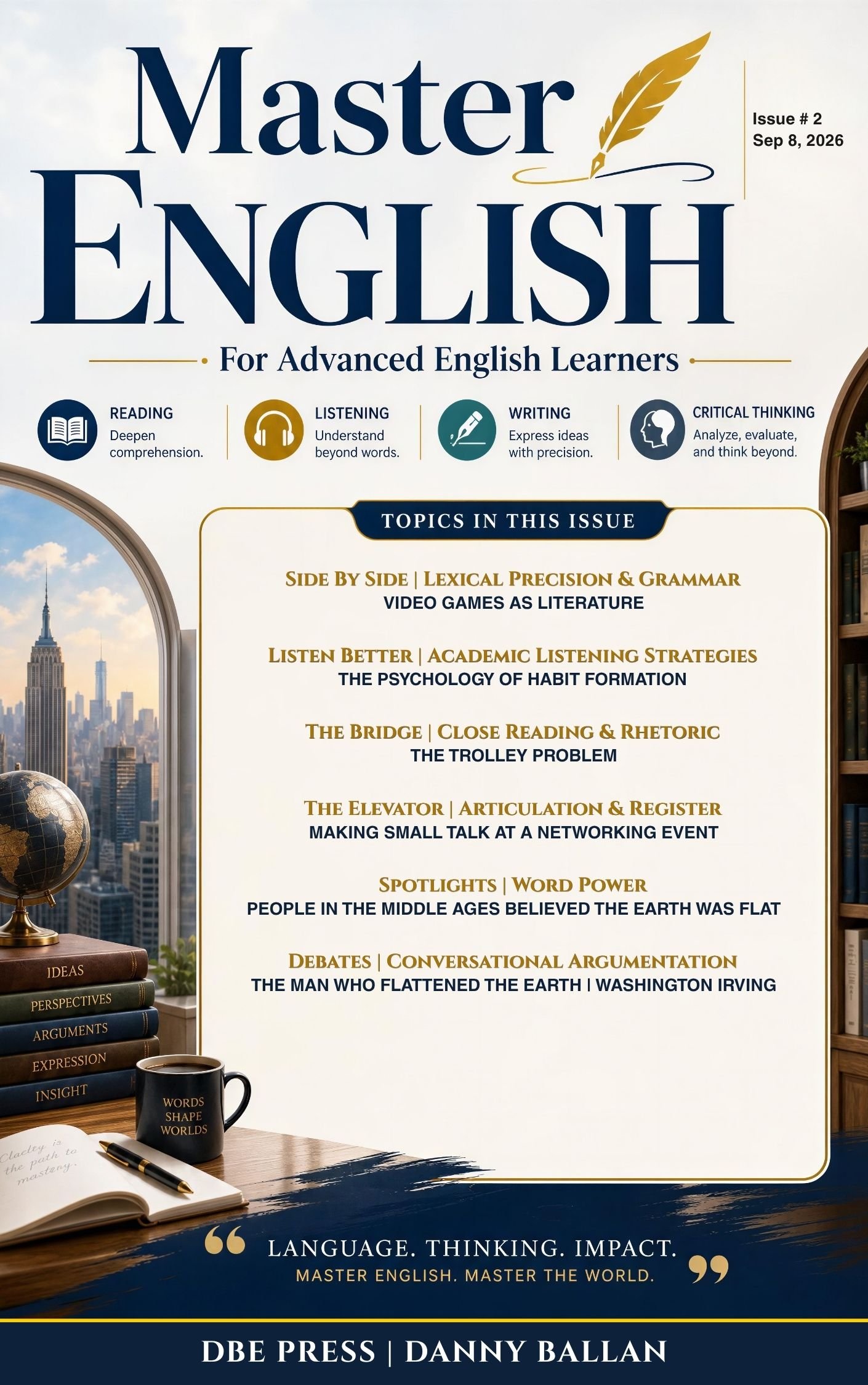 Master English Magazine | Issue #2
 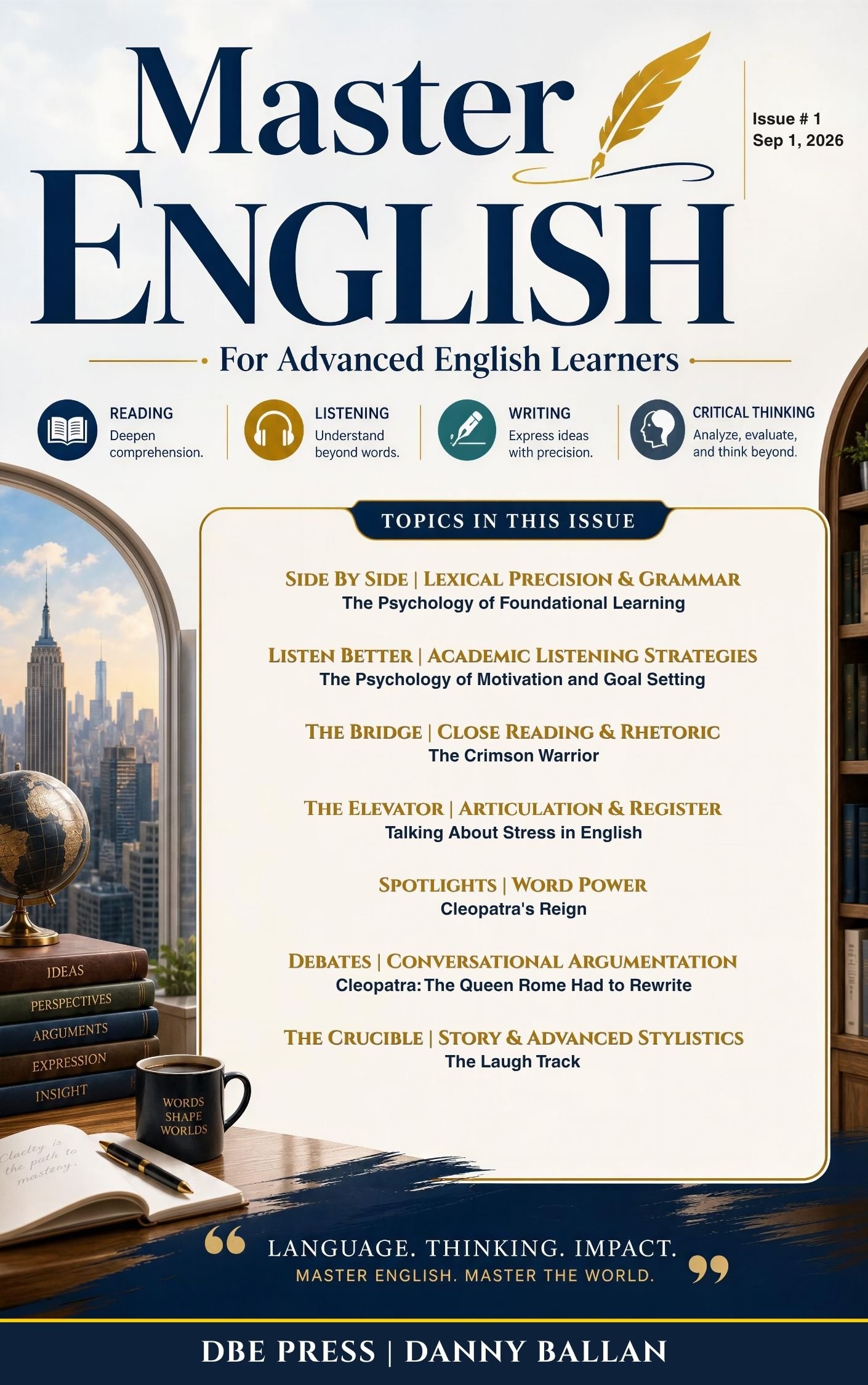 Master English Magazine Issue #1
 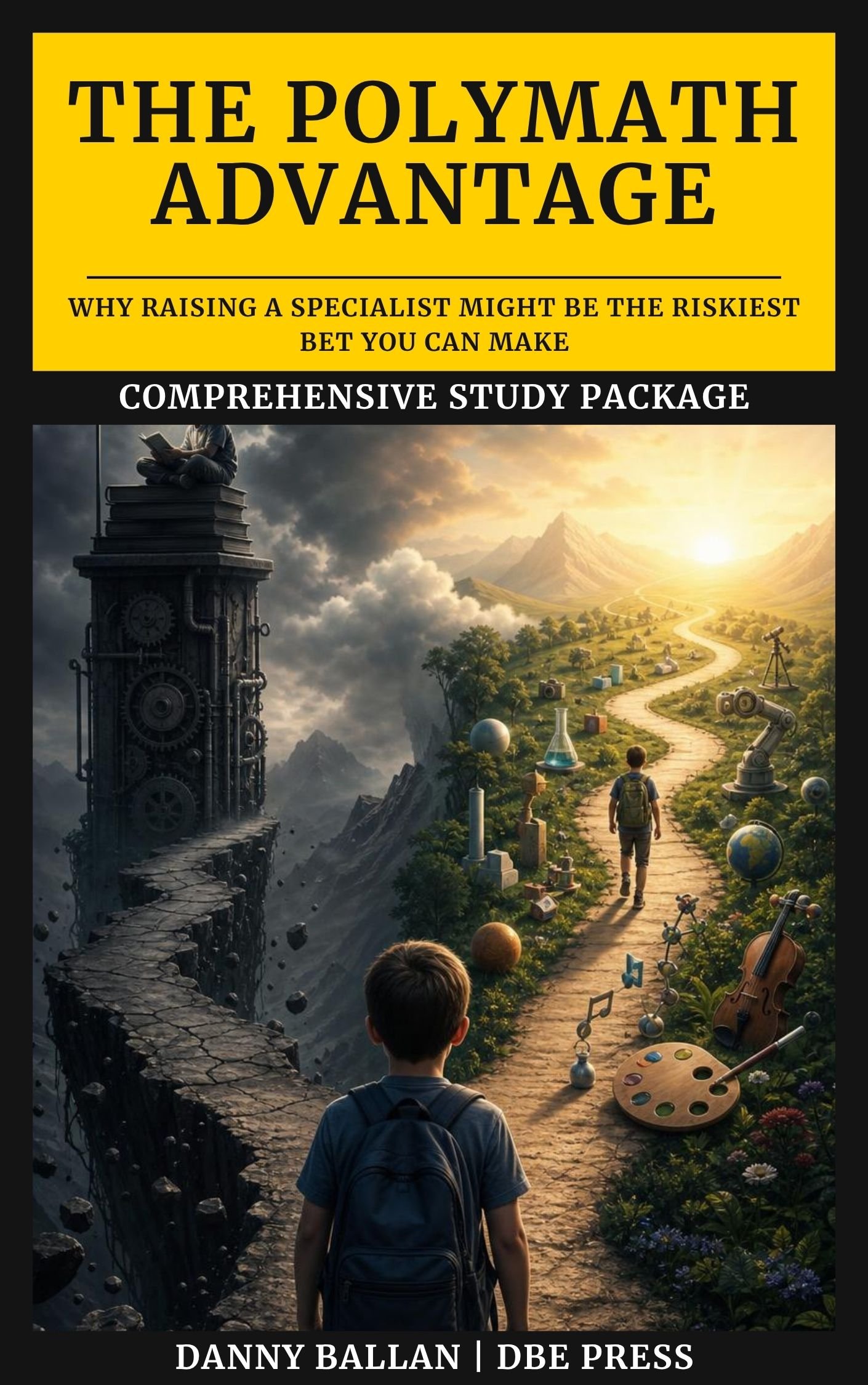 The Polymath Advantage | Comprehensive Study Package (CSP)
 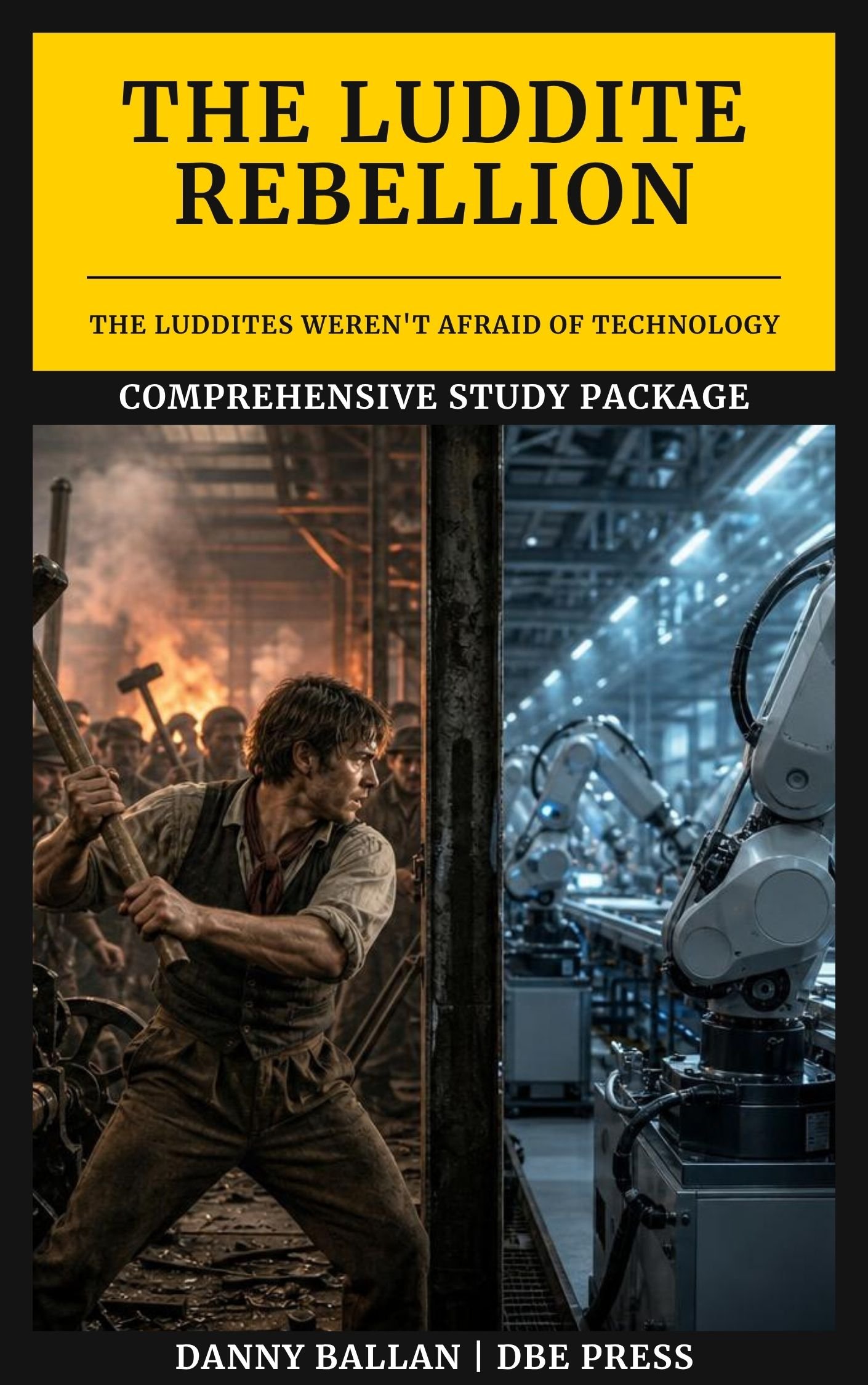 Luddites and AI | CSP
  Living in Lebanon
  When the Bells Stop Ringing
  Identity | Poetry
  The War Edition | Poetry
  The Scream | Poetry
  Long Way from Home | Novel