
English Plus Magazine
Dive into a world of ideas, stories, English and discovery.
Letter from the Editor
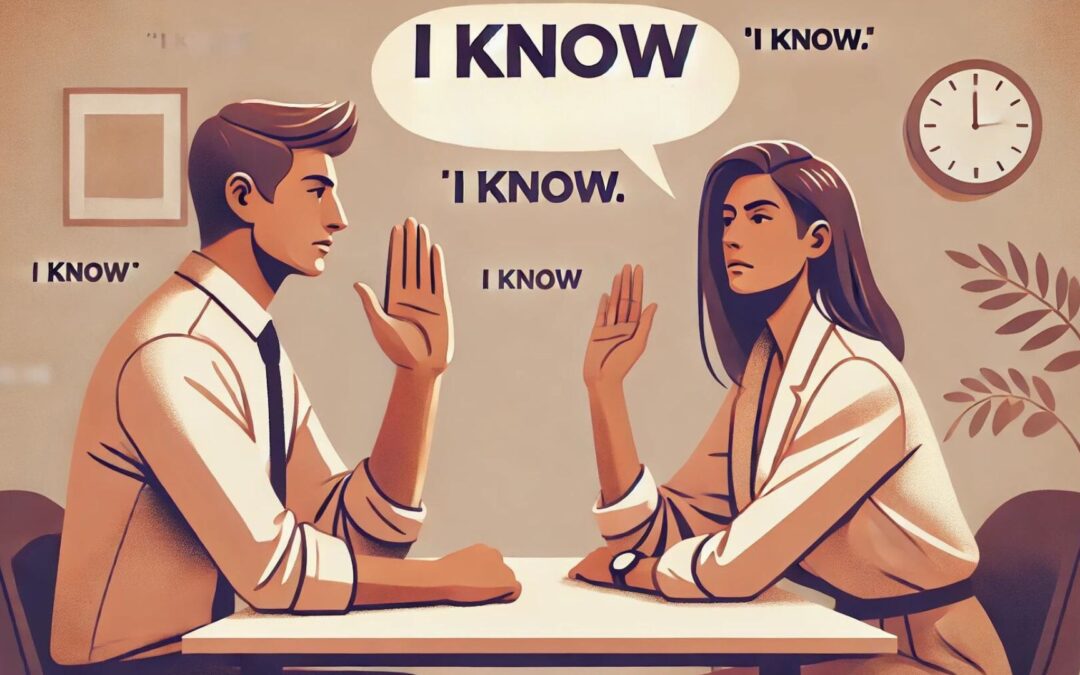
Stop Responding to Everything People Say with, “I Know”
Let’s talk about something that’s been bugging me lately or I may say for quite sometime now. You know that moment when you’re trying to share something with someone—a piece of advice, an interesting fact, maybe even something you learned the hard way—and before you’ve even finished your sentence, they hit you with that infamous “I know.” I mean, how does that make you feel? For me, it’s like an instant conversation killer, a brick wall of assumed knowledge. And here’s the kicker: most of the time, I’m pretty sure they don’t really know.
Now, don’t get me wrong, we live in an amazing time where information is literally at our fingertips. Want to learn about quantum physics? There’s a YouTube video for that. Want to understand the intricacies of ancient Greek philosophy? Google it, and bam, you’re a philosopher—or so you might think. The problem isn’t the access to information; it’s what we do with it. More and more, I’ve noticed that we’ve developed this habit of cutting off conversations before they even begin because we think we already have all the answers. We’ve become a society of “I know” machines, ready to prove our vast knowledge at the drop of a hat. But are we really that knowledgeable?
Let’s take a moment to consider where this “I know” reflex comes from. We’ve all been there, scrolling through our feeds, watching a quick YouTube short, or even asking an AI assistant for a quick answer to something. It’s efficient, it’s easy, and it gives us that satisfying little hit of dopamine when we feel like we’ve learned something new. But here’s the thing: consuming information in bite-sized pieces doesn’t make us experts. It might make us feel like we know more, but in reality, we’re often only scratching the surface.
Enter the Dunning-Kruger effect, that charming little cognitive bias where people with limited knowledge or competence in a domain overestimate their own ability. It’s like the more we learn, the less we realize we actually know—but the problem is that many of us don’t get past that initial stage of learning to reach that realization. We think a couple of well-curated YouTube shorts or a quick Google search puts us on the same level as someone who’s spent years studying and practicing in a particular field. Spoiler alert: it doesn’t.
This is where the habit of saying “I know” can really trip us up. When we respond with “I know” before fully listening to what someone else has to say, we’re not just shutting down the conversation—we’re shutting down our own opportunity to learn. We’re telling ourselves that we’ve already reached the pinnacle of understanding, that there’s nothing new under the sun that we could possibly gain from this interaction. And let’s be honest, that’s just not true.
Think about the last time someone tried to share something with you, whether it was a piece of advice, a life lesson, or even just a random fact. Did you really listen? Or did you mentally check out because you thought you already had it covered? It’s easy to do, especially when we’re constantly bombarded with information from all angles. But here’s the thing: truly listening to someone else isn’t just about hearing their words—it’s about being open to the possibility that they might have something valuable to offer, something you haven’t heard before, or something you need to hear again.
Listening, real listening, is a skill. It’s about being present in the moment and giving the other person the respect of your full attention. It’s about acknowledging that no matter how much you think you know, there’s always room to learn more. And sometimes, the most important things we learn aren’t from textbooks or videos or the internet—they’re from other people’s experiences, perspectives, and wisdom. But you’ll never get to that wisdom if you cut them off with “I know.”
So here’s my challenge to you: the next time you’re in a conversation and you feel the urge to say “I know,” pause. Take a breath. Listen. Really listen. And if you still feel like you know it all, consider this: maybe you don’t. Maybe there’s a nuance you missed, or a new angle you hadn’t considered. Maybe the person you’re talking to has insights that go beyond the facts and figures you picked up online.
In this age of information overload, it’s tempting to rush through conversations, to check off boxes and move on to the next thing. But let’s not lose sight of the fact that real understanding takes time, effort, and humility. It’s not about proving how much you know—it’s about being open to learning more.
So, the next time someone starts to share something with you, resist the urge to interrupt with “I know.” Instead, listen carefully, ask questions, and engage with what they’re saying. Who knows? You might just learn something new. And if not, well, at least you’ll have had a real conversation, and that’s something we could all use a bit more of these days.
In the end, it’s not about having all the answers. It’s about being open to the possibility that we don’t. And that’s where real growth begins.
Danny Ballan
Editor-in-Chief
English Plus Magazine
More Editorials
No Results Found
The page you requested could not be found. Try refining your search, or use the navigation above to locate the post.
Featured Articles

“We Remember Moments, Not Days”
Explore Cesare Pavese’s insightful quote, “We do not remember days, we remember moments.” Learn the meaning, appropriate and inappropriate uses, and how to create lasting memories.

Jason and the Golden Fleece: A Mythological Adventure of Epic Proportions
Embark on a thrilling journey with Jason and the Argonauts as they quest for the Golden Fleece. Explore the myth’s enduring legacy, symbolism, and influence on Western culture.

Delaware Aqueduct: The World’s Longest Tunnel You’ve Never Heard Of
Explore the engineering marvel that is the Delaware Aqueduct, the world’s longest tunnel. Learn about its history, construction, and vital role in supplying water to New York City.

Scientific Breakthroughs: The Next Leap for Humanity?
Explore potential scientific breakthroughs poised to revolutionize our lives. From medical advancements to environmental solutions, discover the cutting-edge research shaping our future.

Benjamin Franklin: Founding Father, Inventor, Statesman, and More
Delve into the remarkable life of Benjamin Franklin, a Founding Father, prolific inventor, influential statesman, and a true Renaissance man who shaped America and the world.

Teutoburg Forest: A Bloody Victory’s Haunting Legacy in the Shadow of War
Explore the Teutoburg Forest massacre, a Roman defeat that echoes through history. Discover the true cost of war and the enduring importance of striving for peace, even against all odds.

Busting Myths and Answering Your Questions about the Middle Ages
Ever wondered if knights were always chivalrous or if people believed the Earth was flat? Get answers to common questions about the Middle Ages.

The Hidden Crisis in Our Classrooms: Confronting Student Mental Health
Our schools face an invisible epidemic – a surge in student anxiety, depression, and burnout. Explore this crisis’s impact and advocate for solutions.

Sinkholes: When the Earth Opens Up – Awe and Responsibility
Explore the surprising science of sinkholes, from their dramatic creation to their ecological impact. Discover the Earth’s hidden wonders and how to protect them.
More Articles
Louis XIV: The Sun King’s Reign and Legacy
Explore the life of Louis XIV of France – the Sun King – his rise to power, the grandeur of Versailles, and his impact on French history and global politics.
Kate Crackernuts: A Scottish Tale of Sisterhood and Hidden Beauty
Discover the enchanting story of Kate Crackernuts, a Scottish folktale about a brave princess, an envious stepmother, and the power of kindness.
Emotional Contagion: Can You Really Catch Feelings?
Have you ever felt down after being around a negative person? Discover emotional contagion and how the moods of others subtly influence your own.
Earth is Crawling with Over 1.4 Billion Insects Per Human
Did you know there are over a billion insects for every single person? Explore the astonishing world of insect populations and their role in our world.
What Does Affable Mean? A Guide to Using This Positive Word
Discover the meaning of ‘affable’ and how to use it to describe friendly, approachable people. Learn when to use this word and when to choose a different one.
“The Only Disability in Life is a Bad Attitude”: A Critical Look
Does Scott Hamilton’s quote about attitude ring true for everyone? Explore the complexities of disability and its relationship to mindset.
Don’t Put All Your Eggs in One Basket: The Art of Diversification
Understand the timeless wisdom of “Don’t put all your eggs in one basket.” Learn when to diversify and the rare times when focusing all your resources makes sense.
Game Theory: Why Your Choices (and Everyone Else’s) Matter
Game theory isn’t just about games. Learn how this concept explains strategic decision-making in business, politics, and everyday life.
Upgrade Your Health: Busting Common Myths for a Better You
Is that health advice you heard fact or fiction? We debunk popular health myths and give you actionable tips for improved well-being.
Empowering New Teachers: The Essential Role of Mentorship Programs
Explore the profound impact of mentorship programs on new teachers. Learn how they foster growth, confidence, and success in the classroom.