
English Plus Magazine
Dive into a world of ideas, stories, English and discovery.
Letter from the Editor
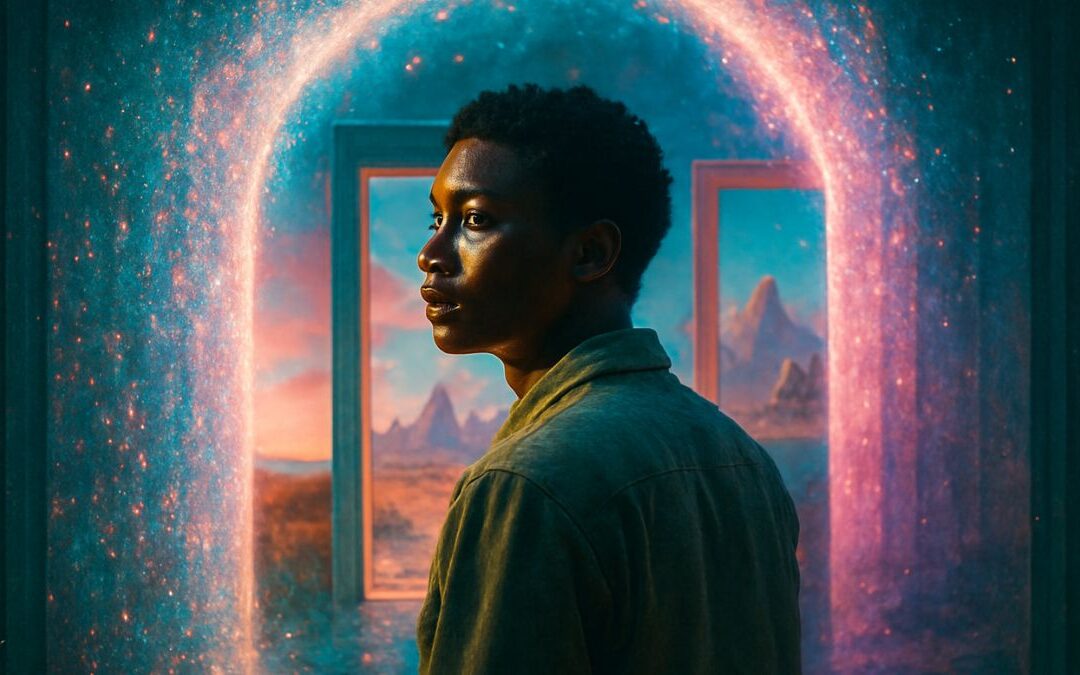
The Universe Next Door: A Tourist’s Guide to Your Other Lives
What if you could knock on the door of the life you never lived? I don’t mean figuratively. I mean literally walk up the front path, rap your knuckles on the door, and have it be answered by… you. A version of you that took that job in another city, or never broke up with your high school sweetheart, or actually pursued that wild dream of becoming a professional beekeeper. For a moment, let’s throw the rulebook of reality out the window. Let’s pretend that for every choice we make, a new reality branches off, creating infinite versions of our world. Let’s talk about parallel universes, not as a dry physics concept, but as the ultimate playground for the imagination, a place that might just hold the key to understanding the incredible life we’re living right now.
The Ghosts of the Roads Not Taken
We all have them, don’t we? Those ghost-lives that flicker at the edges of our minds. The “what ifs” that surface on quiet Tuesday afternoons. What if I’d gone to art school? What if I’d been brave enough to say “I love you” first? What if I’d bought that plane ticket on a whim? The idea of parallel universes gives those ghosts a home. It says that somewhere, in another layer of reality, that version of you exists. They are living, breathing, and dealing with the consequences of that choice. So, the first question is, who would you visit? Would you seek out the successful, glamorous “You”—the one who wrote the bestseller or sold the startup? Or would you be more curious about the simpler “You,” the one who found a quiet contentment you sometimes crave? There’s a strange kind of thrill and a deep terror in that thought. To see your own potential, and your own failings, reflected in your own eyes. Would it bring you peace, or would it be the most profound form of self-torture imaginable?
A Tourist in Your Own Life
Okay, let’s get into the delightful weirdness of it all. You’ve stepped through the cosmic doorway. You’re standing on the street where you live, but the mailboxes are a different color and the air smells faintly of cinnamon for some reason. You see your other self. What’s the etiquette here? Do you introduce yourself? “Hi, I’m you, but from the timeline where we made a questionable fashion choice in 2024.” Imagine the conversation. “So… are we still allergic to shellfish? Do you also have that thing where your left knee clicks when it’s about to rain?” What if the other “You” is just… better? They’re fitter, they laugh more easily, their house is cleaner. The sheer, crushing awkwardness of meeting a version of yourself who seems to have their act together just a little bit more. Or worse, what if they’re a total jerk? You’d have to sit there, forcing a smile, thinking, “Wow. I’m really capable of being that annoying.” It’s the ultimate family reunion, and you’re all the relatives.
Peeking Behind the Cosmic Curtain
This game gets even bigger when you zoom out from our own little lives. Forget your personal choices for a second. What about the big ones? Imagine visiting a universe where the dinosaurs weren’t wiped out by an asteroid. A world of gleaming cities built alongside majestic, grazing brachiosauruses. Or what about a world where technology took a different turn? Where instead of smartphones, we developed incredible organic technologies, and our buildings were grown, not built. A universe where The Beatles stayed together and released another ten albums. Think of the beauty and the tragedy of it. For every masterpiece of art we have, there are a million others that were never created because one person made a different choice. For every moment of peace, there are timelines still locked in terrible wars that we managed to avoid. It paints a picture of our own reality as something incredibly fragile and precious, a beautiful, improbable accident built on a mountain of cosmic coin flips. It makes you look around and see the magic in the fact that any of this exists at all.
The Danger of the “Better” Place
Here’s where the dream could curdle into a nightmare. The danger of this kind of travel isn’t a monster or a paradox; it’s contentment. The grass is always greener in the adjacent universe. What if you found a world that was almost identical to yours, but just… better? A world where that one mistake you can’t forgive yourself for never happened. Where that person you miss is still here. The temptation to stay, to abandon your own story and slip into a life that feels lighter, would be overwhelming. And this is where the real question lies. What makes a life yours? Is it the collection of successes, or is it the whole messy tapestry—the triumphs, the failures, the scars, the regrets? Perhaps the “perfect” life isn’t your life at all. Perhaps our struggles are the very things that give our existence its unique shape and meaning. Maybe home isn’t the place with the least pain, but the place where your pain and your joy have earned their keep.
Bringing the Imagination Back Home
Okay, let’s gently close the door to those other worlds and come back to this one. The truth is, we don’t have a machine for this. But we don’t need one. The most powerful universe-hopping device in existence is sitting right between your ears. Your imagination. The ability to ask “what if?” is not just a tool for writers and artists; it’s a fundamental human superpower. We can use this very same thinking to inject a little bit of that magic into our everyday reality. The next time you’re stuck in traffic, look at the person in the car next to you. In another universe, what’s their story? Are they a secret agent? Are they the “You” who learned to play the guitar? That boring office building you pass every day? In another timeline, it’s the epicenter of a musical revolution. This isn’t about being silly or immature. It’s about using that inner child’s sense of wonder to paint a richer, more interesting world over the one we see. It’s a way to remind ourselves that reality is not fixed, and that possibility is everywhere.
So, here is my question to you. Forget about visiting other universes for a moment. If you could send a one-sentence message to the “You” in another timeline—any timeline you can imagine—what would you say? And what does your answer tell you about what matters most in this one?
Let me know in the comments. I have a feeling the answers will be fascinating.
More Editorials
No Results Found
The page you requested could not be found. Try refining your search, or use the navigation above to locate the post.
Featured Articles

Martin Luther: The Reformer Who Changed the Course of History
Discover the life of Martin Luther, the German monk whose ideas sparked the Protestant Reformation. Learn about his challenges, legacy, and impact on modern Christianity and society.

The Goose Girl by the Brothers Grimm: A Tale of Betrayal, Magic, and Justice
Explore the enchanting tale of The Goose Girl by the Brothers Grimm. Discover themes of betrayal, identity, magic, and justice in this classic fairy tale.

Cultural Norms Surrounding Marriage and Relationships Across the Globe
Explore how cultural norms shape marriage and relationships worldwide. Learn about traditions, expectations, and how different societies approach love, partnership, and commitment.
The Lost City of Atlantis: Myth, Legend, and Ancient Greece
Discover the legend of Atlantis, the lost city described by Plato. Explore the origins of the myth, theories about its location, and its enduring influence on culture.

Why Spending Money on Experiences Brings More Happiness than Buying Things
Discover why spending money on experiences instead of things leads to greater happiness. Learn how shared moments and memories enrich our lives more than material goods.
Did You Know Chocolate Was Once Used as Currency by the Aztecs?
Discover how the Aztecs used chocolate as currency. Learn about the fascinating history of cacao, its role in trade, and why it was considered so valuable.

Robotics: The Science of Building Intelligent Machines
Discover the fascinating world of robotics, where science meets engineering to create intelligent machines. Learn how robots are transforming industries and everyday life.
Frequently Asked Questions about Magical Realism in Literature
Discover answers to frequently asked questions about magical realism in literature. Learn what defines this genre, its origins, key characteristics, and famous examples.

Understanding the Meaning of Mercurial and How to Use It
Explore the meaning of mercurial, how to use it in sentences, and why it’s a great word to describe unpredictable personalities or rapid changes in mood.
More Articles
The Shortest War in History: Britain vs Zanzibar, 1896
Discover the fascinating story of the shortest war in history between Britain and Zanzibar in 1896, lasting only 38 minutes. Learn what triggered it and how it ended so quickly.
The Concept of Entropy: The Universe’s Unstoppable Trend Toward Disorder
Discover the concept of entropy, how it drives the universe toward disorder, and what this fundamental law of thermodynamics reveals about life, time, and energy.
Frequently Asked Questions About Artificial Intelligence: Your Guide to Understanding AI
Explore answers to the most frequently asked questions about artificial intelligence, covering everything from how AI works to its impact on society and future trends.
Understanding the Word Quandary: Meaning, Usage, and Examples
Explore the meaning of the word quandary, learn how to use it effectively in conversations, and discover real-life examples of this intriguing word in action.
Floods: The Rising Dangers and Their Impact on Our World
Explore the rising dangers of floods, their causes, impacts, and the steps we can take to mitigate future risks in a changing climate.
Do People Really Use Only Five Senses? Separating Fact from Fiction
Explore whether people only use five senses or if there’s more to human perception. Learn about lesser-known senses and what science says about our sensory experience.
The Power of Courage: How Dreams Become Reality Through Action
Explore Walt Disney’s famous quote, all our dreams can come true if we have the courage to pursue them, and discover how courage plays a vital role in turning dreams into reality.
Understanding the Meaning and Lessons Behind Pride Comes Before a Fall
Discover the meaning, origin, and relevance of the proverb pride comes before a fall, and explore its lessons and real-life applications in this engaging article.
The Mystery of Area 51: Secrets, Speculations, and Conspiracies
Explore the mystery of Area 51, a secretive military base shrouded in speculation about extraterrestrial encounters, UFOs, and government secrets.
Is There a Multiverse? Exploring the Possibility of Infinite Realities
Discover the concept of the multiverse—whether parallel universes exist beyond our reality and what modern science and theories suggest about infinite possibilities.
Learn English Magazine

Fuming Phrases: Unleashing the Power and Pitfalls of Anger Idioms
Dive into the world of anger idioms with “Fuming Phrases,” where we explore their meanings, origins, and impacts on everyday communication. Unleash the power of language and learn how to skillfully navigate conversations, from heated debates to casual chats.

Hello, Hola, Bonjour: Unleashing the Power of Greetings and Salutations
Dive into the dynamic world of greetings and salutations, exploring the subtle art and profound impact of a well-timed “hello,” and discover how to turn simple salutations into bridges of genuine connection.

Echoes of the Unwritten: Unraveling the Mystical Threads of the Oral Tradition
Venture into the enigmatic world of the oral tradition. Experience the unwritten symphonies of human history, where epics, legends, and myths breathe life into the echoes of bygone eras.

The Symphony of Expressions: Mastering the Art of Articulating Thoughts, Ideas, and Emotions Clearly
Step into a world where words dance, thoughts transform, and emotions find their voice. Explore the art of articulating ideas with clarity, enhancing every conversation, and turning communication into a masterpiece.

From Declarations to Queries: The Dynamic World of Sentence Types
Embark on a captivating journey through the diverse universe of sentence types. Unravel the essence of declarative, interrogative, imperative, and exclamatory sentences, each breathing life and emotion into the written word.

A Plethora of Peas or Much Madness? Unraveling the World of Countable and Uncountable Nouns
Dive into the lively discussion of countable and uncountable nouns! With real-life examples, this engaging piece unwraps the grammatical nuances that make English both a delight and a puzzle.

Navigating the Workflow: Unleashing Productivity in the Modern Workplace
Step into the dynamic world of contemporary work culture! Explore innovative ways of working that boost productivity, foster creativity, and build collaboration, all while adding a touch of fun to the professional realm.

A Stitch in Time: Unraveling Idioms of Necessity and Desirability
Dive deep into the colorful world of idiomatic expressions! Explore the twists and turns of phrases that paint vivid pictures of necessity and desirability, adorning conversations with style and substance.

Unpacking the English Home: From Attic Tales to Living Room Legends
Dive deep into the stories behind common home and furniture terms. From attic mysteries to living room legends, learn English vocabulary in an engaging and humorous style with relatable examples.

The Fascinating World of Nouns: More than Just a Naming Game
Dive into the enthralling universe of nouns. From people and places to the quirkiest of things, let’s explore how these naming words spice up the English language.
Literary Magazine
No Results Found
The page you requested could not be found. Try refining your search, or use the navigation above to locate the post.