
English Plus Magazine
Dive into a world of ideas, stories, English and discovery.
Letter from the Editor
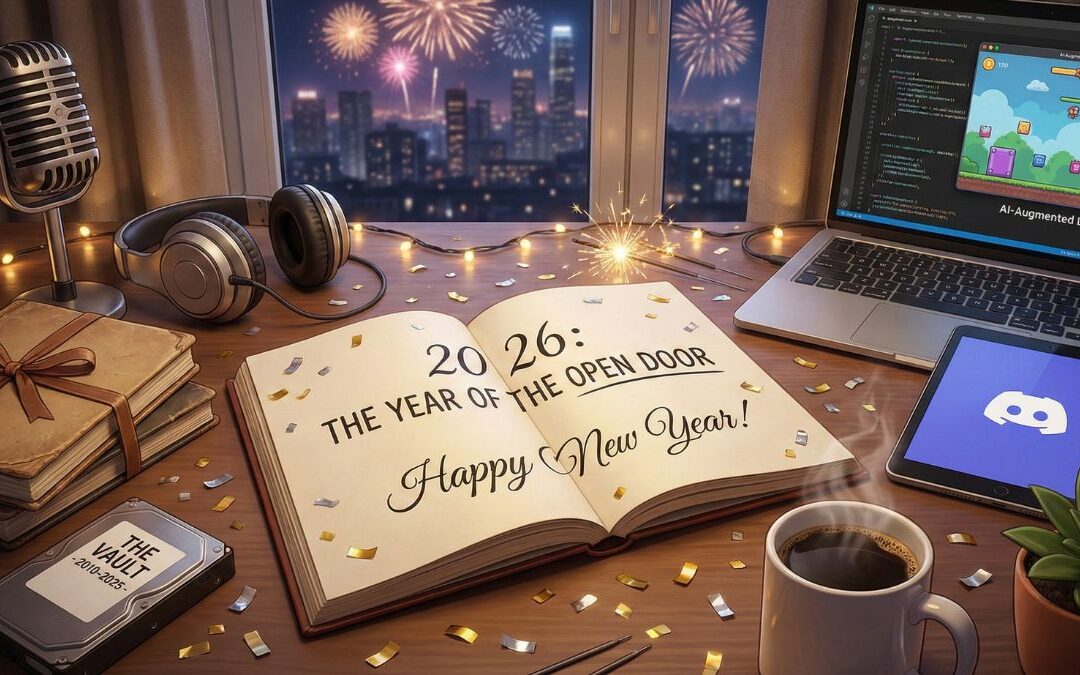
The Year of the Open Door: A Manifesto for 2026
Welcome, everyone.
If you are reading or listening to this, we have made it. We have crossed the threshold into 2026. There is something profoundly quiet about the first few days of January. The holiday noise has faded, the confetti has been swept away, and we are left with that crisp, blank page feeling. I am sitting here, looking at the blinking cursor, thinking about you—my listeners, my readers, the people who have stuck with me through various iterations, experiments, and wild ideas.
I wanted to write this editorial not as a press release, and certainly not as a marketing blast, but as a letter to friends. Because that is what this community has become to me. Over the last few years, we have explored language, culture, music, and stories together. We have built something that feels alive.
But with every new year comes the necessity for reflection. I have spent the last few weeks of December doing a deep dive—not just into my hard drives, which I’ll talk about in a moment—but into my soul and the reality of keeping this creative engine running. I have some big news, some changes, and some dreams I want to share with you. Some of this is about the business of art, some is about the vulnerability of creation, and all of it is about how we are going to make this year unforgettable together.
So, grab a cup of coffee, or tea, or whatever warms you up, and let’s have a real talk.
Let’s start with the hard stuff, so we can get to the fun stuff.
You know that I am a dreamer. If I could, I would live in a world where everything I create—every podcast episode, every song, every chapter—is free for everyone, forever, with no strings attached. For a long time, I tried to make that reality work. I shifted to a “free-for-all” model, relying entirely on voluntary support and the honor system. I wanted to believe that if the value was there, the support would naturally follow in a way that sustained the platform.
I have to be honest with you: it didn’t work the way I wished it would.
This isn’t a complaint. It’s just the reality of the economy and the way we consume content today. The truth is, maintaining the servers, the hosting, the equipment, and—most importantly—the time required to produce high-quality work costs more than passion. It costs resources. I found myself staring at a crossroads: I could continue on the current path and eventually be forced to shut everything down completely, losing not just a business but a massive part of my life’s purpose. Or, I could make a change.
If I shut down, nobody wins. I lose my voice, and you lose the content. So, I have decided to strike a “Middle Ground.”
Starting this year, I am bringing back the premium content model.
I know, I know. We all have subscription fatigue. But let me explain why this is actually a good thing for us. This decision allows me to stabilize the platform. It means I don’t have to wake up every morning worrying if the lights are going to stay on, and instead, I can wake up thinking about what amazing story I can write for you next.
Here is how it’s going to work: There will be premium tiers, much like before. This will apply across the board—from the podcasts to the books and the music. For those who can support the work financially, you will get the premium experience: ad-free episodes, ad-free website browsing, early access, and exclusive content that dives deeper than the public feed.
However—and this is the most important part of this letter—I am not locking the door.
I refuse to let money be the reason someone cannot learn or enjoy a story. I grew up believing that education and art should be accessible. So, while we are moving to a paid model for the premium benefits, I am keeping a permanent option open: The Request Access Feature.
If you want to access the premium content but you genuinely cannot afford it right now, all you have to do is ask. No questions asked. No shame. No hoops to jump through. You send the request, and you get access.
In this way, I want you to look at the subscription model differently. If you are one of the people who subscribes, you aren’t just buying a product for yourself. You are effectively funding a scholarship for someone else. You are the reason a struggling student somewhere in the world, or a literature lover going through a hard financial time, can still access these resources. We are building a micro-economy of kindness.
To balance the scales for the free users, I will be bringing ads back to the website. It’s a necessary trade-off to keep the content flowing. But for my Patreon subscribers? You will continue to enjoy a pristine, ad-free sanctuary.
This is the only way I can see forward that protects the work while protecting the community. It’s a compromise, but it’s one that keeps us alive.
Now, let’s shift gears to something that has my brain buzzing with excitement.
As many of you know, when I’m not behind a microphone or a piano, I work as an educational technology consultant. I live in the space where learning meets innovation. For years, I’ve watched trends come and go, but what is happening right now with Artificial Intelligence is unlike anything I’ve ever seen.
This year, I am embarking on my most ambitious professional endeavor yet: AI-Augmented Educational Games.
I can’t share every single detail just yet—mostly because I want to surprise you—but I can tell you the vision. I am building interactive experiences that go beyond simple “flashcard” style games. I’m talking about immersive, narrative-driven educational gaming where the AI adapts to you.
Imagine learning English vocabulary, or history, or storytelling structures, not by memorizing a list, but by playing a role in a mystery or a sci-fi adventure where the characters react to you in real-time. Imagine a game that knows exactly what you’re struggling with and subtly shifts the gameplay to help you master it, without you even realizing you’re “studying.”
This project is going to be my main focus for 2026 and beyond. It is a massive undertaking. Even with my background in EdTech, I am humbled by how much there is to learn. I’m diving into code, narrative design, and AI prompting in ways I never have before. I am enjoying the process immensely—the frustration of a bug, the joy of a breakthrough, the thrill of seeing a concept come to life.
I will be sharing behind-the-scenes updates on this as we go. I want you to see the messy process of creation, not just the polished final product. For those of you interested in tech, education, or just the future of how we learn, this is going to be a fun ride.
Speaking of the messy process of creation… I had a bit of a revelation over the holidays.
I have a ritual at the end of every year. I perform a “Deep Scan” of my hard disk drives. I organize files, back things up, and generally clean house. This year, I started digging into folders that I hadn’t opened in a very long time.
I found ghosts.
I found hundreds—literally hundreds—of stories, novels, poems, and musical compositions dating all the way back to 2010. Some were finished. Some were half-finished. Some were just sketches. But as I listened to the music and read the stories, I realized something tragic: I was hiding them.
For over a decade, I have held this work back. Why? Because I was waiting for the “perfect strategy.” I was waiting for a publisher to say yes, or for a marketing plan to be perfectly aligned, or for the “market conditions” to be right. I was waiting for the work to be polished to an impossible standard of perfection.
I looked at a folder from 2012 containing a collection of short stories that I loved writing, and I realized that not a single human being on earth had ever read them. If I had died yesterday, those stories would have vanished into the digital void, wiped clean when the hard drive eventually failed.
That thought terrified me. It woke me up.
So, I am making a pledge to you, and to myself: 2026 is the year I empty the vault.
I am going to release everything.
I am not going to wait for a “professional release strategy.” I am not going to fret about whether the mix on a track from 2014 sounds like a track from 2026. I am not going to worry if a story breaks the conventional rules of genre. I am going to release them in a manner that honors their original form—raw, honest, and real.
There is a beauty in the rough edges. There is history in those files. I want to share my evolution as an artist with you. You will hear songs that sound like a younger, angrier me. You will read stories that explore themes I might not write about today, but which were my truth at the time.
I don’t care if this is “bad for the brand.” I don’t care if it confuses the algorithm. I just want to share what I have created with the world, because art is meant to be heard and read, not hoarded on a Seagate drive in a dark room.
For my Patrons on Patreon, you are going to be my test audience. You will get the first listen and the first read of these vault releases before they go public. You’ll be the first to step into the time machine with me.
Now, you might be doing the math in your head.
“Danny,” you’re thinking, “You just said you’re focusing on a massive AI Game project. And you’re releasing a 15-year backlog of content. And you’re running a subscription platform. When are you going to sleep?”
It’s a fair question. But here is the thing about me: I am a fast worker, and I simply cannot help myself.
Creating isn’t just a job for me; it’s a compulsion. It’s how I breathe. Even though I promised myself to prioritize the EdTech project, I know that my brain doesn’t have an “off” switch. When I get an idea for a podcast episode, I have to record it. When a melody hits me, I have to capture it.
So, fans of the existing content—do not worry. The English Plus Podcast is not going anywhere. In fact, I have plans for new additions to the lineup. We are going to dive deeper into language learning, but we’re also going to expand.
I am planning new podcasts in both English and Arabic. The Arabic content is something I’ve wanted to expand on for a while, bridging cultures and bringing some of the English Plus ethos to a different linguistic audience. There will be new episodes, new stories, and new books written this year, alongside the vault releases.
I know it sounds like a lot. It is a lot. But I operate on high energy. The act of creating gives me energy; it doesn’t take it away. I want this year to be a flood of creativity. I want you to have so much content that you can’t possibly keep up, so you always have something waiting for you when you have a quiet moment.
Finally, I don’t want this to be a one-way street. I don’t want to be the “guru” on the stage broadcasting to the masses. I want to be in the trenches with you.
That is why I am launching the Creative Challenge Weeks.
This will be a recurring event on the podcast and the website. It’s a challenge not just for me, but for you. Maybe it’s “Write a 500-word story in a genre you hate.” Maybe it’s “Compose a melody using only three notes.” Maybe it’s “Learn five words in a language you don’t speak and use them in a conversation.”
I want you to participate. I want you to share your work. We are going to showcase fan creations. We are going to celebrate the attempt, not just the success. We are going to push each other to be better artists, better learners, and better thinkers.
To facilitate this, I am thrilled to announce that our Discord Community is kicking off very soon.
For a long time, the conversation has been scattered—emails, comments sections, social media DMs. It’s time to bring it all under one roof. The Discord will be a place for everyone. Whether you are a free listener or a top-tier Patron, there is a seat for you at the table.
Yes, there will be private channels for Patrons to discuss the early-access content and have direct lines to me, but the heart of the server will be open. I will be there. I will be hanging out, chatting, answering questions, and sharing memes. I want to build a digital living room where we can actually get to know each other. More details on how to join will be coming in the next few weeks, so keep an ear out.
So, there it is. The roadmap for 2026.
It’s messy. It’s ambitious. It’s a little bit scary.
We are pivoting the business model to survive, but keeping the heart of it generous with the scholarship idea. We are building the future of education with AI. We are unlocking the ghosts of the past by releasing the vault. And we are building a home for us all to hang out in.
I don’t want you to just “subscribe” or “follow.” I want you to join me.
Consider this a FAT, BIG INVITATION to come along on this journey. Whether you are here for the English lessons, the music, the stories, or just the vibes—you are welcome here.
Let’s stop waiting for the perfect time. Let’s stop holding back our best work. Let’s stop worrying about whether we are doing it “right” and just start doing it together.
I am ready to work harder than I ever have. I hope you’re ready to read, listen, play, and create harder than you ever have.
Let’s make 2026 the year we didn’t hold anything back.
With hope, high energy, and endless gratitude,
Danny
More Editorials
No Results Found
The page you requested could not be found. Try refining your search, or use the navigation above to locate the post.
Featured Articles
“The More, The Merrier”: Unpacking the Timeless Wisdom of a Beloved Proverb
Explore the surprising history and multifaceted meanings of “The More, The Merrier.” Discover how this proverb reflects human nature, collaboration, and the joy of shared experience.

The Franklin Expedition: Unlocking the Arctic’s Most Haunting Mystery
Dive deep into the chilling tale of the Franklin Expedition, the lost British polar venture that vanished in the Arctic. Discover the grim clues, modern discoveries of HMS Erebus and Terror, and the enduring mystery of its 129 doomed men.
Tornado Secrets: What Really Happens Inside Nature’s Wildest Storms?
Ever wondered what’s truly inside a tornado? Dive into the terrifying physics, incredible forces, and hidden dangers of these swirling giants. Discover the science behind nature’s most violent vortex.

Ada Lovelace: The Unsung Visionary Who Programmed the Future
Discover the incredible story of Ada Lovelace, Lord Byron’s daughter, a brilliant mathematician, and the world’s first computer programmer. Explore her revolutionary insights into the Analytical Engine and her lasting legacy that continues to inspire innovation in the digital age.

Uranus: The Solar System’s Mysteriously Tilted Ice Giant
Explore Uranus, the enigmatic “sideways planet.” Discover why it spins on its side, its extreme seasons, icy composition, unique moons, and the call for new missions to this frigid frontier.

Libraries & Reading: Unlocking Potential in Education for All
Discover the vital role of libraries and reading in fostering cognitive development, empathy, and equitable access to knowledge. Explore how they remain indispensable cornerstones of modern education.

Ethical Business: How Doing Good Can Mean Good Business (Profit with Purpose)
Explore the rise of ethical business: balancing profit with purpose. Learn why companies are embracing sustainability, social responsibility, and strong governance, and how it benefits everyone.

Paws, Claws, and Literary Flaws: Exploring the Human-Animal Bond in Books
Dive into the rich literary history of the human-animal bond. From ancient fables to modern novels, discover how animals in literature reflect, challenge, and deepen our understanding of humanity.

Fado: Unveiling the Soulful & Sorrowful Beauty of Portugal’s Music
Discover Fado, Portugal’s iconic music of “saudade.” Explore its history, key artists like Amália Rodrigues, and the profound emotion that makes Fado a UNESCO Intangible Cultural Heritage.
More Articles
The Cradle, The World, and The Unseen Power: Unpacking a Timeless Proverb
Explore the profound meaning of “The hand that rocks the cradle rules the world.” Delve into the history, impact, and modern relevance of this powerful proverb about the essential influence of caregivers on shaping future generations.
The Dybbuk Box: Unlocking the Truth Behind the Internet’s Most Haunted Object
Is the Dybbuk Box truly cursed? Explore the chilling history, alleged paranormal events, Jewish folklore, skepticism, and the shocking confession behind this infamous wine cabinet. Discover the mystery revealed.
Sustainable Agriculture: Feeding the Future Without Costing the Earth
Discover how sustainable agriculture can nourish our growing population while protecting the planet. Explore key practices like soil health, water conservation, biodiversity, and the role of technology and policy in creating a resilient and equitable food system.
Frida Kahlo: Unmasking the Woman, Artist, and Icon – Her Life, Art, and Enduring Legacy
Explore the extraordinary life of Frida Kahlo. Delve into her passionate art, her resilience against immense pain, her complex relationship with Diego Rivera, and why she remains a global icon. Learn about her symbolism, her impact on feminism, and her vibrant Mexican heritage in this comprehensive article.
Saturn: Exploring the Stunning Rings, Mysterious Moons & Wonders of the Jewel of the Solar System
Journey to Saturn! Discover its iconic rings, Titan’s alien lakes, Enceladus’s hidden ocean geysers, and the legacy of the Cassini mission. Explore the giant planet.
Unlock Your Brainpower: The Surprising Benefits of Language Learning & Bilingual Education for All
Discover the cognitive boosts (sharper thinking!), cultural bridges, and educational models of language learning and bilingualism. Why multilingualism matters for everyone.
Crisis Management & Business Resilience: How to Prepare, Adapt, and Thrive
Navigate business disruptions effectively. Learn key strategies for crisis management planning, response, and building long-term business resilience to adapt and thrive in volatile times.
The Art of Suspense and Tension: How Storytellers Keep You Hooked
Learn the secrets of suspense & tension in storytelling! Explore techniques writers & filmmakers use (like dramatic irony & pacing) to create edge-of-your-seat moments.
Belgian Beer Culture: History, Rituals & Why It’s UNESCO Heritage
Explore Belgium’s rich beer culture, a UNESCO heritage. Discover Trappist ales, sour Lambics, unique brewing history & the time-honored rituals of Belgian beer appreciation.
Transforming Failure into Opportunity: Learn, Grow & Build Resilience
Don’t let setbacks define you. Learn how to reframe failure as a powerful opportunity for growth, resilience, and success with practical steps and mindset shifts.